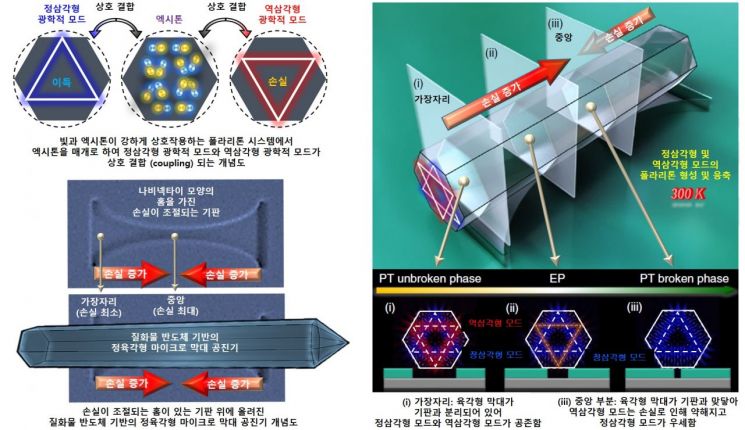
[Asia Economy Reporter Kim Bong-su] The Korea Advanced Institute of Science and Technology (KAIST) announced on the 11th that Professor Yong-Hoon Cho's research team in the Department of Physics has succeeded in developing a novel concept of a parity-time symmetry laser that generates highly interacting quantum particles inside a hexagonal semiconductor rod structure 100 times thinner than a human hair, where the luminescence performance improves as losses increase.
The parity-time symmetry laser developed through this research is expected to be widely utilized in the future, ranging from high-efficiency laser devices to quantum optical devices.
In any physical system, loss has traditionally been something to be eliminated or overcome whenever possible. Therefore, in laser systems that require gain, the presence of loss increases the minimum energy (threshold energy) needed for operation, making loss something to be minimized.
However, when the concept of parity-time reversal symmetry and its breaking, which exist in quantum mechanics, is mathematically applied to optical systems, a unique optical system emerges that can beneficially utilize loss for operation.
Since light fundamentally does not interact with itself, implementing an optical system with parity-time symmetry using light previously required fabricating two or more spatially separated optical unit structures identically without error and individually controlling loss and gain in these units?a challenging optical system condition.
Meanwhile, if appropriate conditions are met where light can strongly interact with excitons (electron-hole bound particles) inside a semiconductor for a long time, a third quantum particle called a polariton (exciton-polariton), which has characteristics of both excitons and light, can be generated. Due to the material properties of excitons, interactions between polaritons become strong. In particular, using a hexagonal microcavity structure based on nitride semiconductors, polaritons can be realized even at room temperature through strong interactions between spontaneously formed light modes?formed by total internal reflection without mirrors?and excitons.
Professor Yong-Hoon Cho's research team devised a unique method to directly control interactions between different modes existing inside a single hexagonal microcavity by using polaritons, which have stronger interactions than light.
Inside a single cavity with hexagonal symmetry, two light modes with equal energy and triangular and inverted triangular paths coexist without interaction. The research team focused on the possibility that using polaritons instead of light would enable direct interaction between these two modes mediated by excitons.
Among these, only the inverted triangular mode was coupled with a substrate carved in a bowtie shape to continuously control the loss magnitude. Through this, they observed at room temperature the unusual result that the energy required for operation decreases as loss increases, and systematically identified the cause.
This result contradicts the common intuition that higher loss increases the energy required for operation. It is significant in that it overcomes the complexity and limitations of previous parity-time symmetry systems using light and realizes the first parity-time symmetry laser using a single semiconductor microcavity.
Such a system applying parity-time symmetry is an important platform that turns loss?which was previously something to be eliminated or overcome?into a beneficial factor. Using this platform, it is possible to lower laser oscillation energy and apply it not only to classical optical devices such as nonlinear optical devices and sensitive optical sensors but also to irreversible devices that control light directionality and superfluid-based integrated circuit quantum optical devices.
Professor Yong-Hoon Cho, who led the research, said, “As a novel single microcavity platform using the quantum particle polariton, this will lower the threshold for fundamental research related to parity-time symmetry without complex low-temperature equipment,” and added, “We expect it to be utilized in various quantum optical devices that operate at room temperature and make use of loss through continuous research.”
The research results were published online on the 10th in the international photonics journal Nature Photonics.
© The Asia Business Daily(www.asiae.co.kr). All rights reserved.
![Clutching a Stolen Dior Bag, Saying "I Hate Being Poor but Real"... The Grotesque Con of a "Human Knockoff" [Slate]](https://cwcontent.asiae.co.kr/asiaresize/183/2026021902243444107_1771435474.jpg)















