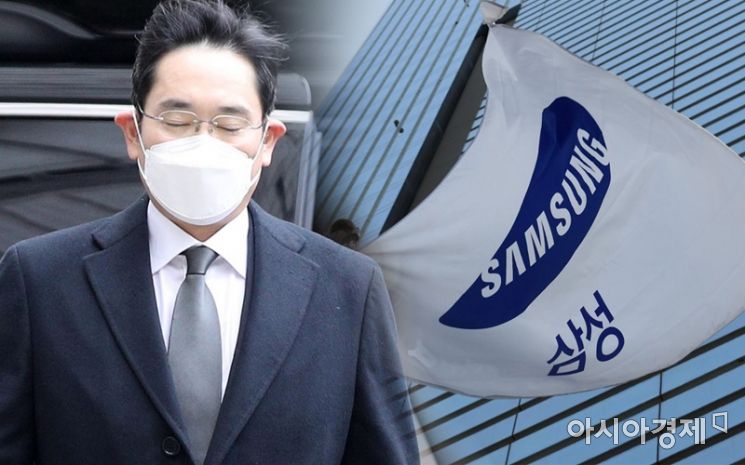
[Asia Economy Reporter Kim Daehyun] On the 10th, the cross-examination of the person who drafted the 'Project G' document, identified as the succession plan, continued in the trial of Samsung Electronics Vice Chairman Lee Jae-yong, who was indicted on charges including ordering and approving an unfair merger for the succession of Samsung Group's management rights.
Following the prosecution's direct examination, during the cross-examination that began toward the end of the previous hearing, Lee's defense attorneys focused on proving that the merger was not part of the succession process but rather a business necessity to protect management rights from foreign funds and respond to regulatory moves by the political sphere. Their argument was that without the merger, in other words, if the so-called 'group shares' in Samsung C&T were reduced, the company and shareholders would have suffered significant damage from attacks by foreign hedge funds.
At 10 a.m. that day, the 5th hearing of Lee's trial was held at the Seoul Central District Court Criminal Division 25-2 (Presiding Judge Park Jeong-je). Han, a former Samsung Securities team leader who drafted Project G, appeared as a witness for the fourth time. According to the prosecution, Han is considered a 'key witness' related to 13 out of the 16 charges.
Lee's side emphasized that if Samsung Group's stake in Samsung C&T, where securing control was essential for management succession, had been insufficient, a management dispute could have arisen due to foreign hedge fund intervention. In the worst case, management rights of Samsung C&T could have been transferred to foreign shareholders.
Han also testified, "There were many funds overseas focusing on short-term capital gains that threatened management rights, so the threat was always present," adding, "The lower the group's shareholding ratio, the higher the probability of external attacks."
The defense also highlighted the political discussions at the time about regulating the circular shareholding structure of large conglomerates and strengthening the separation of banking and commerce. They pointed out that in 2010, presidential candidates commonly proposed regulatory pledges, which posed a significant risk of weakening the controlling family's dominance over Samsung C&T. Circular shareholding and the combination of financial and industrial capital were means for the controlling family to maintain control over Samsung C&T.
The defense questioned, "In fact, in 2015, the U.S. hedge fund Elliott intervened and triggered a management dispute. Wasn't there a possibility that selling affiliate shares could weaken management control?"
Han responded, "At the group level, they had no choice but to consider where to sell affiliate shares to meet regulations and how to recover the sold shareholding ratio." He added, "This was likely a common concern among large business groups at the time."
Meanwhile, a tense exchange between the prosecution and defense occurred from the start of the trial, continuing from previous hearings. The prosecution argued, "The defense submitted evidence documents just before the trial today and asked us to respond. We had provided materials and sought opinions before the witness examination. This is an unfair situation."
In contrast, the defense said, "It is unreasonable to provide evidence the day before cross-examination. We will provide it in the morning of the day as soon as it is prepared." They also rebutted, "We were organizing cross-examination points late into the night yesterday, so delays were inevitable. However, it is hard to accept that the submission of evidence itself is a problem." They appealed to the court, "Please allow evidence submission for free proof."
The prosecution did not back down and requested additional time to review the evidence. However, the court mediated by saying, "We understand the prosecution's position. We will give time for the prosecution to sufficiently review the evidence when resuming the direct examination," allowing the witness examination to begin about 20 minutes after the trial started.
© The Asia Business Daily(www.asiae.co.kr). All rights reserved.
![Clutching a Stolen Dior Bag, Saying "I Hate Being Poor but Real"... The Grotesque Con of a "Human Knockoff" [Slate]](https://cwcontent.asiae.co.kr/asiaresize/183/2026021902243444107_1771435474.jpg)















