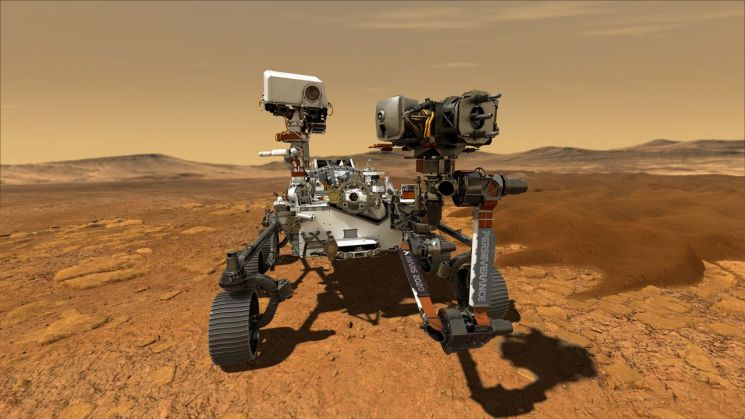
[Asia Economy Reporter Kim Bong-su] NASA's fifth rover, Perseverance, sent to Mars to search for signs of life and resources, has begun its full-scale exploration.
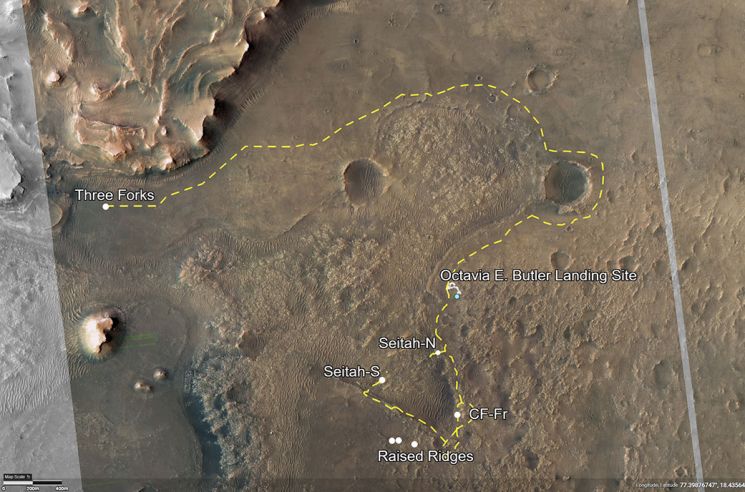
According to NASA on the 9th (U.S. time), Perseverance, which landed on Mars last February, completed its commissioning phase by the 1st and left its landing site, 'Octavia E. Butler,' heading south to embark on its first scientific exploration journey. Over the next few months, Perseverance will explore about 4 square kilometers of the floor of Jezero Crater, collecting various samples to send back to Earth.
Until now, Perseverance has successfully conducted a scientific experiment converting carbon dioxide from the Martian atmosphere into oxygen. It also completed seven test flights of the unmanned helicopter Ingenuity, achieving the first powered flight on an extraterrestrial planet in human history. In addition, it has taken approximately 75,000 photos and recorded natural sounds of Mars for the first time, transmitting them back to Earth.
Through this exploration, Perseverance aims to understand the terrain and geology of the Jezero Crater region and verify the possibility of ancient life. In particular, it will collect rock and sediment samples to be sent back to Earth through a joint project with the European Space Agency (ESA) planned for around 2031. Various measurements and tests that could assist future human Mars landing missions will also be conducted.
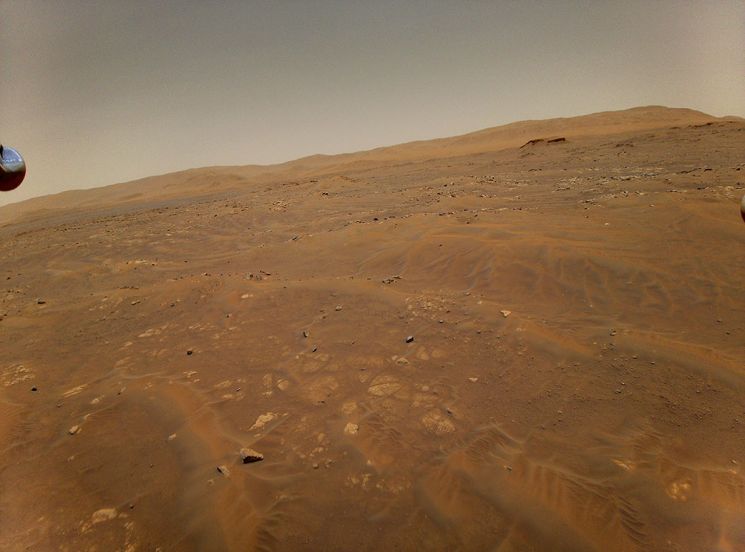
Perseverance will focus its exploration on two areas of exposed bedrock in Jezero Crater: the 'Crater Floor Fractured Rough (CF-Fr),' which contains the oldest rock layers, and 'Seitah.' The name Seitah comes from the Navajo language meaning 'surrounded by sand,' and the area features sand dunes, layered rocks, and ridges in addition to bedrock.
Perseverance will travel 2.5 to 5 km during this first exploration before returning to its landing site. It will then move northward to conduct a second exploration in the delta region within Jezero Crater. This area, where an ancient lake and river once met, is rich in carbonate minerals and may provide clues to the existence of life.
NASA stated, "The core objective of Perseverance is to search for traces of ancient microbes, understand the planet's geology and past climate characteristics, pave the way for manned exploration, and collect and store rock and sediment samples to be sent back to Earth in the future."

© The Asia Business Daily(www.asiae.co.kr). All rights reserved.
![Clutching a Stolen Dior Bag, Saying "I Hate Being Poor but Real"... The Grotesque Con of a "Human Knockoff" [Slate]](https://cwcontent.asiae.co.kr/asiaresize/183/2026021902243444107_1771435474.jpg)

















