5800 Housing Units Supplied in Dongtan 2, Yangju Hoecheon, Paju Unjeong 3, Pyeongtaek Godeok Reserved Sites
Mostly on Outskirts of Seoul Metropolitan Area, Doubts on Genuine Demand... Resident Opposition Expected
[Asia Economy Reporter Kangwook Cho] The Democratic Party's Special Committee on Real Estate announced on the 10th the 'Housing Supply Plan for Low-Income and Homeless People in the Seoul Metropolitan Area,' which includes the 'Nuguna House' project that significantly reduces the initial burden of home purchase funds and a plan to supply more than 16,000 households using reserved land in the 2nd New Towns. However, most of the supply sites are located on the outskirts of the metropolitan area, and since the plan involves changing the use of existing supply housing, there are criticisms that it falls short of the "unimaginable level" of supply measures originally promised by the Democratic Party. In particular, changing the use of reserved land, which is used as self-sufficient facilities by residents, is likely to face opposition from local residents.
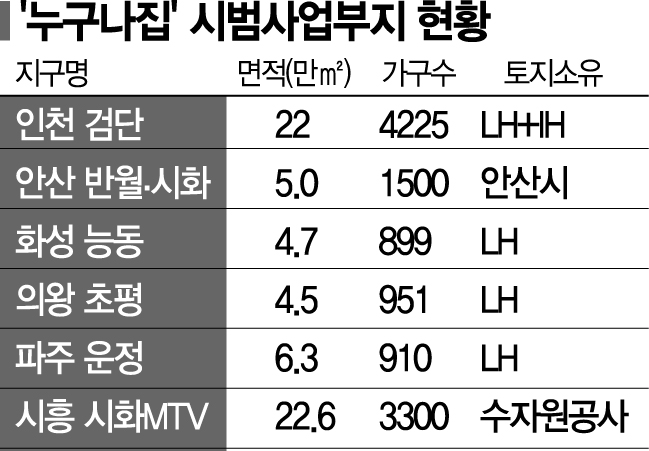
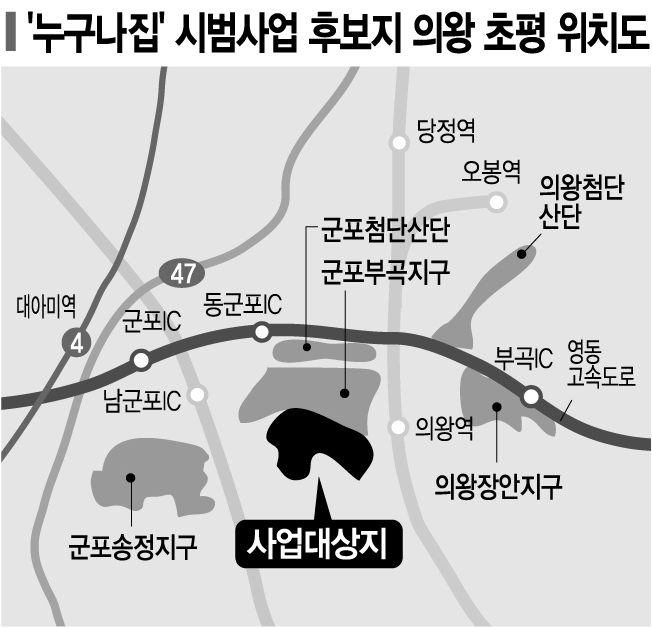
◇ Pilot supply of 10,785 'Nuguna House' units in Uiwang, Paju, Siheung, etc. = The special committee plans to supply pilot project sites for about 10,785 'Nuguna House' units this year in six areas: Incheon, Ansan, Hwaseong, Uiwang, Paju, and Siheung. By district, the breakdown is △4225 units in Geomdan, Incheon △500 units in Banwol and Siwha, Ansan △899 units in Neungdong, Hwaseong △951 units in Chopyeong, Uiwang △910 units in Unjeong, Paju △3300 units in Siwha Multi Techno Valley (MTV), Siheung. Among these, Incheon, Ansan, Hwaseong, and Uiwang can proceed immediately, but Paju and Siheung require changes in use from sale to rental and from distribution to residential, respectively.
'Nuguna House' is supplied through a public-supported private rental housing model. The rental conditions for public-supported private rental housing include △a mandatory rental period of 10 years △rent increase within 5% △initial rent at 85-95% or less of market price △priority supply to homeless people (special supply of 20% or more for youth and newlyweds). The special committee plans to continue negotiations with about 10 other local governments besides the six pilot project areas and to continuously announce plans to expand the pilot projects within the year.
Additionally, the special committee has a plan to supply one-third of the reserved land in the 2nd New Towns, where infrastructure is already established, as residential land. This includes about 5,800 units in four districts: Yangju Hoecheon (1,000 units), Paju Unjeong 3 (1,700 units), Pyeongtaek Godeok (1,750 units), and Hwaseong Dongtan 2 (1,350 units). The Korea Land and Housing Corporation (LH) will directly develop and supply these, with pre-subscription planned for next year.
◇ Location and scale fall short of expectations... concerns over resident opposition = Experts acknowledge positive aspects of the plan for low-income groups to own homes but raise doubts about its effectiveness in stabilizing the real estate market. The profit-sharing model does not align with current public sentiment, and most locations are inferior even to the 3rd New Towns, which are about to have pre-subscription.
Kwon Il, head of the research team at Real Estate Info, said, "While the 'Nuguna House' model is good because it is a sale conversion type and has a low initial cost, the idea of sharing the profits does not fit public sentiment. If the location were outstanding, it might be considered, but general buyers think it is better to have a home in their own name immediately."
There are also significant concerns about risks due to reduced profitability. In the 'Nuguna House' project, the social responsibility of the project operator is strengthened, requiring the operator not to recover investment (at least 5% of total project cost) and profit (10% of total project cost) until the sale conversion. Also, in case of a price drop, the operator must cover losses first. For example, if the confirmed sale price is 500 million KRW, even if the price falls after 10 years, the operator must compensate up to 425 million KRW with their investment and profit. This means the project owner or the state/public bears the risk.
Moreover, opposition from existing residents is a concern. There is no legal basis yet to use reserved land for residential purposes. The special committee plans for the Ministry of Land, Infrastructure and Transport to revise the 'Sustainable New Town Planning Standards' to address this. However, under current regulations, reserved land is used as self-sufficient facility land after consultation with local governments and residents, not for residential use. The Democratic Party intends to proceed after fully listening to nearby residents' opinions, but opposition is expected.
Professor Jin-Hyung Seo of Gyeongin Women's University (President of the Korean Real Estate Society) pointed out, "Since the reserved land in the 2nd New Towns has already been rejected by the market once, it is hard to say the location is good. Especially, reserved land was originally prepared for self-sufficient functions in new towns, so using it for residential purposes may fail to provide self-sufficient functions and could turn the area into a bedroom community, leading to strong opposition from residents."
© The Asia Business Daily(www.asiae.co.kr). All rights reserved.
![Clutching a Stolen Dior Bag, Saying "I Hate Being Poor but Real"... The Grotesque Con of a "Human Knockoff" [Slate]](https://cwcontent.asiae.co.kr/asiaresize/183/2026021902243444107_1771435474.jpg)

















