[Asia Economy Reporter Kim Eunbyeol] # On the European travel online community ‘Yurang,’ nearly 30 posts have been uploaded this month alone asking whether quarantine exemption is possible after overseas travel if vaccinated. Similar posts can be frequently seen in other travel communities, with people saying they have received the first dose of the vaccine and plan to travel abroad this summer or during the Chuseok holiday. Not only those who have already booked tickets to Rome and Paris, but also lists of countries requiring PCR (polymerase chain reaction) test submissions upon foreigner entry and travel bubble information are being shared. A worker in their 30s said, "I was lucky to complete a no-show vaccine shot," adding, "If there is no quarantine system upon returning to Korea, I would travel abroad."
As the COVID-19 vaccination speed accelerates, overseas travel is joining the ranks of revenge consumption. With the government announcing the implementation of travel bubbles starting next month, the travel demand of citizens who have not been able to travel abroad for over a year has begun to surge rapidly. While exports and manufacturing have so far defended the economy, consumption is expected to lead economic recovery from the second half of this year.
According to the travel industry on the 10th, travel agencies are continuously releasing products targeting the summer vacation season. Chamjoeun Travel has confirmed a 5-night, 7-day group trip to Paris, France, starting next month on the 12th. Hana Tour is planning a charter flight to Europe with Korean Air around September. On platforms like Wemakeprice and TMON, overseas flight ticket reservations surged about fivefold from the 27th of last month to the 2nd of this month compared to the previous week.
Signs of revenge consumption intensifying as overseas travel demand increases
Flight ticket reservations rise and travel agencies continuously launch products
Most household consumption increased in Q1... Mobility indices for leisure facilities rise
Deputy Prime Minister Hong Nam-ki: "Increase in net savings rate will manifest as consumption surge"
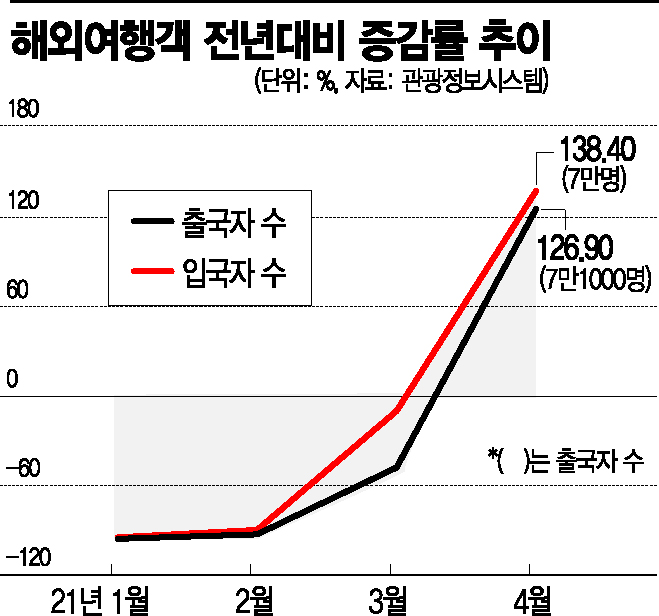
Looking at the Bank of Korea’s provisional international balance of payments data for April, general travel payments reached $1.22 billion, the highest since February last year ($1.33 billion). General travel income from foreigners spending domestically also increased by 29% year-on-year to $810 million. According to the Tourism Knowledge Information System, the number of overseas departures in April was about 71,000, and arrivals about 70,000, surging 126.90% and 138.40% respectively compared to the same month last year. The number of entries and exits has gradually reduced its decline since the beginning of this year and turned positive year-on-year in April for the first time since the COVID-19 outbreak.
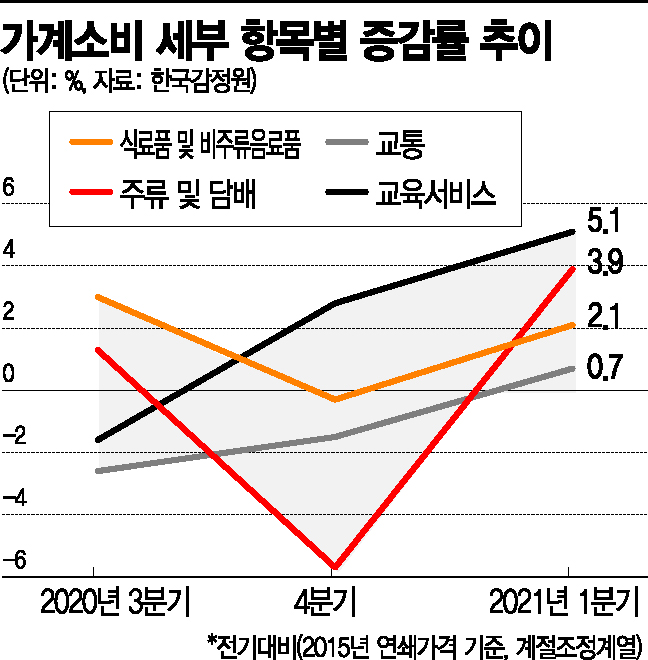
The increase in travel demand is attracting attention as a new factor driving consumption growth. Looking at the Bank of Korea’s recent ‘Household Consumption Growth Rate by Purpose’ data, household consumption items in the first quarter increased significantly, centered on food and alcoholic beverages. Consumption of alcoholic beverages and tobacco (3.9%) turned sharply positive compared to the fourth quarter of last year (-5.7%), and consumption of food and non-alcoholic beverages also increased by 2.1%, turning positive. Household consumption for education services (5.1%) and transportation (0.7%) also increased compared to the previous quarter. It is understood that related household consumption increased as the proportion of remote work gradually decreased and routine activities such as academies and meetings increased.
Google’s ‘Korea Mobility Index’ (as of the 6th) also shows that compared to before COVID-19, people are rapidly increasing outings to restaurants, shopping malls, cafes, parks, and beaches. The mobility index uses Google Maps and other data to represent lifestyle changes after COVID-19 as an index. Mobility for retail sales and leisure facilities increased by 8% compared to pre-COVID-19 levels, and visits to grocery stores (39%) and parks/beaches (66%) surged.
The household net savings rate, which indicates the proportion of savings out of disposable income, surged by 5 percentage points to 11.9% last year compared to the previous year, suggesting strong consumption capacity. Deputy Prime Minister and Minister of Economy and Finance Hong Nam-ki mentioned the household net savings rate on Facebook yesterday, stating, "If the COVID-19 situation calms down in the second half of this year, a significant portion is expected to manifest as a consumption surge."
The Bank of Korea’s Research Department, in a report titled ‘Checking the Possibility of Future Pent-up (Revenge) Consumption,’ stated, "Consumption, which contracted during crises, tends to recover rapidly during economic recovery periods," and judged that consumption could increase further if vaccination expands to emerging countries next year.
© The Asia Business Daily(www.asiae.co.kr). All rights reserved.
![Clutching a Stolen Dior Bag, Saying "I Hate Being Poor but Real"... The Grotesque Con of a "Human Knockoff" [Slate]](https://cwcontent.asiae.co.kr/asiaresize/183/2026021902243444107_1771435474.jpg)

















