Korea Research Foundation, Professor Jo Jeong-hee of GIST and Research Team
Confirm Long Non-Coding RNA Involvement in Birth Sex Ratio Balance Through Mouse Experiments
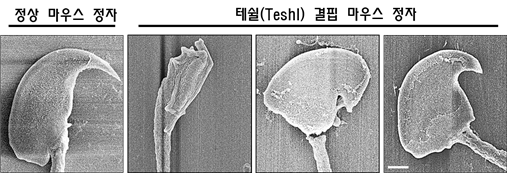 Comparison of Normal Mouse Sperm and Teshl-Deficient Mouse Sperm
 This is the result of observing the head morphology of normal mouse sperm and Teshl-deficient mouse sperm using scanning electron microscopy. Various morphological abnormalities were observed in the head region of Teshl-deficient mouse sperm.
[Figure description and provided by: Seonghyun Hong, Graduate Student at GIST, and Professor Jo Jeonghee]
[Asia Economy Reporter Kim Bong-su] A gene involved in balancing the sex ratio at birth has been discovered for the first time in the world by a Korean research team.
The National Research Foundation of Korea announced on the 9th that a research team led by Professor Jo Jeong-hee and graduate student Hong Seong-hyun from Gwangju Institute of Science and Technology (GIST) confirmed that a unique non-coding RNA produced only in the testis helps the function of sperm carrying the Y chromosome and is involved in balancing the birth sex ratio. The research team named this non-coding RNA Teshl (testis-specific HSF2-interacting long non-coding RNA).
In mammals including humans, sex is determined by whether the sperm inherited from the father carries the X chromosome or the Y chromosome. Therefore, the quantity and quality of sperm carrying each chromosome play an important role in maintaining the balance of the birth sex ratio. There are about 1,000 testis-specific genes thought to be involved in sperm production and function, and research has mainly focused on genes that are translated into proteins mediated by messenger RNA.
The research team focused on the fact that long non-coding RNAs are abundant in the testis and discovered 26 testis-specific non-coding RNAs. Among these, they paid particular attention to Teshl, which is also present in humans and exhibits high expression levels. A male mouse with the Teshl gene removed showed abnormal sperm head morphology, and among the offspring born from this mouse, the male-to-female ratio significantly decreased from the normal 1:1 to 1:0.641.
The research team also found that Teshl binds to a specific transcription factor and helps the expression of genes located on the Y chromosome. This promotes sperm carrying the Y chromosome and is involved in balancing the sex ratio. The team explained that birth sex ratio imbalance could possibly occur due to genetic causes.
Meanwhile, the research team stated that long non-coding RNAs have various structures and functions, greatly affecting tissues or cells, and show tissue-specific expression, making them good candidates for development as diagnostic markers and therapeutics.
The results of this study were published on the 9th in the international academic journal Science Advances.
© The Asia Business Daily(www.asiae.co.kr). All rights reserved.

















