Agreement to Exclude Tasks in 1st Accord
Delivery Workers' Union "Social Agreement Not Honored"
Tomorrow's 2nd Meeting Also Analyzes Pressure Tactics
[Asia Economy Reporter Donghoon Jung] "Promises made in front of the entire nation (regarding the deployment of parcel sorting personnel) must be kept. Haven't delivery workers also contributed to enduring COVID-19 this far?"
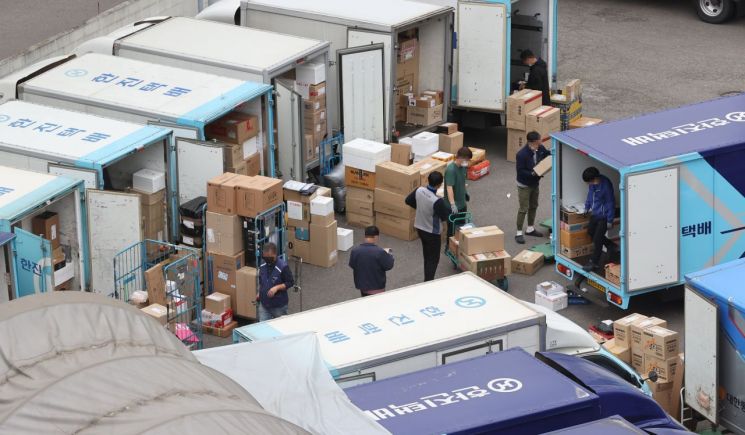
At 8 a.m. on the 7th, in front of a local branch of a delivery company in Seoul. Normally, this would be the busy time for parcel sorting at the local terminal, but Kim Seong-in (39, pseudonym) let out a long sigh. Kim said that the additional deployment of sorting personnel is a matter of health and life rights, adding, "Most of the time, I start work at 6 a.m. and work until 8 or 9 p.m." He continued, "I live with back pain. Seeing colleagues collapse from overwork scares me."
The delivery workers' union began refusing parcel sorting work, known as ‘kkadaegi,’ starting that day. They delayed their clock-in and delivery departure times by two hours. Sorting work is identified as a primary cause of death from overwork and involves sorting parcels by region (sales points) at local terminals. The union argues that although sorting takes 4 to 5 hours, it is not included in their wages, making it ‘unpaid labor.’ Although they stopped sorting work that day, the low volume of parcels on Monday meant minimal disruption on site. A CJ Logistics official stated, "About 4,000 sorting personnel have already been deployed nationwide at delivery terminals," adding, "Since Monday is a low-volume day, there should be no delays in parcel delivery on site." However, if the union's refusal to sort work prolongs, confusion at the sites may increase.
So far, the ‘Social Agreement Body for Measures Against Overwork Deaths of Delivery Workers,’ which includes the government, ruling party, delivery workers' union, and Korea Integrated Logistics Association (employers), agreed in the first round to exclude parcel sorting from delivery workers' duties, limit their working hours, and ban late-night deliveries. The three major companies, including CJ Logistics, announced measures such as deploying a total of 6,000 sorting support personnel. The delivery workers' union claims that the first social agreement, which stated that parcel sorting is the responsibility of delivery companies, has not been properly implemented.
A survey conducted by the delivery workers' union on June 2-3 targeting 1,186 delivery workers nationwide found that 84.7% (1,005 workers) still performed sorting work. Additionally, 30.2% (304 workers) were found to be solely responsible for sorting work due to the absence of separate personnel. Ahead of the final drafting of the second social agreement on the 8th, the union criticized, "Delivery companies are making absurd claims such as requesting another one-year grace period for implementing overwork death countermeasures."
Some analysts view the union's collective action as a ‘pressure card’ aimed at the second agreement. The second meeting of the social agreement body, targeting a final agreement, will be held on the 8th. The union demands that the deployment of sorting personnel be explicitly stated in the second agreement.
© The Asia Business Daily(www.asiae.co.kr). All rights reserved.
![Clutching a Stolen Dior Bag, Saying "I Hate Being Poor but Real"... The Grotesque Con of a "Human Knockoff" [Slate]](https://cwcontent.asiae.co.kr/asiaresize/183/2026021902243444107_1771435474.jpg)















