Education Disaster Relief Fund of 100,000 KRW Provided to All Kindergarten, Elementary, Middle, and High School Students
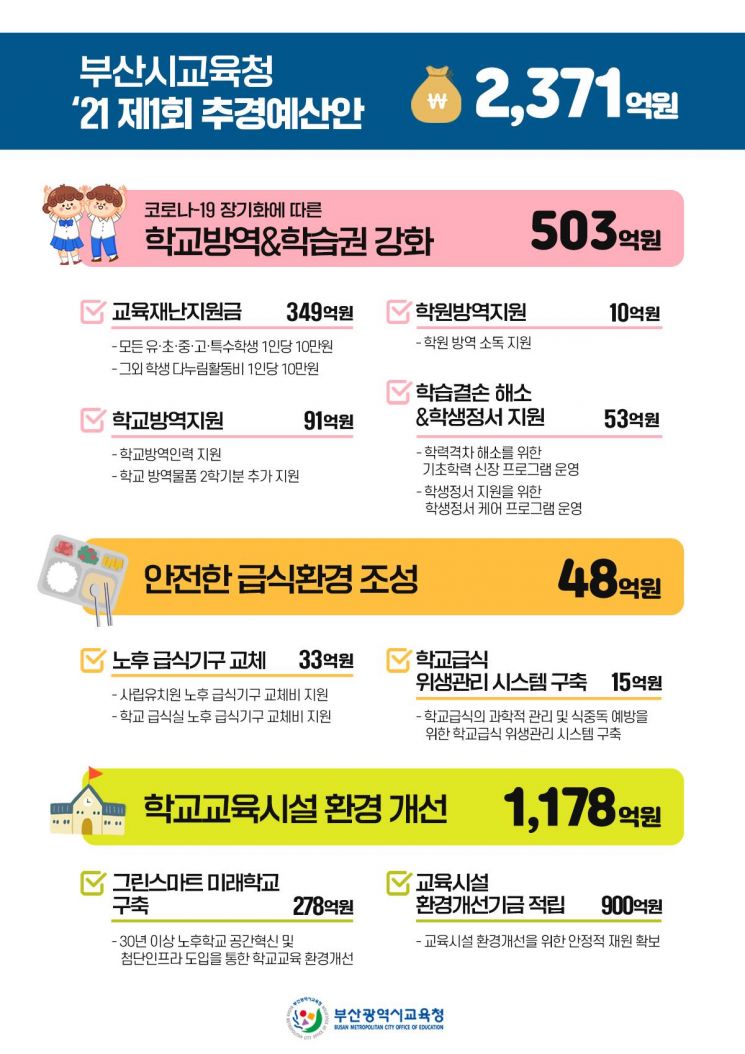
[Asia Economy Yeongnam Reporting Headquarters Reporter Kim Yong-woo] The Busan Metropolitan Office of Education has prepared an additional supplementary budget of 237.1 billion KRW for this year.
The Busan Metropolitan Office of Education (Superintendent Kim Seok-jun) announced on the 7th that it has prepared the first supplementary budget for the 2021 Busan Metropolitan City Education Special Account and submitted it to the Busan City Council.
This supplementary budget is known to have been prepared with a focus on overcoming the prolonged COVID-19 crisis and laying the foundation to return to normalcy through "full in-person classes."
The supplementary budget was composed of revenue sources totaling 237.1 billion KRW, including 147.8 billion KRW from central and local government transfers, 68.7 billion KRW from self-generated income, and 20.6 billion KRW carried over from the previous year.
The Busan Metropolitan Office of Education reflected the budget for supporting school quarantine personnel and supplies, guaranteeing students' right to learn, addressing learning gaps and emotional support, creating a safe meal environment, and improving school educational facilities.
To expand in-person classes, a budget of 2.9 billion KRW was allocated to deploy infectious disease response personnel in the second semester following the first semester.
For special schools, a separate 1.9 billion KRW was spent to temporarily assign 200 quarantine personnel to support a safe school environment for students with disabilities.
Additionally, 4.3 billion KRW was allocated to provide quarantine supplies such as masks and hand sanitizers, as well as disinfection costs, to 1,018 schools ranging from kindergartens to foreign schools.
With 1 billion KRW, disinfection will also be conducted at 8,570 private academies and tutoring centers to eliminate quarantine blind spots.
To enhance students' diverse basic academic skills, 4.7 billion KRW was reflected for projects such as the "Dakkaechim Project," "Aiseum Learning Companion," "Online Tutor Program," and "Academic Improvement Program with Pre-service Teachers."
Regular teachers and learning assistant teachers will collaborate to provide supplementary instruction, learning counseling, and remote classes for students struggling with basic academic skills.
A budget of 500 million KRW was also allocated for a school visit support project by mental health experts, allowing students at risk of suicide to receive help from psychiatrists.
To support the emotional well-being of first and second graders in elementary school, 21 million KRW was allocated for a storybook travel project where teachers directly tell stories through YouTube broadcasts.
To establish a safe meal environment at 259 private kindergartens in Busan, 700 million KRW was allocated for replacing old meal equipment, and 2.6 billion KRW was allocated for replacing old meal equipment in 80 public and private school cafeterias.
For scientific management of school meals and prevention of food poisoning, 1.5 billion KRW was allocated to establish hygiene management systems in 135 schools.
Budgets for safety and securing the right to education were also reflected. For 15 schools over 40 years old, 27.8 billion KRW was allocated for the Green Smart Future School project to innovate spaces and introduce advanced infrastructure, and 90 billion KRW was allocated to the Education Facility Environment Improvement Fund to secure stable funding for improving educational facility environments.
The Busan Metropolitan Office of Education prepared 34.6 billion KRW in educational disaster relief funds using the budget that could not be executed last year due to COVID-19, to ease the burden on students and parents and guarantee the right to learn, providing 100,000 KRW each to approximately 346,000 students from all kindergartens, elementary, middle, and high schools in the Busan area.
With 300 million KRW allocated, 10 million KRW each will also be provided as Danurim activity expenses to about 3,000 students in special school vocational classes, broadcasting and communication middle and high schools, and adult classes at accredited lifelong education facilities.
A Busan Metropolitan Office of Education official explained, "This supplementary budget was prepared focusing not only on quarantine budgets to expand full in-person classes but also on closing students' academic gaps, emotional support, and safety and educational environment improvements such as space innovation projects equipped with advanced equipment."
The supplementary budget bill will undergo preliminary review by the Education Committee and examination by the Budget and Accounts Special Committee during the 297th regular session of the Busan City Council held from the 16th to the 30th, and will be finally approved at the plenary session on the 30th.
© The Asia Business Daily(www.asiae.co.kr). All rights reserved.
![Clutching a Stolen Dior Bag, Saying "I Hate Being Poor but Real"... The Grotesque Con of a "Human Knockoff" [Slate]](https://cwcontent.asiae.co.kr/asiaresize/183/2026021902243444107_1771435474.jpg)
















