May Consumer Prices Rise 2.6%... Largest Increase in 9 Years and 1 Month
Hong Nam-ki: "Due to Base Effect of Price Increase... Will Ease in Second Half"
Experts: "Price Pressure Will Decrease as Vaccine Coverage Expands"
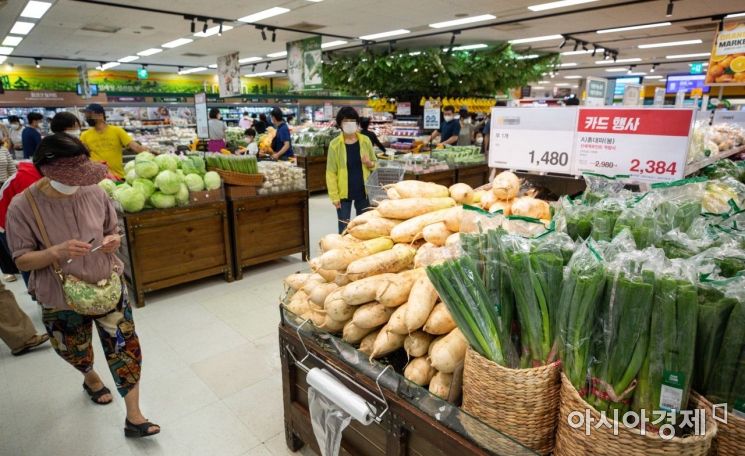 On the 6th, as concerns over rising grocery prices increase, citizens visiting a large supermarket in Seoul are shopping for groceries. Photo by Jinhyung Kang aymsdream@
[Asia Economy Reporter Heo Midam] # Office worker Kim (29) recently sighs whenever he looks at his household ledger. He said, "My salary remains the same, but my expenses keep increasing. I’m tightening my belt, so I deliberately avoid eating out and ordering delivery food," adding, "I mostly cook at home, but the continuously rising prices of ingredients are still burdensome." He continued, "A few months ago, the price of green onions soared so much that the term 'Patech' (green onion + investment) even emerged. Although green onion prices have dropped compared to a few months ago, they are still burdensome compared to last year."
Recently, consumers’ sighs have deepened due to the rapidly rising prices of daily food items. Eggs and green onions have been called 'golden eggs' and 'golden green onions' for several months now, and vegetable prices have also fluctuated repeatedly. Given this situation, office workers are even complaining, "Everything has gone up except my salary." However, the government has pointed out that the recent inflation surge is a 'temporary phenomenon' due to base effects and expects prices to stabilize in the second half of the year.
According to the 'May Consumer Price Trends' released recently by Statistics Korea, the consumer price index last month rose 2.6% compared to the previous year, marking the highest level in about 9 years and 1 month.
The consumer price inflation rate rose from 0.6% in January, 1.1% in February, and 1.5% in March to the 2% range in April (2.3%), and then to 2.6% last month. The main causes of the sharp price increase include ▲COVID-19 base effects ▲sharp rise in agricultural and livestock product prices ▲global raw material price increases.
Prices of agricultural, livestock, and fishery products, which are directly linked to grocery prices, also soared to 12.1%. Agricultural and livestock products affected by poor harvests and avian influenza (AI) have maintained double-digit growth for five consecutive months since January (10.0%). In particular, green onions (130.5%), eggs (45.4%), and domestic beef (9.4%) showed steep increases.
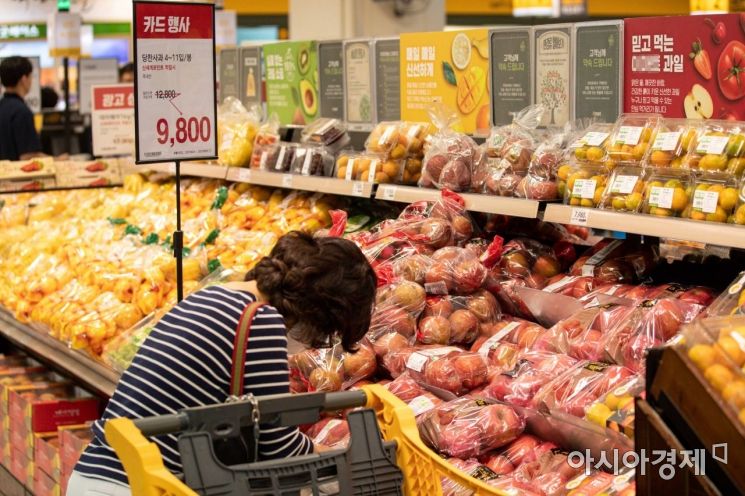
As a result, consumers’ hardships are growing. Especially, some workers whose wages were frozen last year due to the COVID-19 impact are feeling burdened, pointing out that prices are rising sharply compared to their wages.
Office worker Kang (35) said, "There isn’t a single item that hasn’t gone up little by little," adding, "When I go to the supermarket and buy this and that without much thought, I’m surprised at the checkout. Because the total price is higher than expected, I end up removing one or two items that aren’t absolutely necessary."
He continued, "It’s the same at traditional markets. I often used them because prices were cheaper than supermarkets and vendors often gave extra items. But recently, prices at traditional markets have also risen, so it’s just as burdensome."
Another office worker, Lee (26), also said, "I’ve seen many cases where restaurant food prices have gone up, but rarely seen them go down," adding, "Food ingredient and meal prices keep rising, so can prices really stabilize in the second half of the year? Especially eggs are a basic ingredient, but their prices have risen so much lately that I’m afraid to buy them."
On online communities, many posts express dissatisfaction with the skyrocketing prices. One netizen wrote on a mom caf?, "When green onion prices went down, egg prices went up. Eggs have no substitutes, right? The saying that everything except salaries has gone up is true. In my neighborhood, a tray of eggs (30 pieces) sells for 10,000 won. It’s no wonder they call it 'golden eggs.'"
In response, the government expects consumer prices to gradually ease as the second half of the year progresses. Deputy Prime Minister and Minister of Economy and Finance Hong Nam-ki evaluated the May consumer price trends on his Facebook on the 2nd, saying, "The recent inflation surge driven by base effects and temporary supply shocks is expected to gradually ease as we move into the second half of the year."
He added, "It is noteworthy that personal service prices, which are closely related to consumption, are gradually rising as consumption recovery trends appear in retail sales and service production."
Experts also predict that the inflation trend will calm down in the second half of the year. Professor Kim Taegi of Dankook University’s Department of Economics analyzed, "Due to the COVID-19 impact, supply disruptions caused recent price increases. As vaccination expands in the second half of the year, the shock from COVID-19 is expected to subside. If that happens, inflationary pressures will also decrease."
Professor Kim also forecasted, "Our domestic market is highly polarized. Therefore, while some consumers may engage in revenge spending on high-priced goods, it will be difficult for prices to rise broadly or continuously."
© The Asia Business Daily(www.asiae.co.kr). All rights reserved.
![Clutching a Stolen Dior Bag, Saying "I Hate Being Poor but Real"... The Grotesque Con of a "Human Knockoff" [Slate]](https://cwcontent.asiae.co.kr/asiaresize/183/2026021902243444107_1771435474.jpg)
















