[Asia Economy Reporter Changhwan Lee] As the development of fuel cells for hydrogen vehicles continues, it is expected that eco-friendly power generation projects utilizing these cells will also expand.
According to the report "Fuel Cells for Hydrogen Vehicles Transforming into Eco-Friendly Power Plants" published on the 6th by the Korea Automotive Technology Institute, recent attempts to establish power generation systems using fuel cells for hydrogen electric vehicles are ongoing, centered around major domestic and international automakers.
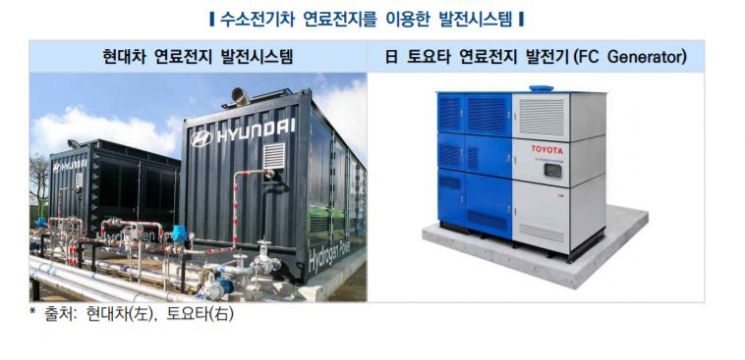
Hyundai Motor Company began a demonstration of a 1-megawatt (MW) power generation system using fuel cells installed in the hydrogen vehicle Nexo in collaboration with Korea East-West Power and Deokyang since February.
Japan's Toyota has been operating a 100-kilowatt (kW) generator at its headquarters factory using fuel cells from the hydrogen vehicle Mirai since September 2019, and since June last year, a 50 kW generator using by-product hydrogen at the Tokuyama manufacturing plant.
Germany's Daimler Truck AG and the UK's Rolls-Royce also announced a cooperation plan last year to develop emergency generators using fuel cell systems jointly developed by Daimler and Volvo.
The report explained that polymer electrolyte membrane fuel cells (PEMFC) installed in hydrogen electric vehicles have advantages such as excellent reliability, operability, and flexible applicability.
With fast initial startup speed and low-temperature operability, the site conditions for power generation use are less demanding, and since solid electrolytes are used, issues related to corrosion or electrolyte management are relatively minor.
Operating at a lower temperature (typically below 80℃) compared to other fuel cells allows quick startup, and installing small automotive PEMFCs for power generation faces fewer site restrictions and facilitates future capacity expansion.
However, to achieve high efficiency, the fuel (hydrogen) must be free of impurities, and due to low-temperature operation, waste heat utilization is relatively difficult. Additionally, the use of platinum catalysts results in relatively high costs.
Kim Seyup, principal researcher at the Korea Automotive Technology Institute, stated, "With the expansion of renewable energy power generation and the hydrogen electric vehicle market, the utilization of polymer electrolyte membrane fuel cells will rapidly increase. They can be widely used in transportation and various other fields, enabling cost reduction through mass production, and modularizing fuel cells for hydrogen vehicles for power generation is also convenient."
© The Asia Business Daily(www.asiae.co.kr). All rights reserved.
![Clutching a Stolen Dior Bag, Saying "I Hate Being Poor but Real"... The Grotesque Con of a "Human Knockoff" [Slate]](https://cwcontent.asiae.co.kr/asiaresize/183/2026021902243444107_1771435474.jpg)















