
[Asia Economy Reporter Seoyoung Kwon] As the types of COVID-19 vaccines and the range of eligible recipients have expanded domestically, interest in adverse reactions has also increased.
Prime Minister Kim Boo-kyum announced today (the 6th) that 14.8% of the entire population, or 7.6 million people, have completed the first dose of the COVID-19 vaccine 100 days after the vaccination began. Currently, citizens aged 60 and over can receive leftover vaccines without a separate reservation until the 19th. The vaccination reservation rate for citizens aged 30 to 59 through apps like Naver or Kakao has also reached 84%. However, some voices express hesitation about vaccination due to concerns about adverse reactions. As the age range of eligible recipients widens and new vaccines such as Janssen and Moderna are introduced, there is a growing response that safety should be given more attention.
According to the COVID-19 Vaccination Response Promotion Team on the 5th, a total of 3,592 new cases suspected of adverse reactions after vaccination were reported to health authorities in Korea from the 2nd to the 4th. Among these, 190 cases were special interest adverse reactions requiring medical attention, including ICU admissions and life-threatening major adverse reactions. The remaining 3,368 cases were general adverse reactions such as fever, pain, and swelling. The reporting rate of adverse reactions relative to the total cumulative cases was approximately 0.19% for the Pfizer vaccine and 0.46% for the AstraZeneca (AZ) vaccine.
In the early stages of vaccination, not only vaccine supply but also the vaccination rate itself was considered a problem. By May, only about 51% of the target population had actually been vaccinated. Since the vaccination of the elderly aged 60 and over began in earnest, the vaccination rate has continued to increase, but surveys still show that some of the target population are reluctant to get vaccinated. According to a perception survey conducted by the Central Disaster and Safety Countermeasures Headquarters and the Ministry of Culture, Sports and Tourism on the 31st of last month targeting 1,000 adults aged 18 and over nationwide, 69.2% of unvaccinated respondents said they intended to get vaccinated. About 3 out of 10 people still show resistance to vaccination.
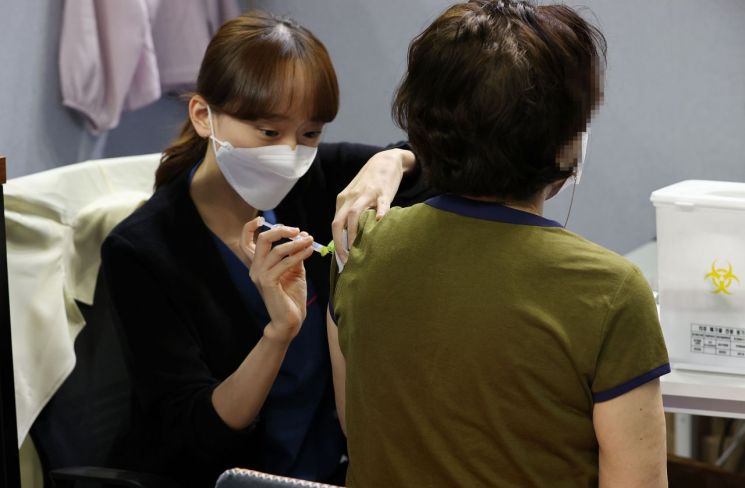 On the 4th, citizens are receiving vaccinations at the COVID-19 vaccination center set up at Sadang Sports Complex in Dongjak-gu, Seoul. [Image source=Yonhap News]
The Pfizer vaccine is an mRNA-type vaccine that injects RNA, which composes the virus's protein, into the body to form antibodies. Another COVID-19 vaccine, the Moderna vaccine, also forms antibodies based on the same principle. Recently, in countries like Israel, a very small number of young men who received the Pfizer vaccine reported mild myocarditis symptoms, raising concerns. The U.S. Centers for Disease Control and Prevention (CDC) explained that "it is difficult to say that there is a particularly high number of cases compared to the average incidence of myocarditis," but also stated that "healthcare providers should be informed about potential adverse reactions."
There is also a possibility of adverse reactions related to the AstraZeneca (AZ) vaccine. The AZ vaccine is a viral vector vaccine that uses another virus to form antibodies. The most representative reported adverse reaction is 'thrombocytopenic thrombosis,' with the first confirmed case in Korea last month involving a 30-year-old man who received the vaccine. However, unlike the early stages of occurrence, rare thrombosis is now recognized as having a virtually 0% fatality rate due to the widespread adoption of early diagnosis and treatment methods. Other well-known adverse reactions to the AZ vaccine include headaches and abdominal pain.
Meanwhile, with the introduction of the Janssen vaccine in Korea being announced, concerns about related adverse reactions have also been raised. Vaccination is expected to begin from the 10th to the 20th for military personnel such as reservists aged 30 and over. Since it is a viral vector vaccine similar to the AZ vaccine, similar adverse reactions should be monitored. High fever, abdominal pain, headaches, seizures, and skin bleeding are the most representative symptoms. There have also been reports of thrombosis in a small number of vaccine recipients, so experts urge caution. It is especially known that the incidence of adverse reactions is relatively higher among young people and males.
© The Asia Business Daily(www.asiae.co.kr). All rights reserved.
![Clutching a Stolen Dior Bag, Saying "I Hate Being Poor but Real"... The Grotesque Con of a "Human Knockoff" [Slate]](https://cwcontent.asiae.co.kr/asiaresize/183/2026021902243444107_1771435474.jpg)
















