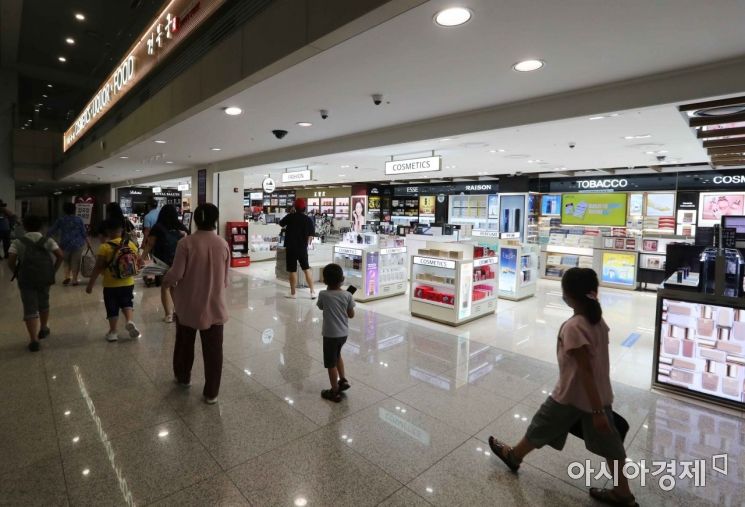
 On the 4th, the duty-free shops at the arrival hall of Incheon International Airport, which had been closed since last October due to the impact of COVID-19 and a change in operators, reopened after 7 months. Tourists are enjoying shopping at the arrival hall duty-free shops in Terminal 1 of Incheon Airport. Photo by Airport Photographers Group
[Asia Economy Reporter Dongwoo Lee] The employment retention support fund for paid leave in the aviation industry, which was scheduled to end at the end of this month, has been extended by 90 days, easing the immediate pressure on airlines. However, they pointed out that additional measures such as financial support must follow.
According to the aviation industry on the 6th, the Ministry of Employment and Labor recently extended the employment retention support fund period by 90 days through the Employment Policy Deliberation Committee, enabling domestic airlines such as Korean Air, Asiana Airlines, Jeju Air, Jin Air, and T'way Air to benefit.
The scale of paid leave in airlines is about 50% of each company's employees. The aviation industry plans to submit paid leave consent forms from employees to the Ministry of Labor soon.
However, some in the aviation industry are calling for the employment retention support fund period to be extended by 180 days instead of 90 days. Previously, 16 labor unions from 15 domestic airport and aviation-related companies advocated for a 6-month extension of the employment retention support fund period.
The reason is that even if COVID-19 vaccine distribution becomes full-scale in the second half of the year, additional time is needed for the industry to recover, including the normalization of international flights. The industry expects management conditions to remain difficult through the second half of this year.
In fact, in the first quarter of this year, Jeju Air recorded an operating loss of 87.3 billion KRW, Jin Air 60.1 billion KRW, T'way Air 45.4 billion KRW, and Air Busan 47.2 billion KRW, showing significant management damage to low-cost carriers (LCCs). During the same period, debt ratios were also at liquidity crisis levels: Jeju Air at 705%, Jin Air at 1790%, and Air Busan at 1750%.
An aviation industry official said, "Active government support is urgently needed for airlines facing management limits," adding, "Industry protection is necessary until COVID-19 is over."
© The Asia Business Daily(www.asiae.co.kr). All rights reserved.
![Clutching a Stolen Dior Bag, Saying "I Hate Being Poor but Real"... The Grotesque Con of a "Human Knockoff" [Slate]](https://cwcontent.asiae.co.kr/asiaresize/183/2026021902243444107_1771435474.jpg)















