[Asia Economy Reporter Ji Yeon-jin] As COVID-19 vaccination accelerates, expectations for 'economic' normalization and concerns about 'policy' normalization are intersecting. While vaccination helps the economy recover from the COVID-19 shock, tightening policies to withdraw liquidity that supported stock markets in various countries may be implemented earlier than expected.
According to the financial investment industry on the 6th, the UK and the US have vaccinated more than half of their total population at least once, and major European countries such as Germany are also recording relatively high vaccination rates. In Korea, the rate of at least one vaccination is about 13%, but recently there has been an atmosphere of expanding vaccination targets and easing supply risks. Expectations are growing for the normalization of face-to-face economic activities, such as the resumption of international flights by domestic airlines and the reopening of duty-free shops.
Investors are closely watching the timing of tightening in each country. In fact, recently major countries announced selective liquidity adjustment plans. The People's Bank of China decided to raise the reserve requirement ratio on foreign currency deposits from the existing 5% to 7% to control the yuan's appreciation. The US Federal Reserve (Fed) also announced plans to sell ETFs and corporate bonds purchased through the Secondary Market Corporate Credit Facility (SMCCF), a temporary emergency lending facility established in response to COVID-19. This increases the possibility of normalization of monetary policies in major countries.
However, experts say that such monetary policy normalization is not yet strong enough to overwhelm expectations for economic normalization. So-eun Ahn, a researcher at IBK Industrial Bank, explained, "After the measures by the US and Chinese central banks, short-term government bond yields reflecting expectations of monetary policy in various countries have not shown strong upward pressure," adding, "It may be that the market has accepted the central banks' repeated easing stance, and that employment or domestic demand is not strong enough to justify a shift to tightening." Researcher Ahn added, "As seen in the US ISM manufacturing index in May, employment weakness, production damage, supply chain disruptions, and cost burdens continue across a wide range of industries," and "Contrary to the Fed's hopes, consumption recovery among low-income and employment-vulnerable groups is still slow from the domestic demand perspective."
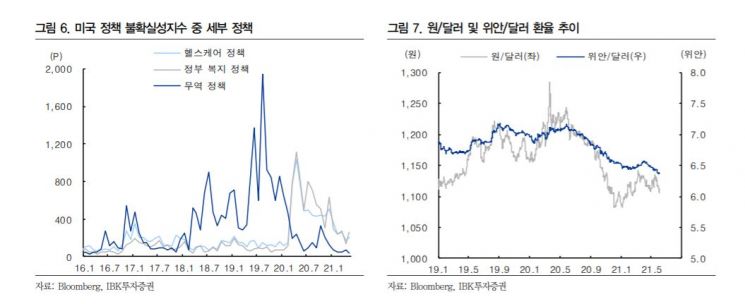
Attention is also focused on whether the US-China conflict, a global issue before the COVID-19 pandemic, will reemerge. During the COVID-19 crisis, both the US and China focused on economic recovery, causing the US-China conflict to subside. However, it is pointed out that once COVID-19-related concerns ease, the US-China conflict could resurface.
Since the Biden administration took office, various measures to check China have been underway. First, President Biden issued an executive order in February directing a supply chain analysis of key technologies (semiconductors, batteries, rare earths, active pharmaceutical ingredients, etc.), with the report deadline on the 4th of this month. Since these technologies are either core to China's rise or areas where the US heavily depends on Chinese products, a new supply chain policy aimed at reducing or excluding China's influence is expected to be pursued.
On the 8th of this month, the US Senate is scheduled to discuss the passage of the 'US Innovation and Competition Act.' This $250 billion bill aims to check China in various fields including politics, economy, and military. It includes strengthening US domestic technology and semiconductors as well as responding to China's growing international influence through allies and international organizations. If passed, China's backlash is considered inevitable.
Researcher Ahn said, "The Biden administration is focusing more on technology and security sectors than trade compared to the Trump administration, so physical damage to the domestic economy and profits from aggressive tariff increases is expected to be limited," but added, "However, changes in the business environment of industries such as semiconductors that heavily depend on US and Chinese demand, exchange rate fluctuations due to geopolitical risks, and foreign capital flows could pose risk factors to the domestic stock market."
© The Asia Business Daily(www.asiae.co.kr). All rights reserved.
![Clutching a Stolen Dior Bag, Saying "I Hate Being Poor but Real"... The Grotesque Con of a "Human Knockoff" [Slate]](https://cwcontent.asiae.co.kr/asiaresize/183/2026021902243444107_1771435474.jpg)















