Sudden Announcement Ahead of G7 Participation
Expanded Beyond 48 Sites Under Trump Administration
Pressure on China Expected to Intensify
Increased US-China Conflict Risks
Korean Companies Need to Revise China Strategies
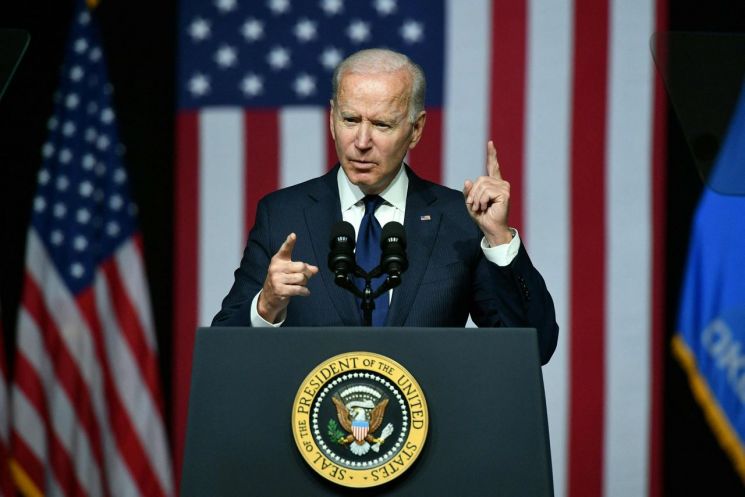
[Asia Economy New York=Correspondent Baek Jong-min, Beijing=Correspondent Jo Young-shin, Reporter Song Hwa-jung, Reporter Kim Heung-soon] The Joe Biden administration in the United States announced investment bans on 59 Chinese companies known to be linked with the Chinese military.
This is a significant increase from the 48 companies listed during the previous Donald Trump administration. As President Biden intensifies pressure on China, there are calls for South Korean companies to revise their China strategies. Concerns are also rising that South Korean companies’ risks related to China may increase.
The White House announced that President Biden signed an executive order on the 3rd (local time) defining 59 Chinese companies subject to the ‘blacklist’ banning investments by U.S. individuals and institutional investors.
The companies subject to the investment ban include telecommunications equipment maker Huawei, China’s largest semiconductor company SMIC, and the three major Chinese telecom operators China Mobile, China Unicom, and China Telecom. The list covers not only IT-related companies but also Chinese defense-related military-industrial complex firms. Companies owned by personnel related to the Chinese People’s Liberation Army were also included in the sanctions.
The investment ban will take effect on August 2. Once the executive order is in effect, U.S. investors will be prohibited from investing in corporate bonds, stocks, derivatives, and other financial products of these companies. They will also be barred from investing in funds that include these companies. However, investors will be allowed to conduct transactions to divest their holdings for 12 months after the order takes effect. After this period, divestment will no longer be permitted.
Announcement Alongside G7 Participation
The White House announced this measure alongside President Biden’s schedule to attend the G7 summit. This is interpreted as signaling an alliance-level pressure campaign against China while rallying democratic allies to counter China.
The White House stated, "This executive order allows for banning investments in Chinese companies that undermine the security or democratic values of the United States and its allies," sending a signal that allied countries should also join in pressuring China.
Initially, the market speculated that the Biden administration might withdraw the China ‘blacklist’ established by the Trump administration, as President Biden had delayed implementing the executive orders decided by the previous administration. However, President Biden’s choice was to intensify pressure on China.
U.S. economic broadcaster CNBC commented, "This move is the strongest action taken against China so far," and predicted that it would either continue or advance the measures taken during the Trump administration.
According to the White House, President Biden will meet with British Prime Minister Boris Johnson on the 10th and attend the G7 summit in Cornwall, UK, from the 11th to the 13th. Besides the G7 member countries?the United States, the United Kingdom, Canada, Germany, France, Italy, and Japan?President Biden is expected to hold bilateral meetings with leaders from four invited countries: South Korea, India, Australia, and South Africa.
Stronger Biden Stance... "Need to Revise China Strategy"
The direct impact of this measure on South Korean companies is expected to be minimal. However, as President Biden tightens the pressure on China more than anticipated, there are calls for South Korean companies to adjust their strategies accordingly.
Lee Won-seok, team leader of the Trade Support Center at the Korea International Trade Association, said, "This measure is different in nature from export-import regulations led by the U.S. Department of Commerce, so our companies may not be directly affected immediately," but added, "Domestic companies that had planned their China business expecting flexible sanctions from the Biden administration may need to revise their approach."
Yoo Seung-min, head of the Global Investment Strategy Team at Samsung Securities, said, "Since the details are already somewhat known, there will be no new shock to the financial market," but also predicted, "The U.S.-China conflict may intensify under the Biden administration, which could affect the domestic market as well."
Strong Chinese Backlash... Possible Retaliation
Wang Wenbin, spokesperson for the Chinese Ministry of Foreign Affairs, before the U.S. announcement, criticized, "The Biden administration announced sanctions banning investments in Chinese military-related companies to achieve political goals," and said, "These sanctions completely ignore the reality of Chinese military-related companies and seriously undermine market norms and order."
He added, "This measure harms the legitimate rights and interests of Chinese companies as well as the interests of global investors, including American investors," and stated that China will take necessary measures to protect the legitimate rights and interests of Chinese companies.
© The Asia Business Daily(www.asiae.co.kr). All rights reserved.
![Clutching a Stolen Dior Bag, Saying "I Hate Being Poor but Real"... The Grotesque Con of a "Human Knockoff" [Slate]](https://cwcontent.asiae.co.kr/asiaresize/183/2026021902243444107_1771435474.jpg)
















