Differentiation in Korean and Math Common Subjects... Higher Difficulty in Math Killer Questions
English Section Changed to EBS Indirect Linkage, Harder Than Last Year's CSAT
Experts Say "Inevitable Advantage and Disadvantage Between Humanities and Sciences... Need to Aim for High Scores in Common Subjects"
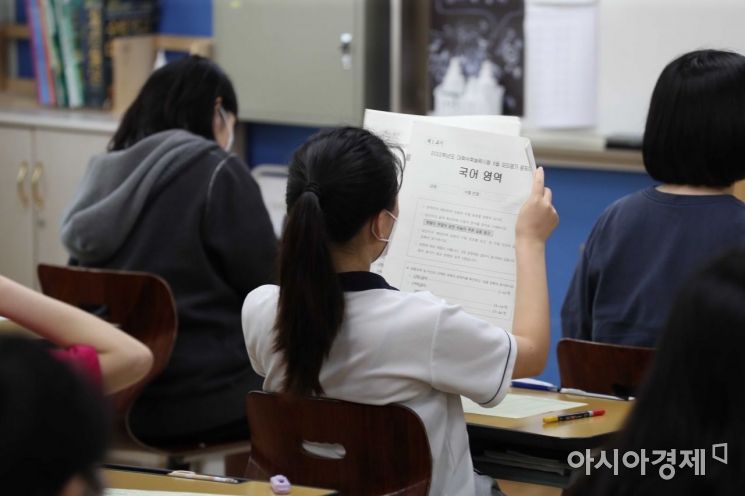 On the 3rd, the first mock evaluation of the 2022 College Scholastic Ability Test, conducted under the integrated liberal arts and sciences system, took place at Yeouido Girls' High School in Yeongdeungpo-gu, Seoul, where students are receiving their exam papers.
[Asia Economy Reporter Han Jinju] In the June mock exam conducted under the first integrated CSAT system, the common subjects in both Korean and Mathematics were difficult, while the elective subjects were relatively easy. From this year, the English section was presented in an indirect linkage format with EBS materials, which was evaluated to have increased the difficulty level.
On the 3rd, the Korea Institute for Curriculum and Evaluation (KICE) administered the '2022 Academic Year CSAT June Mock Exam.' According to KICE, to minimize the possibility of advantages or disadvantages among elective subjects, the discriminative power of the common subject questions was increased, which is a common analysis among entrance exam companies.
This June mock exam was the first KICE-administered mock exam conducted under the integrated humanities and sciences system according to the basic plan for the CSAT scheduled for November 18 this year. The Korean and Mathematics sections changed to a 'common subject + elective subject' structure.
From this year’s CSAT, the linkage rate with EBS CSAT textbooks and lectures was reduced from the previous 70% to 50% based on the number of questions. The English section was presented using an indirect linkage method, utilizing passages and themes similar to those in EBS-linked textbooks but not directly from them.
For Korean, the difficulty level was similar to last year’s CSAT, but Mathematics and English were somewhat more difficult. In Korean, the number of questions increased by two each in the 'Reading' and 'Literature' areas, and new types appeared, such as four passages in the reading section, which is expected to differentiate high scorers in the reading area.
In Mathematics, the common subjects were particularly difficult, while the elective subjects were at an easy level, raising concerns that this might disadvantage humanities students. This was due to the 'killer questions' being difficult in the common subjects. The killer questions were number 22 in the common subjects, number 30 in Calculus, and number 30 in Geometry.
Lee Mangi, director of the Uway Education Evaluation Research Institute, explained, "The difficulty of the common subjects was higher than that of the elective subjects, so humanities students likely felt the difficulty more intensely. The elective subjects were presented at an easy level, and the difficulty among elective subjects was similar."
Kim Byungjin, director of the Etoos Education Evaluation Research Institute, said, "This exam showed the Korea Institute for Curriculum and Evaluation’s determination regarding the change in the CSAT system, especially the 'common + elective subject' system in Korean and Mathematics," adding, "The fact that the difficulty of the Calculus elective subject was not very high was an attempt to minimize the variance among elective subjects."
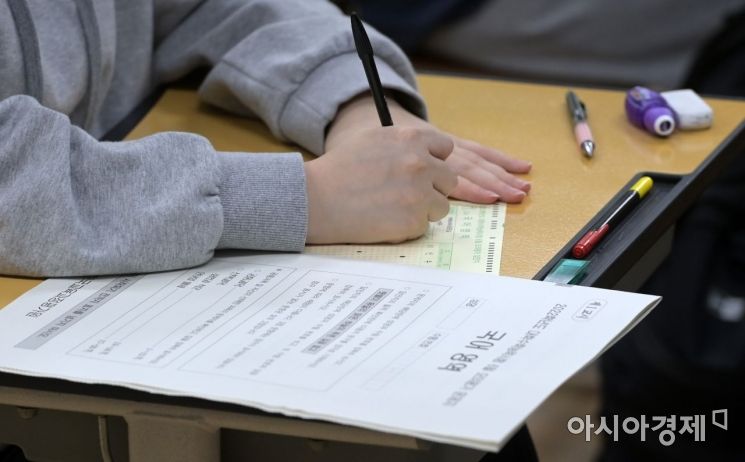 On the morning of the 3rd, high school seniors preparing for the 2022 College Scholastic Ability Test (CSAT) are getting ready for the June mock exam at Yeouido Girls' High School in Yeongdeungpo-gu, Seoul. A total of 482,899 students registered for the first mock exam of the 2022 CSAT, which has been reorganized into an integrated liberal arts and science format. Among them, 415,794 (86.1%) are current students, and 67,105 (13.9%) are graduates and others.
The English section was more difficult than last year, and with the change to an indirect linkage method with EBS materials, the passages likely felt unfamiliar to examinees. It was evaluated as more difficult than last year’s CSAT and last year’s June mock exam. Although there were no new question types, the increased difficulty is expected to result in a top grade (1st grade) rate of about 5-6%.
Woo Yeoncheol, director of the Jinhaksa Entrance Exam Strategy Research Institute, said, "Overall, it is analyzed that there were difficulties in the common subjects compared to the elective subjects, and the English section was also presented with higher difficulty than the previous year’s CSAT," adding, "Even if the June mock exam results are not good, it is most important to regard this exam as a test that evaluates learning so far and determines the direction of future study rather than reacting emotionally."
Lim Seongho, CEO of Jongro Academy Haneul Education, explained, "With the disappearance of direct EBS linkage, the difficulty increased, and especially in humanities students’ Mathematics, securing the top grade became significantly harder, causing an emergency regarding securing the minimum CSAT grade for early admission," adding, "Due to the change in linkage method, English may become more difficult, so it should not be neglected."
Entrance exam experts advised that rather than overly worrying about elective subject selection and humanities disadvantages, it is important to do one’s best in the subjects currently chosen.
Lee Youngdeok, director of Daesung Academic Development Research Institute, said, "The introduction of elective subjects inevitably causes advantages and disadvantages, but it seems that the common subjects were somewhat difficult and the elective subjects somewhat easy to adjust the difficulty among elective subjects," adding, "The difference in difficulty among elective subjects is reduced by calculating adjusted scores, so there is no need to be overly sensitive, and it is better to continue efforts to achieve high scores in common subjects and do one’s best in the chosen subjects."
Director Lee Mangi said, "The adjustment of elective subject scores using common subject scores is intended to provide some compensation to examinees who took elective subjects considered difficult in content and volume," adding, "It is a method to alleviate the concentration on easier subjects and reduce advantages and disadvantages among elective subjects. Since elective subjects cannot be changed, it is best to focus on the current situation and avoid being overly concerned about humanities disadvantages."
© The Asia Business Daily(www.asiae.co.kr). All rights reserved.


















