National Cancer Center, Study on Predicting Long-term Complications and Chronic Diseases in Cancer Patients Based on Combined Data
[Asia Economy Reporter Seulgina Jo] A study has found that cancer patients are more likely to experience chronic disease complications, including heart failure, compared to general patients. This result was identified through the linkage of pseudonymized data, and it is expected that detailed occurrence status and risk factors of long-term complications and chronic diseases by six major cancer types will be identified, enabling the presentation of predictive models for prevention.
According to the National Cancer Center and the Personal Information Protection Commission on the 3rd, this study tracked the occurrence of long-term complications and chronic diseases in patients with six major cancers treated at the National Cancer Center over nine years. It was conducted as one of seven projects in five major fields utilizing big data pseudonymized information.
For the first time ever, this study pseudonymized and linked health-related big data, including clinical information from the National Cancer Center (200,000 people) and medical treatment information from the National Health Insurance Service (200,000 people). Based on this, important information such as complications and chronic diseases mainly occurring in cancer survivors could be observed.
Analysis results showed that compared to patients without cancer (general patients) who visited the National Cancer Center, cancer patients had higher incidences of chronic diseases and complications such as cardiovascular and cerebrovascular diseases, metabolic diseases, and musculoskeletal diseases.
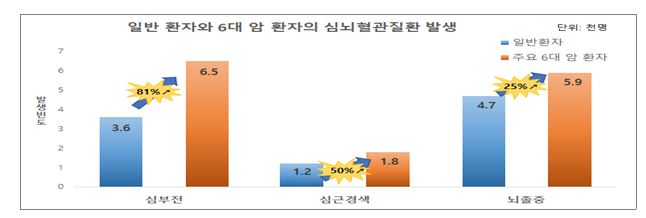
First, looking at cardiovascular and cerebrovascular diseases, cancer patients had an 81% higher incidence of heart failure than general patients. Myocardial infarction was 50% higher, and stroke was 25% higher. In musculoskeletal diseases, fractures were found to occur 47% more frequently. Among metabolic diseases, the incidence of diabetes, the most representative, was 35% higher.
The National Cancer Center explained, "Compared to general patients, cancer patients had higher occurrences of metabolic diseases, cardiovascular and cerebrovascular diseases, and musculoskeletal diseases, suggesting that long-term management and prevention of complications and chronic diseases after cancer survival are important."
The National Cancer Center plans to identify detailed occurrence status and major factors of long-term complications and chronic diseases by six major cancer types through in-depth analysis in the future.
Furthermore, by applying artificial intelligence (AI) learning to this linked data, they plan to identify risk factors for long-term diseases throughout the life cycle of cancer survivors and present predictive models to prevent these diseases.
Seo Hong-gwan, Director of the National Cancer Center, said, "As cancer survival rates improve and the number of cancer survivors reaches 2 million, active health management after cancer treatment is very necessary to improve the quality of life of cancer survivors," adding, "Through this pilot case, not only the management of chronic diseases in cancer survivors but also the efficiency of clinical medical care through precision medicine is expected to increase."
Yoon Jong-in, Chairman of the Personal Information Protection Commission, said, "This case, following the previous lung cancer treatment effectiveness study, demonstrates the potential for the safe use of health and medical big data," and added, "If customized medical services based on empirical data and predictive models are developed in connection with MyData, another axis of safe personal information use, it will contribute diversely to the promotion of public health."
© The Asia Business Daily(www.asiae.co.kr). All rights reserved.
![Clutching a Stolen Dior Bag, Saying "I Hate Being Poor but Real"... The Grotesque Con of a "Human Knockoff" [Slate]](https://cwcontent.asiae.co.kr/asiaresize/183/2026021902243444107_1771435474.jpg)
















