Bank of Korea '2020 Corporate Management Analysis Results (Preliminary)'
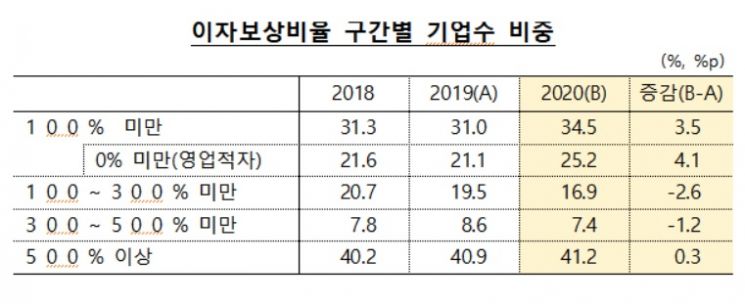
[Asia Economy Reporter Eunbyeol Kim] Last year, amid the severe impact of the COVID-19 pandemic on companies, the proportion of firms unable to cover even their interest expenses with operating profit reached an all-time high of 34.5%. However, the share of companies with an interest coverage ratio exceeding 500% also increased, driven by firms in sectors such as semiconductors and medical industries that benefited from the pandemic's positive spillover effects. The gap between the rich and the poor among companies has intensified drastically due to COVID-19. While the growth potential of domestic companies deteriorated, their profitability showed improvement.
According to the "2020 Corporate Management Analysis Results (Preliminary)" released by the Bank of Korea on the 3rd, the proportion of companies with an interest coverage ratio below 100% rose by 3.5 percentage points from 31.0% to 34.5% last year. An interest coverage ratio below 100% means that operating profit was insufficient to cover interest expenses. The interest coverage ratio declines when operating profit margin decreases while financial costs increase.
However, the proportion of companies with an interest coverage ratio above 500% also expanded slightly from 40.9% to 41.2% last year.
Last year, the sales growth rate of companies fell by 3.2%, widening the decline compared to 2019 (-1.0%). This indicates a deterioration in corporate growth potential. The total asset growth rate remained similar to the previous year (5.0% → 4.9%).
By industry, the sales growth rate in manufacturing dropped sharply from -2.3% to -3.6%. Despite increases in some sectors such as electronic, video, and communication equipment, and medical substances and pharmaceuticals, sales decreased mainly in petroleum refining and chemical products. The non-manufacturing sector (0.8% → -2.6%) also showed a downward trend, centered on wholesale and retail trade, and transportation and warehousing.
The operating profit margin on sales improved from 4.8% to 5.1%. Manufacturing rose from 4.7% to 4.9%, showing an upward trend influenced by electronic, video, communication equipment, and medical substances and pharmaceuticals. In the non-manufacturing sector, as oil prices fell sharply last year, fuel costs decreased significantly, leading to an improvement in the operating profit margin of the electricity and gas industry, which rose from 4.9% to 5.3%.
The debt ratio, an indicator of corporate stability, decreased slightly from 97.6% in 2019 to 97.4%. The dependence on borrowings also fell marginally from 28.3% to 28.2% compared to the previous year. With an increase in cash inflows from operating activities, the cash flow coverage ratio rose from 49.4% to 61.3% year-on-year.
© The Asia Business Daily(www.asiae.co.kr). All rights reserved.

















