International Financial Center: "Possibility of Oil Prices Peaking in Q3~Q4"
CNBC: "Temporary Surge Above $80 This Summer, Potential Return to $100 Within 3 Years"
Pressure Mounts on Korea Electric Power Corporation for Electricity Rate Hikes Reflecting Oil Price Increase
However, Considering Recent Inflation, Rate Freeze Also Possible
[Asia Economy Reporter Kim Eunbyeol, Sejong=Reporter Joo Sangdon] Forecasts are emerging that the strong oil prices will continue through the second half of the year. This is because the pace of crude oil demand growth due to economic recovery is likely to outpace supply even after this summer. The possibility of fuel cost increases being reflected in domestic electricity rates has also grown.
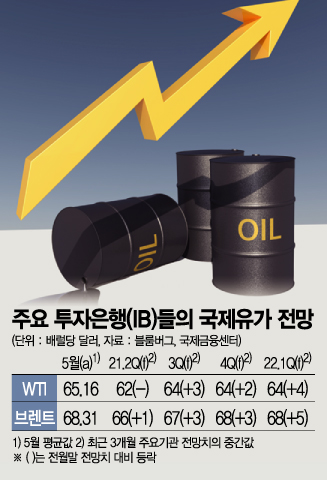
On the 3rd, the International Financial Center stated in its recent report "International Commodity Market Trends and Key Issues" that "the oil market has been facing a supply shortage of about 1 million barrels since the pandemic," adding, "there is a possibility that oil prices will reach a peak in Q3~Q4." The center further cited figures from major investment banks, predicting that Brent crude oil prices will rise to $67 per barrel in Q3 and $68 per barrel in Q4 based on median values.
On the 2nd (local time) at the New York Mercantile Exchange (NYMEX), the July West Texas Intermediate (WTI) crude oil price closed at $68.83 per barrel, up $1.11 (1.16%) from the previous session, marking the highest level since October 22, 2018. August Brent crude also closed at $71.35, surpassing $70.
US CNBC reported that oil prices could temporarily exceed $80 per barrel this summer and relayed expert comments stating that "oil prices could return to $100 within three years."
As oil prices are expected to continue rising in the second half, the possibility of domestic electricity rate hikes has increased. Korea Electric Power Corporation (KEPCO) introduced a 'fuel cost linkage system' this year, reflecting fuel costs used in electricity production into electricity rates every three months. Since international fuel prices are typically reflected in fuel costs with a 3 to 6-month lag, electricity rates are inevitably set to rise. KEPCO will decide on whether to raise electricity rates for Q3 around the 21st.
However, since the government announced inflation countermeasures the day before and expressed a policy to "manage public utility rates such as electricity stably," the possibility of electricity rates being frozen in Q3 as well as Q2 cannot be ruled out. Although considering fuel prices makes electricity rate hikes unavoidable, such increases could burden the low-income economy. Electricity rates for Q2, which were expected to rise due to the increase in international oil prices over the previous three months, were also frozen.
© The Asia Business Daily(www.asiae.co.kr). All rights reserved.
![Clutching a Stolen Dior Bag, Saying "I Hate Being Poor but Real"... The Grotesque Con of a "Human Knockoff" [Slate]](https://cwcontent.asiae.co.kr/asiaresize/183/2026021902243444107_1771435474.jpg)















