Won the 1947 Boston Marathon by beating Miko Pitanen
The dramatic participation process inspired the film 'Boston 1947'
Showed that sports exert the power of dozens of diplomats or more
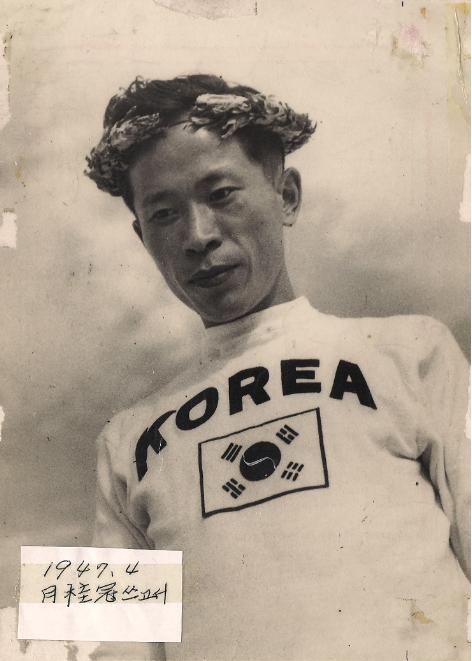 Seo Yun-bok, the winner of the Boston Marathon
In April 1947, at the Boston Marathon in the United States, Seo Yun-bok (1923?2017) joined the leading group midway through the race. As he fiercely competed with Finland's Miko Pitanen, they reached a hill known as the "heart rupture hill." This spot, about two-thirds along the one-way course, was famous for causing many exhausted runners to drop out. However, for Seo Yun-bok, it was a hill of joy.
He was born and raised in Hyeon-jeo-dong, Seodaemun-gu, Seoul. Hyeon-jeo-dong means a neighborhood between hills. Between Inwangsan and Ansan mountains ran the Uiju road, connecting to Gaeseong and Pyongyang. In his childhood, Inwangsan and Ansan were playgrounds he ran up several times a day. Climbing mountains was as routine as eating, which led him to become an athlete, and he never suffered from the hardships of hills.
Seo Yun-bok quickly took the lead and widened the distance. Although he lost his balance and fell when a large dog ran at him on a downhill, he quickly got up and entered the Boston city streets in the lead.
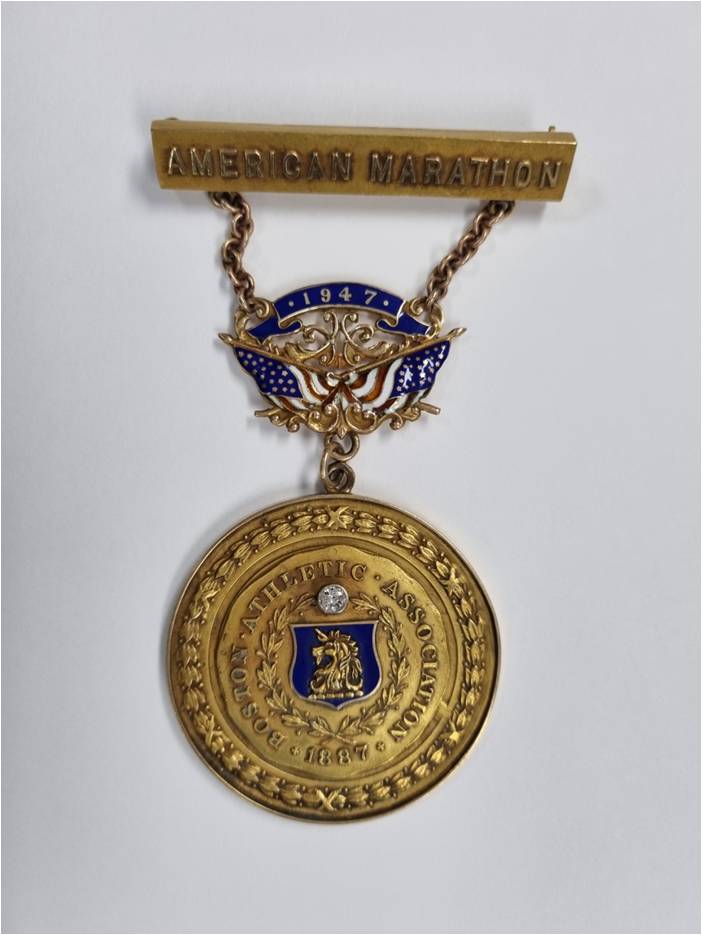
The medal Seo Yun-bok received wearing a laurel wreath on his head is becoming a national registered cultural heritage. On the 3rd, the Cultural Heritage Administration announced it would pre-register Seo Yun-bok’s Boston Marathon medal, the first international victory after liberation bearing the national name "KOREA" and the Taegeukgi flag. After a month of gathering opinions from various sectors and review by the Cultural Heritage Committee, the registration decision will be finalized. The Cultural Heritage Administration explained, "It has great historical significance as it revealed the capabilities of the Republic of Korea and our people to the world under difficult conditions during the US military government period before the establishment of the Republic of Korea."
Seo Yun-bok’s Boston Marathon victory is so dramatic that director Kang Je-gyu made the film Boston 1947. He managed to raise travel expenses through donations from US military government Americans and boarded a military plane at Gimpo Airport along with director Sohn Ki-jung and Nam Seung-ryong.
They passed through the Atsugi Air Base in Japan and arrived in Hawaii, USA, where they faced the crisis of not being allowed to enter the US mainland. The travel certificate issued by the military government they carried was only valid west of a certain demarcation line drawn north-south in the middle of the Pacific, meaning it was only recognized within General MacArthur’s Pacific occupation command area. Seo Yun-bok received a new travel certificate late with the help of a Korean pastor living in Honolulu. After about 12 hours of flight, they arrived at the San Francisco military airfield. Then, with the help of a US Army sergeant stationed in Korea, they safely reached Boston.
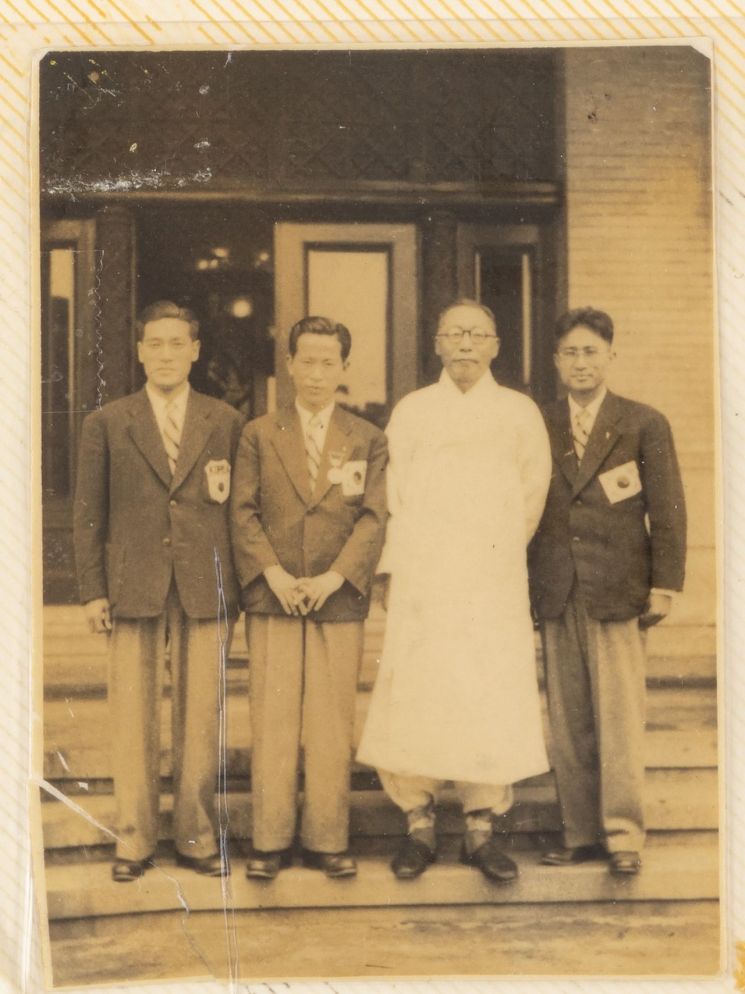 Teacher Kim Gu was moved by Seo Yun-bok's victory in the Boston Marathon and took a commemorative photo at Gyeonggyojang, writing the calligraphy "Jokpa Cheonha (足覇天下)." From the left: Sohn Kee-chung, Seo Yun-bok, Kim Gu, Nam Seung-ryong.
At that time in New York, Korean political heavyweights such as Cho Byung-ok, Chang Myon, and Lim Young-shin were engaged in diplomatic efforts to achieve South Korean independence through the United Nations. However, Soviet representatives were obstructing these efforts, making success seem unlikely.
Nevertheless, by holding a victory celebration for Seo Yuk-bok at the Pennsylvania Hotel, they were able to explain and persuade the world about Korea’s position. They even received a promise from Avery Brundage, Vice President of the International Olympic Committee (IOC), to strive for IOC membership, which was officially approved two months later. The following year, Korea participated in the London Olympics and the St. Moritz Winter Olympics, recognizing that sports could exert the power of dozens of diplomats.
© The Asia Business Daily(www.asiae.co.kr). All rights reserved.
![Clutching a Stolen Dior Bag, Saying "I Hate Being Poor but Real"... The Grotesque Con of a "Human Knockoff" [Slate]](https://cwcontent.asiae.co.kr/asiaresize/183/2026021902243444107_1771435474.jpg)
















