Jinwoo Sanjeon, a Traffic Communication Specialist
Proves Technical Expertise through Highway ITS System Construction
Following Multi-Lane Hi-Pass Success, Begins Development of Next-Generation C-ITS System
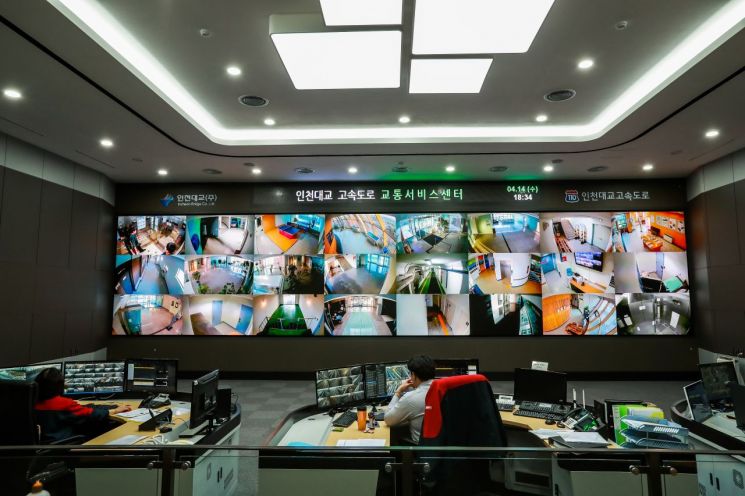 Jinwoo Sanjeon, which demonstrated its technological capabilities through the Incheon Bridge ITS project, the longest domestic bridge last year, is expanding its business area in the field of traffic safety by successfully completing multi-lane Hi-Pass system construction projects one after another. Photo by Jinwoo Sanjeon
[Asia Economy Reporter Kim Heeyoon] Highways with over 4 million vehicles passing daily are battlegrounds for Intelligent Transport Systems (ITS). From the Hi-Pass system that facilitates smooth vehicle statistics and toll collection to traffic management systems that gather and analyze traffic information, ITS has become an essential element for driver safety and efficient traffic flow management.
Jinwoo Sanjeon, which recently completed the ITS system construction for the Seoul-Munsan Expressway, is an ITS specialist company with 32 years of experience in traffic communication technology, building expertise since 1990 in unmanned enforcement equipment, LED traffic lights, CCTV systems, and more, based on traffic signal control technology.
Last year, the company demonstrated its technological capabilities through the Incheon Bridge ITS project, the longest bridge in Korea, and has been expanding its business scope in traffic safety by successfully implementing multi-lane Hi-Pass system projects one after another. Lee Dongwon, Head of ITS Business Division at Jinwoo Sanjeon, stated, "Hi-Pass systems, which require accounting and convenience, have traditionally been projects mainly awarded to large corporations due to their technical difficulty. We hold patented technology specialized in toll collection, so we are also focusing on traffic management and video detection solution fields where we can create synergy." Jinwoo Sanjeon holds a 50% share of the domestic ITS market and is also investing efforts in developing next-generation C-ITS (Cooperative Intelligent Transport Systems).
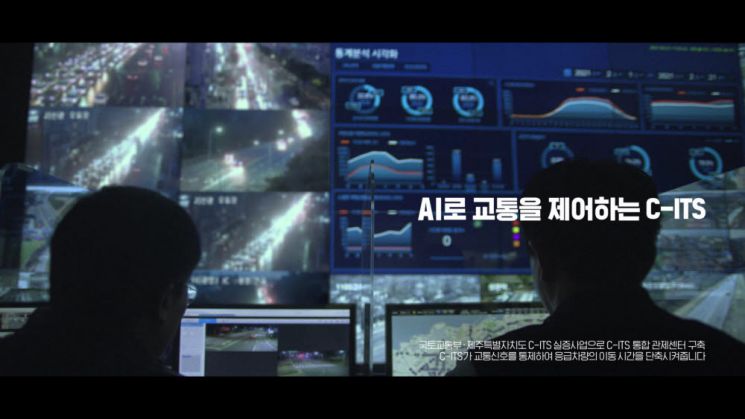 C-ITS, well known through KT video advertisements, is a safety service where vehicles communicate with each other and with the road to share information in real time. It can control road conditions using AI, making it a promising next-generation traffic system. Photo by KT advertisement capture.
Annual Savings of 800 Billion KRW Expected with Full-Scale C-ITS Introduction
Well known through KT video advertisements, C-ITS is a safety service where vehicles communicate with each other and with roads, sharing information in real time. An easy-to-understand example of C-ITS is an ambulance carrying an emergency patient receiving green lights throughout the entire route to the hospital, allowing it to proceed directly and safely.
Lee explained, "We recently joined a demonstration project in Gangneung City as a consortium with KT and have begun full-scale system construction. As traffic safety technology has evolved from first-generation traffic lights to second-generation ITS and now to third-generation C-ITS, data connectivity has become a crucial factor, leading us to take on this challenge with KT," he said.
C-ITS utilizes Vehicle-to-Everything (V2X) communication to collect wired and wireless information exchanged between vehicles and infrastructure, forming vast amounts of data. It especially shares location data of pedestrians and vehicles for real-time autonomous driving and synthesizes and analyzes traffic conditions collected from all vehicles to disperse traffic congestion, creating an advanced system. Lee said, "C-ITS is a collection of IT technologies that can simultaneously reduce traffic operation budgets and create synergy. Based on our experience building ITS-centered smart intersections, smart school zones, and road incident monitoring systems, we are becoming a leading company in C-ITS."
Meanwhile, the Ministry of Land, Infrastructure and Transport anticipates that with the full-scale introduction of C-ITS, vehicle travel speeds will improve by 30%, annual fuel and congestion costs related to traffic jams will be reduced by 800 billion KRW, and traffic accidents will decrease by 46%.
© The Asia Business Daily(www.asiae.co.kr). All rights reserved.
![Clutching a Stolen Dior Bag, Saying "I Hate Being Poor but Real"... The Grotesque Con of a "Human Knockoff" [Slate]](https://cwcontent.asiae.co.kr/asiaresize/183/2026021902243444107_1771435474.jpg)
















