Conspiracy Theories Persist Around Jeongmin's Death, Friend A Left in Suspicion
Conspiracy Theories Rampant Online...Baseless Speculation and Witch Hunts
2010 'Tajinyo' Incident and US 'QAnon' Also Spread Online
Experts Say "Conspiracy Theories Are Human Instinct...A Tool to Explain Uncertain Reality"
"Not Only Low-Educated but Also Highly Educated Can Be Deceived," Warn Experts
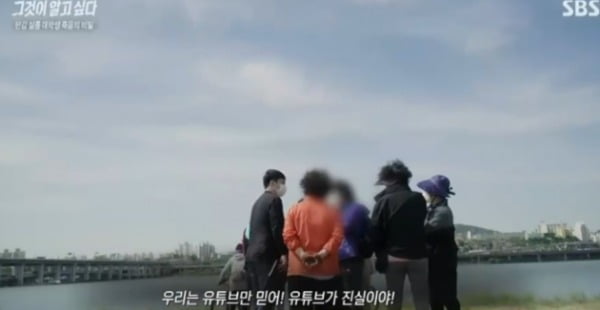
[Asia Economy Reporter Lim Juhyung] "We only trust YouTube! YouTube is the truth."
This was a statement made by a citizen on the SBS investigative program "Unanswered Questions" aired on the 29th of last month. Regarding the recent social issue surrounding the death of the late Son Jung-min, this citizen, demanding a thorough investigation, claimed to trust internet broadcasters more than the police investigation results.
Fake news and conspiracy theories are rampant on social networking services (SNS) and YouTube. Such internet conspiracy theories can obstruct investigations and are highly dangerous as they may wrongly accuse unrelated third parties of crimes. Experts warn that anyone, regardless of their level of knowledge, can be susceptible to conspiracy theories.
Suspicions about friend A, who drank with Jung-min at the time of his disappearance, have persisted since the early stages of the investigation. On SNS and YouTube, baseless speculation and conspiracy theories have been rampant.
The problem lies in some citizens, misled by these conspiracy theories, obstructing the police investigation or engaging in 'witch hunts' against ordinary citizens who are not suspects.
On the 16th of last month, about 300 citizens gathered at Seoul Hangang Park to hold a protest demanding a thorough investigation of the incident. They effectively pointed to A as the culprit with slogans like "Investigate A" and "Do not fabricate evidence." Some citizens broke away from the march chanting "Let's go to Seocho Police Station" and even clashed with the police.
 Malicious comments from netizens are posted on the review page of a hospital in Seoul on 'Kakao Map'. / Photo by Internet homepage capture
Rumors spread online that A is the nephew of a high-ranking public official, and a hospital presumed to be where A’s family works was subjected to a 'star rating attack.' On the 11th of last month, the review page of a Seoul hospital registered on Kakao Maps was flooded with the lowest rating of one star along with abusive comments such as "Hospital where the murderer’s father goes. Never go there," "Don’t live your life like that," and "Demonic guy. Your family and the police are all accomplices and murderers."
It is pointed out that online spaces, where baseless rumors can spread rapidly, have effectively become the breeding ground for conspiracy theories and fake news. This is not the first time the internet has played a decisive role in spreading conspiracy theories.
Previously, in 2010, the 'Demand the Truth from Tablo' (Tajinyo) incident erupted, where suspicions of academic fraud were raised against singer Tablo, demanding a thorough investigation. Even after Tablo’s academic background was verified, Tajinyo members refused to believe it and continuously raised doubts, eventually leading to legal battles between Tablo and Tajinyo.
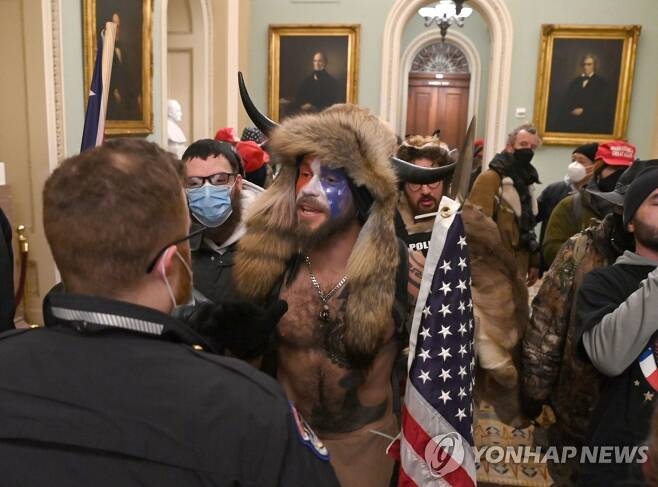 On January 6th (local time), Jacob Anthony Chansley, the so-called 'QAnon shaman' who entered the United States Capitol in Washington DC and was widely featured in global media, stands with fellow intruders. / Photo by Yonhap News
The spread of internet conspiracy theories is not limited to Korea. Recently, the United States also suffered from the conspiracy theory group 'QAnon.' Believers in the conspiracy theory that pedophiles secretly control the U.S. political and financial sectors spread false claims of election fraud on social media after former President Donald Trump lost the recent U.S. presidential election.
On January 6 (local time), when hundreds of Trump supporters stormed the U.S. Capitol in Washington, D.C., causing violent incidents, it was confirmed that some of the supporters were QAnon followers, sparking controversy.
So why do some citizens fall for such absurd conspiracy theories?
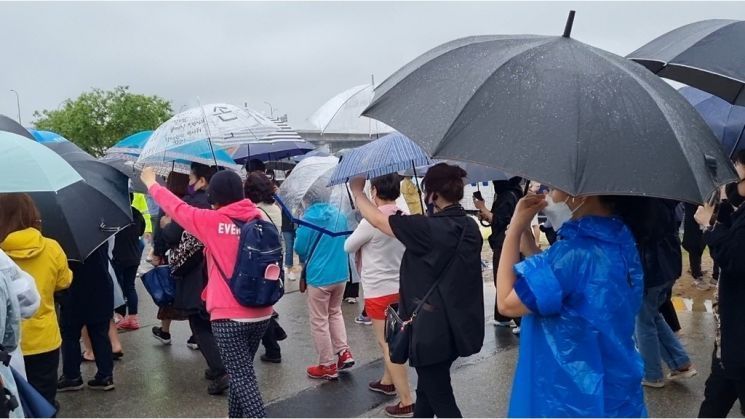 Citizens participating in the march to commemorate the death of Jeong-min and demand a thorough investigation are marching. / Photo by Yonhap News
Experts say that belief in conspiracy theories is a natural phenomenon closely linked to human instincts. It is not that people with low intelligence or naivety believe in conspiracy theories; rather, everyone can be susceptible, so greater caution is needed.
Jan-Wilhelm van Prooijen, a professor of psychology at the University of Amsterdam and a leading scholar in conspiracy theory research, told the U.S. media outlet VOX, "Conspiracy theories are sometimes tools to explain various events in reality that we cannot understand," adding, "When overwhelming events such as natural disasters, mass unemployment, or terrorism occur, people tend to imagine the worst-case scenarios to make sense of the phenomena."
According to Professor Prooijen, conspiracy theories are a self-defense instinct passed down from ancient times. Ancient humans, who had to survive in always hostile environments, thought by strictly distinguishing themselves from others. Because of this, humans today are prone to believe in conspiracy theories that claim powerful groups secretly engage in evil acts.
Professor Prooijen warned, "Conspiracy theories are more likely to spread rapidly when socially uncertain events occur or when society suddenly changes drastically. While less educated people may be more easily drawn into conspiracy theories, it does not mean that highly educated people are immune."
© The Asia Business Daily(www.asiae.co.kr). All rights reserved.
![Clutching a Stolen Dior Bag, Saying "I Hate Being Poor but Real"... The Grotesque Con of a "Human Knockoff" [Slate]](https://cwcontent.asiae.co.kr/asiaresize/183/2026021902243444107_1771435474.jpg)

















