Major Indexes Up 70% in One Year
Long-Term Uptrend Expected for the First Time in 10 Years
Deputy Minister Lee Okwon: "Simple Uptrend Due to Economic Recovery"
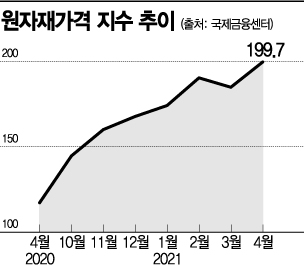
[Asia Economy Reporter Jang Sehee] Major commodity price indices have surged more than 70% over the past year. This is due to continued monetary easing by major countries including the United States and increased demand from economic recovery. As international commodity prices soar, there are forecasts that a commodity "super cycle" (long-term upward trend) could reemerge for the first time in 10 years, but the government assesses that it is premature to judge it as a super cycle, stating that the price strength is expected to weaken from the second half of the year.
According to the International Finance Center on the 1st, the CRB index, an international commodity price index, stood at 199.7 in April, a 70.4% increase from 117.2 a year earlier. The CRB index is composed of 19 commodity futures including grains, crude oil, and precious metals. The strength was seen across commodities rather than in specific items.
The price of electrolytic copper (per ton), a key material for electric vehicle batteries, recorded $11,159.5, up $127 from the previous day. In April last year, it was about $5,000. Non-ferrous metal prices also rose, with lead (per ton) increasing by $25.5 to $2,208 and nickel rising $447 to $17,811. Dubai crude oil reached $67.94 per barrel, nearly doubling compared to six months ago.
The rise in international commodity prices is largely due to a strong demand exceeding supply, resulting in a persistent excess demand phase. Other factors analyzed include poor crop yields, mining strikes, and various countries' eco-friendly industrial policies.
Experts predict that commodity prices will continue to rise as actual demand increases with further economic recovery, along with investment demand (excess demand). Professor Kim Soyoung of Seoul National University’s Department of Economics said, "Although the U.S. has recovered significantly, there is potential for further recovery," adding, "As the global economy recovers, global demand will increase, inevitably pushing commodity prices higher." She also analyzed that "the promotion of eco-friendly industrial policies and infrastructure investments in various countries are also factors driving up commodity prices."
However, the government maintains that it is too early to conclude a commodity super cycle. The current rise in international commodity prices is seen as a temporary phenomenon caused by supply and demand imbalances. Lee Eokwon, First Vice Minister of Strategy and Finance, said at a macroeconomic financial meeting he chaired on the day, "There are opinions that international commodity prices have entered a super cycle, but many also evaluate it as a simple upward trend due to natural economic recovery." He added, "However, if volatility expands excessively, it could negatively impact the economy, so we will closely monitor related trends and devise countermeasures." The government plans to discuss and announce measures to prepare for price increases in commodities and agricultural, livestock, and fishery products at the price-related vice ministerial meeting scheduled for the 2nd.
© The Asia Business Daily(www.asiae.co.kr). All rights reserved.
![Clutching a Stolen Dior Bag, Saying "I Hate Being Poor but Real"... The Grotesque Con of a "Human Knockoff" [Slate]](https://cwcontent.asiae.co.kr/asiaresize/183/2026021902243444107_1771435474.jpg)















