China Raises Foreign Currency Deposit Reserve Ratio from 5% to 7% for the First Time in 14 Years
Adjusting Market Foreign Currency Liquidity... Cooling Speculative Capital in Yuan
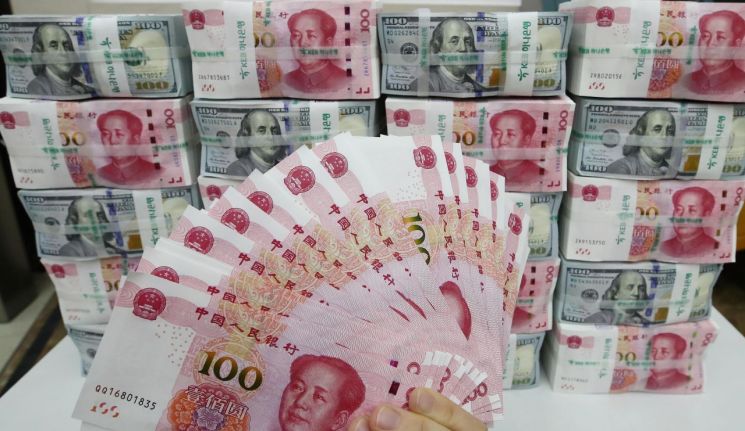
[Asia Economy Beijing=Special Correspondent Jo Young-shin] Chinese financial authorities have taken the card of raising the 'foreign currency deposit reserve ratio' to prevent a rapid appreciation of the yuan. China first introduced the foreign currency reserve ratio system in November 2004, and the last time the reserve ratio was raised was on May 15, 2007, from 4% to 5%. The revival of this system by Chinese authorities after 14 years is interpreted as a strong indication of their intention to intervene in the market.
The People's Bank of China, the central bank, announced on the 31st of last month that from June 15, the foreign currency reserve ratio for banks and other financial institutions will be raised by 2 percentage points from the current 5% to 7%. The increase in the foreign currency reserve ratio means an intention to regulate the level of foreign currency funds in the market.
Regarding this, the economic media Caixin explained that as of the end of April, foreign currency deposits held by Chinese financial institutions amounted to 1 trillion dollars (KRW 1,108 trillion), and a 2 percentage point increase in the reserve ratio would have the effect of withdrawing 20 billion dollars of funds. Caixin interpreted this move as sending a signal to the market that 'the authorities can intervene' and 'if they intervene, they will do so decisively.'
Guan Tao, Chief Economist at Bank of China and former Director of the Foreign Exchange Management Department of the People's Bank of China, said, "The Chinese central bank has rarely used the reserve ratio policy in the past, and even when it did, it adjusted by 0.5 percentage points at a time," adding, "The central bank has many tools it can use to prevent yuan appreciation, and it will choose which tool to use."
Wang Jingyuan, a macro analyst at Minsheng Bank, said, "Raising the foreign currency reserve ratio has the effect of locking up the amount of foreign currency held by banks and other financial institutions," and evaluated that this measure could suppress yuan appreciation.
Li Liuyang, Chief Foreign Exchange Analyst of the Financial Markets Department at China Merchants Bank, said, "A 2 percentage point increase in the foreign currency reserve ratio will result in the withdrawal of short-term liquidity in the region," and added, "This move by the central bank will help calm the market's excitement."
As the yuan continued to strengthen, the dominant view in the market was that Chinese financial authorities would intervene in some way. Especially since April, the pace of yuan appreciation accelerated sharply, lending weight to this expectation. The yuan's value against the dollar rose more than 3% since April and over 11% in the past year since May of last year.
As the atmosphere became tense, Liu Guochang, Deputy Governor of the People's Bank of China, stated on the 23rd of last month, "The recent yuan strength is the result of supply and demand in the foreign exchange market and changes in the international financial market, and Chinese financial authorities will maintain the yuan at a reasonable and balanced level," but the market appeared indifferent.
Within China, complaints have emerged that yuan appreciation is hurting the profitability of export companies, leading to analysis that financial authorities have taken out the foreign currency reserve ratio card, which had not been used for 14 years.
In fact, Sheng Songcheng, a professor at the China Europe International Business School and former Director of the Survey and Statistics Department of the People's Bank of China, emphasized in an interview with Xinhua News Agency, "Yuan appreciation can worsen the profitability of export companies, especially small and medium-sized enterprises," and added, "Rapid exchange rate fluctuations can damage the real economy, so active support from financial institutions is necessary."
There is also a persuasive interpretation that the increase in the foreign currency reserve ratio was influenced by the view that the yuan is overshooting (rapidly rising) due to short-term speculative funds rather than fundamentals of the foreign exchange and financial markets.
The state-run Global Times evaluated that the People's Bank of China's move will pour cold water on speculative capital in the foreign exchange market.
Tian Yun, Vice Chairman of the Beijing Economic Operation Association, said, "The rapid appreciation of the yuan is due to short-term speculative funds rather than economic fundamentals," and added, "This increase in the foreign currency reserve ratio is a clear warning from the central bank that it will not tolerate yuan strength."
© The Asia Business Daily(www.asiae.co.kr). All rights reserved.
![Clutching a Stolen Dior Bag, Saying "I Hate Being Poor but Real"... The Grotesque Con of a "Human Knockoff" [Slate]](https://cwcontent.asiae.co.kr/asiaresize/183/2026021902243444107_1771435474.jpg)















