Increased Management Burden Expected for SMEs with 5-49 Employees
Experts Warn "Rising Labor Costs May Lead to More Evasive Practices"
Government Faces Red Light on Enforcement Decree Approval Early Next Month
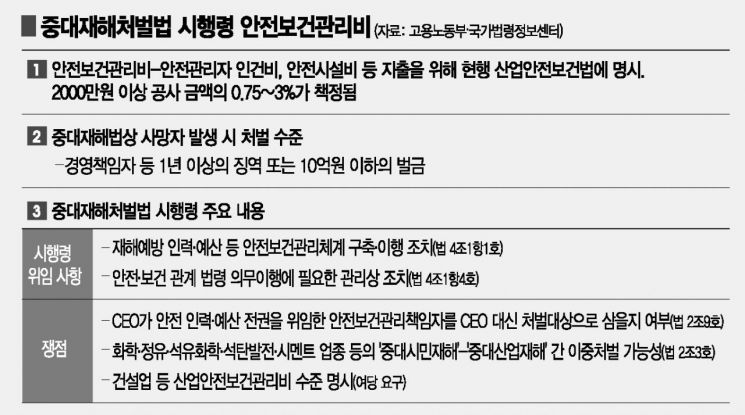
[Sejong=Asia Economy Reporter Moon Chaeseok] It has been confirmed that the ruling Democratic Party, which is pushing forward the Serious Accident Punishment Act starting next year, has requested the government to add a clause on Industrial Safety and Health Management Expenses (San-an-bi) to the enforcement decree of the related law. San-an-bi refers to a portion of construction costs allocated for safety expenses, as stipulated in the Industrial Safety and Health Act. Nevertheless, the ruling party has urged the government to include similar provisions in the enforcement decree of the Serious Accident Punishment Act. From the corporate perspective, this means they face not only increased penalties due to the enforcement of the Serious Accident Punishment Act but also additional cost burdens. The government has expressed reluctance, indicating that even if adopted, it would be difficult to apply to industries other than construction.
According to the government and the National Assembly on the 31st, Ahn Ho-young, the ruling party's senior member of the Environment and Labor Committee, recently demanded that San-an-bi be explicitly stated in the enforcement decree of the Serious Accident Punishment Act. A staff member from the lawmaker’s office said, "We requested clear expression regarding ambiguous parts related to the appropriate budgeting of San-an-bi," adding, "Since it was already mentioned during the confirmation hearing of Minister of Employment and Labor An Kyung-duk, the message to the government was to refer to the Industrial Safety and Health Act if necessary." The ruling party’s demand stems from the frequent industrial accidents at Pyeongtaek Port, Busan New Port, Hyundai Heavy Industries, and Hyundai Steel, prompting a need for a more proactive response. In particular, labor groups, which form the support base of the current government, have opposed this, making it politically significant ahead of next year’s presidential election.
However, the ruling party’s demand is likely to impose a burden on the business community. The business sector regards the discussion of applying San-an-bi regulations to the enforcement decree itself as a risk. If a regulation similar to the Industrial Safety and Health Act is separately established, it could act as a double regulation. Especially, small and medium-sized enterprises with 5 to 49 employees are concerned about increased management burdens. Large corporations have already complied smoothly with the Industrial Safety and Health Act’s notice that "for construction projects over 20 million KRW, up to 3% of the construction cost should be allocated as San-an-bi," but small and medium enterprises see this as a burden.
A business community official said, "If related regulations are added, it is unclear what criteria will be applied, such as sales, number of workers, or risk of industrial accidents." The Construction Industry Research Institute also suggested in a recent report that "since additional obligations for safety and health assurance by management are specified, the necessary safety management costs for companies, including construction firms, will inevitably increase," indicating that the cost burden is already significant.
The government is also showing reluctance. A Ministry of Employment and Labor official explained, "It is difficult to establish criteria for applying the Industrial Safety and Health Act across all industries other than construction," adding, "It is difficult to disclose details about the enforcement decree, but even if the San-an-bi regulation is reflected, it will not apply to industries other than construction."
Experts point out that simply increasing the penalty provisions of the Serious Accident Punishment Act will not achieve the primary goal of eradicating industrial accidents. Professor Geum Jae-ho of Korea University of Technology and Education said, "No matter how much the enforcement level of the Serious Accident Punishment Act increases, it will still be difficult for the primary contractors to manage all industrial accident cases nationwide uniformly," adding, "Since the Serious Accident Punishment Act only punishes when a serious accident occurs, small businesses might resort to superficial safety management practices or other loopholes due to concerns about increased labor costs." He further noted, "The scope of application of the Industrial Safety and Health Act is much broader, but the Serious Accident Punishment Act only increases penalties."
The government plans to approve the enforcement decree of the related law early next month, but the outlook has become uncertain. Issues such as whether the safety and health management officer, not the corporate CEO, could be punished in the event of a serious accident, and concerns about double regulation for some industries under both serious industrial accidents and serious citizen accidents, have emerged as key points.
Article 2, Paragraph 9 of the Serious Accident Punishment Act states, "Management personnel, etc., are persons who represent the business and have authority and responsibility for overall business management or persons responsible for safety and health tasks equivalent to them." The business community interprets this as referring to safety and health management officers under the current Industrial Safety and Health Act. In other words, they argue that it is acceptable for the person delegated by the CEO with budget and organizational authority over safety tasks to be punished instead.
Industries such as chemical, refining, petrochemical, coal power, and cement are on high alert due to the possibility of double regulation under both "serious citizen accidents" and "serious industrial accidents." They must prepare for budgets related to "construction materials, equipment, raw materials, gas, steam, dust, etc." (serious industrial accidents) and "defects in design, manufacture, installation, or management of specific raw materials or products, public facilities, or public transportation" (serious citizen accidents). A government official stated, "The serious citizen accident regulations apply to consumption and distribution processes, while industrial accident regulations apply to production processes, so this is not double regulation."
Meanwhile, the legislative notice for the enforcement decree of the Serious Accident Punishment Act is likely to be approved at the Cabinet meeting on the 8th of next month. The government was supposed to submit the draft to the ruling party by the 27th, but it has not yet been submitted as of the morning of that day, citing incompleteness. The enforcement decree is expected to be announced as per the government-party agreement, and the possibility of reflecting the business community’s requests is slim.
© The Asia Business Daily(www.asiae.co.kr). All rights reserved.
![Clutching a Stolen Dior Bag, Saying "I Hate Being Poor but Real"... The Grotesque Con of a "Human Knockoff" [Slate]](https://cwcontent.asiae.co.kr/asiaresize/183/2026021902243444107_1771435474.jpg)
















