Among 21 Nationwide Locations, 13 Have Unsold Units
In Gyeonggi and Incheon, 10 Out of 13 Locations... Over Half Have Competition Rates Below 0.1 to 1
Unpopular Small Units Mainly Supplied
Regional Disparities Widen... Demand Concentrates in Popular Areas Like Seoul and Sejong
[Asia Economy Reporter Ryu Tae-min] A supply bomb warning has been triggered in the officetel market. While popular areas continue to see high subscription competition rates and price increases as officetels gain popularity as alternatives to soaring house prices, large-scale unsold units are emerging in the outskirts of the metropolitan area. This trend contrasts with the historic low levels of unsold apartments due to rising house prices and preference for new apartments.
According to the Ministry of Land, Infrastructure and Transport and KB Management Research Institute as of the end of March, the number of unsold apartments nationwide stood at 15,270 units. This is the lowest level in 29 years and 2 months since January 1992 (13,028 units). It is about one-eleventh of the peak in March 2009 (165,641 units).
On the other hand, unsold officetel complexes are appearing in various locations. According to the Ministry of Land, Infrastructure and Transport’s subscription website on the same day, out of 21 officetel complexes launched nationwide this year, only 8 closed subscriptions without unsold units. The remaining 13 complexes (61.9%) had unsold units.
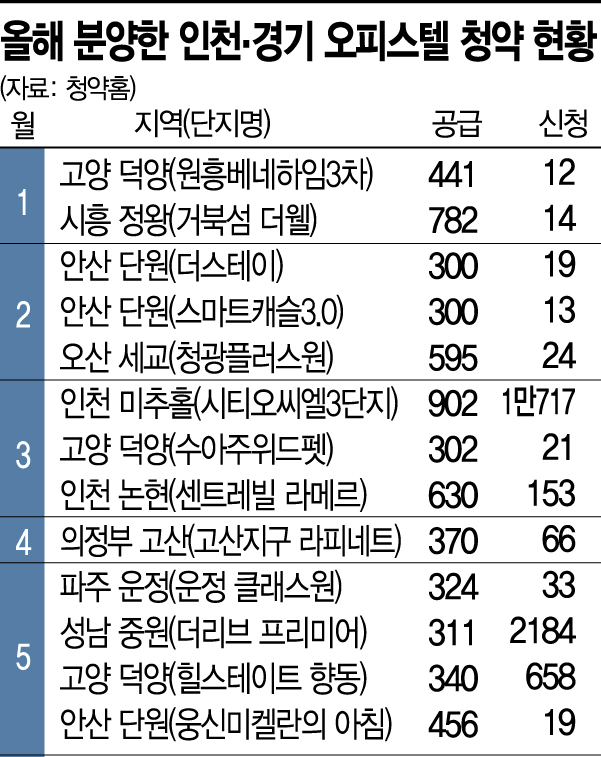
Officetel unsold units are appearing in many parts of Incheon and Gyeonggi Province. Of the 13 officetel complexes launched in Incheon and Gyeonggi this year, 10 had unsold units. Among them, 7 complexes recorded dismal competition rates below 0.1 to 1.
The unsold unit issue began with the first complex launched this year. In January, ‘Wonheung Beneheim 3rd Phase’ in Deogyang-gu, Goyang-si, Gyeonggi Province, had only 12 applications for 441 units. The following complex, ‘Geobukseom The Well,’ also recorded the lowest competition rate (0.02 to 1) with only 14 applications for 782 units.
Officetel unsold units have continued steadily until recently. On the 27th, ‘Woongshin Michelangelo Morning’ in Danwon-gu, Ansan-si, Gyeonggi Province, had only 19 applicants for 456 units, causing a large-scale shortfall.
So far this year, successful officetel launches in Gyeonggi and Incheon include only three complexes: ‘City OCELE 3rd Complex’ in Michuhol-gu, Incheon (11.88 to 1), ‘The Live Premier’ near Sujin Station in Jungwon-gu, Seongnam (7.02 to 1), and ‘Hillstate Hyangdong’ in Deogyang-gu, Goyang (1.94 to 1).
Demand Concentrated Only in Popular Areas like Seoul and Sejong
In contrast, highly popular areas such as Seoul and Sejong boast high competition rates, showing significant regional disparities. ‘Hillstate Janghan Central’ in Dongdaemun-gu, Seoul, recorded a peak competition rate of 23.96 to 1 with 1,325 applications for 369 units in the resident priority category alone. ‘Luca831’ in Yeoksam-dong, Gangnam-gu, attracted 4,092 applications for 337 units. In Sejong City, ‘Sejong Richensia Familier H3 Block Officetel’ received 5,233 applications for 87 units, and ‘Sejong Richensia Familier H2 Block Officetel’ had 1,478 applicants for 130 units.
Experts point to the recent sharp increase in supply as the background for this subscription polarization. According to Real Estate 114 statistics, the nationwide officetel move-in volume over the past three years increased significantly: 82,191 units in 2018, 93,258 units in 2019, and 83,623 units in 2020. Notably, the proportion of small units under 40㎡ approaches an average of 70%.
Lim Byung-chul, Senior Researcher at Real Estate 114, explained, "Market demand is concentrated on medium- to large-sized officetels considered alternatives to apartments, but supply has increased mainly in small-sized units, creating a gap. Due to the recent overall rise in real estate prices, many investors aiming for capital gains rather than rental income are concentrating demand in well-located areas."
© The Asia Business Daily(www.asiae.co.kr). All rights reserved.

















