Achieving Half of the 1 Million Household Supply Target by 2035
Solar Power Homes Supplied to 380,730 Households... Renewable Energy Production Effect of 165,281 TOE
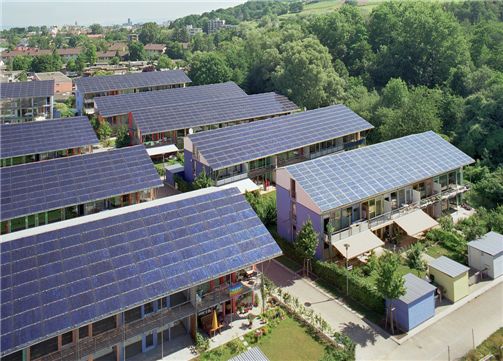 Solar-Powered House in Freiburg, Germany
[Sejong=Asia Economy Reporter Kwon Haeyoung] It has been revealed that 'Green Homes,' which allow the use of renewable energy such as solar and wind power at home, have been supplied to 420,000 households over the past 16 years. The government plans to expand Green Homes to 1 million households by 2035, having spent about 1 trillion won so far to achieve about half of the target.
According to the Ministry of Trade, Industry and Energy and the Korea Energy Agency on the 29th, the government provided subsidies totaling 929.715 billion won for renewable energy housing support projects to 426,009 households from 2004 to the end of 2019.
The government introduced the Green Home 1 million households project in 2009 to enable every household to use renewable energy. This expanded and reorganized the solar housing supply project of 100,000 households initiated in 2004, broadening the scope to include not only solar power but also solar heat, geothermal, fuel cells, wind power, and other renewable energy sources. The plan was to supply renewable energy to 1 million households out of a total of 12.5 million households (as of 2005) by 2035.
As a result of investing about 1 trillion won in subsidies, Green Homes have been supplied to a total of 426,009 households: 380,730 solar power households, 26,582 solar heat households, 15,236 geothermal households, and 2,761 fuel cell households. The renewable energy production effect is estimated to be about 165,281 TOE (unit of energy consumption; 1 TOE = 10 million kcal).
By region, Seoul had the highest installation rate at 21%, followed by Gyeonggi (14.5%), Gyeongnam (9.2%), and Chungnam (7.6%).
When installing residential solar power, subsidies can be received from the government and local governments, and electricity bills can also be reduced by using the electricity generated from solar power.
However, the number of households installing solar power has recently been decreasing. The number of residential solar power installations surged from 38,959 households in 2017 to 93,991 households in 2018 but dropped significantly to 35,848 households in 2020. The number of households giving up on residential solar power projects increased from 198 in 2017 to 1,150 in 2020. This is attributed to the intermittency problem of renewable energy, where power generation varies depending on weather and seasons, as well as difficulties in quality and management.
© The Asia Business Daily(www.asiae.co.kr). All rights reserved.
















