Elementary Student Dies After 13t Large Metal Coil Falls from Truck
Accidents Rise Despite Mandatory 'Cargo Load Detachment Prevention Standards' Including 12 Major Negligence Cases
Experts Urge Drivers to Follow Basic Duties and Authorities to Enforce Regulations
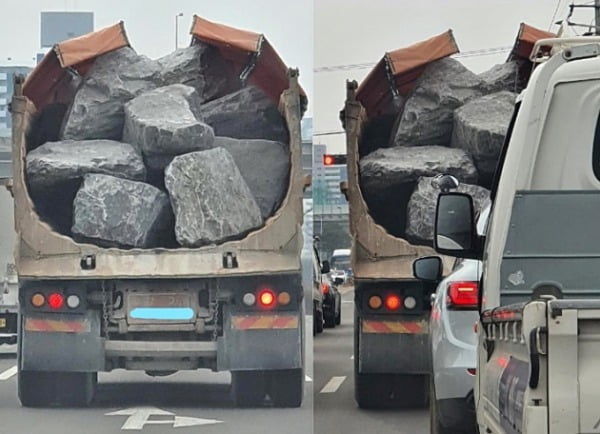 A dump truck is driving on the road without any separate safety devices such as straps or covers to secure the piled-up rocks. Photo by Online Community Capture
[Asia Economy Reporter Kim Choyoung] "It's terrifying, it feels like a major accident could happen at any moment...", "It's very unsettling to drive behind them."
Recently, as fatal accidents caused by falling cargo from trucks have occurred repeatedly, drivers' anxiety has been increasing. Last September, there was an incident where a vehicle occupant was seriously injured after a leaf spring flew through the windshield of a car driving on the highway.
The government has announced measures to strengthen crackdowns on trucks with improperly loaded cargo, but there are criticisms that these are not fundamental solutions. Experts emphasize the need for drivers to comply with basic duties and for authorities to conduct thorough enforcement.
According to the Korea Expressway Corporation's "Falling Object Collection Cases and Accident Status," the total number of falling object collection cases over the past five years was 1,271,660, averaging about 254,000 cases annually. The number of accidents caused by falling objects totaled 206 in the past five years, resulting in 17 casualties. The number of detected cases of improper loading, identified as a major cause of falling object accidents, increased by 11% from 72,120 cases in 2016 to 80,352 cases in 2019 over three years.
As the seriousness of improperly loaded trucks has come to the forefront, since 2017, "violation of cargo securing measures" has been included among the 12 major traffic violations under the Special Act on Traffic Accident Handling, alongside "signal violations" and "crossing the center line," as part of efforts to prevent accidents, but accidents have not significantly decreased.
In December last year, a man's leg was severed by a steel structure that fell from a trailer while he was standing at a nearby crosswalk, and in mid-this month, a steel coil fell from a truck, causing the death of an 8-year-old child.
The current Freight Vehicle Transportation Business Act stipulates that transport operators must take necessary measures such as covers, packaging, and securing devices according to standards and methods prescribed by the Ministry of Land, Infrastructure and Transport to prevent loaded cargo from falling. According to the "Cargo Load Detachment Prevention Standards" mandated by the Ministry since 2018, transport operators must install a "closed-type cargo box" with sufficient performance to prevent cargo detachment or use covers, packaging, and securing devices when transporting cargo.
Typical cases of improper loading include "open cargo boxes and uncovered loads" where cargo is transported without securing devices such as covers or packaging, "poorly tied cargo" where loads are not firmly tied, and "overloading" where cargo exceeds the loading standard amount.
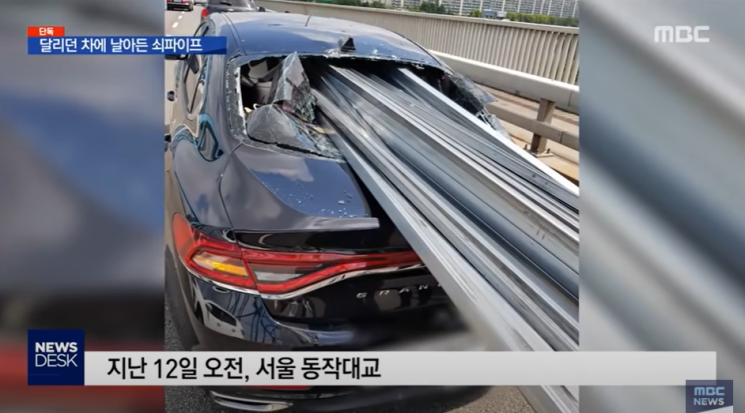 Unsecured steel pipes struck a passenger car, shattering the rear window into pieces and penetrating through to the front windshield. Photo by MBC News Screen Capture
Recently, cases have been found where leaf springs, a type of buffer device installed under vehicles to absorb shocks from the road surface, are used as side supports on trucks to carry more cargo. After a series of accidents occurred where unsecured leaf springs struck surrounding vehicles during driving, the Ministry of Land, Infrastructure and Transport revised safety standard guidelines in October last year to require tuning approval and safety inspections to ensure leaf springs used as auxiliary supports are fixed to the vehicle. However, there are ongoing criticisms that it is difficult to detect unauthorized use, reducing the effectiveness of these measures.
Given the situation, some voices call for strengthening penalties to raise awareness. Under the current Road Traffic Act, penalties for simple improper loading are limited to a fine of 50,000 KRW and 15 penalty points. In cases where accidents occur, penalties can include imprisonment of up to five years or fines up to 20 million KRW, but actual sentences mostly range from one to two years.
In September last year, Jang Kyung-tae, a member of the National Assembly's Land, Infrastructure and Transport Committee from the Democratic Party, stated, "The improper loading crackdown system, which currently relies on reports and guidance, needs to be reorganized, and measures such as boxing freight vehicles should be promoted to fundamentally prevent cargo from falling," adding, "It is also necessary to strengthen penalties, which are currently at the level of 40,000 to 50,000 KRW fines."
Meanwhile, the Korea Expressway Corporation announced in April that it plans to install and operate an AI-based automatic improper loading detection system at five additional service areas in the metropolitan area this year to strengthen crackdowns on improperly loaded vehicles. This system uses AI video analysis technology to capture and analyze the rear of cargo boxes on trucks entering highways and automatically identifies suspected improperly loaded vehicles in real time. Since its pilot operation on 14 lanes at three service areas from November last year, the workload has decreased by about 85% compared to the existing CCTV analysis method, and the number of crackdowns has increased 4.7 times.
Experts emphasize drivers' compliance with basic duties and thorough enforcement by authorities. Lawyer Jung Kyung-il explained in an interview with YTN's "Wise Radio Life," "If drivers adhere well to the two most basic duties?keeping their eyes on the road ahead and maintaining a safe distance?they can prevent many falling object accidents." He added, "If fines are used to cover personnel and costs, and road management authorities are given enforcement authority to conduct thorough crackdowns, it would greatly help prevent accidents."
© The Asia Business Daily(www.asiae.co.kr). All rights reserved.