Five Confirmed Candidates for People Power Party Leadership Primary
General Public Opinion to Account for 30% in Primary
Attention on Whether 'Lee Jun-seok Wave' Will Continue
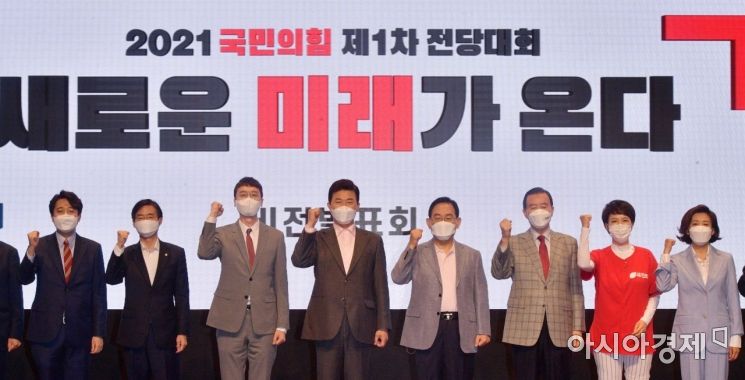 On the 25th, the People Power Party's first party convention vision presentation was held at Nurikkum Square in Mapo-gu, Seoul. Candidates Lee Jun-seok (second from the left), Cho Kyung-tae, Kim Woong, Yoon Young-seok, Joo Ho-young, Hong Moon-pyo, Kim Eun-hye, and Na Kyung-won, who are running for party leader, are shouting "Fighting." Photo by Yoon Dong-joo doso7@
[Asia Economy reporters Naju-seok and Geum Bo-ryeong] In the People Power Party leadership election, former Future United Party Supreme Council member Lee Jun-seok passed the cutoff in first place. Including former Supreme Council member Lee, former lawmaker Na Kyung-won, and lawmakers Joo Ho-young, Cho Kyung-tae, and Hong Moon-pyo, a total of five candidates advanced to the main election. The 'Lee Jun-seok whirlwind' was confirmed in reality, but the elimination of first-term lawmakers such as Kim Woong and Kim Eun-hye also confirmed that party sentiment leaned toward senior members.
The People Power Party Election Commission announced the results of the party member vote and public opinion poll conducted on the 26th and 27th on the morning of the 28th. The cutoff, which narrowed the candidates for party leader from eight to five, saw not only the big three?former Supreme Council member Lee, former lawmaker Na, and lawmaker Joo?who were initially expected to advance to the finals, but also lawmakers Hong and Cho pass the cutoff. Three-term lawmaker Yoon Young-seok and first-term lawmakers Kim Woong and Kim Eun-hye tasted defeat.
Initially, the Election Commission decided not to disclose the ranking of each candidate, but according to party insiders, former Supreme Council member Lee took first place, followed by former lawmaker Na, lawmaker Joo, lawmaker Hong, and lawmaker Cho. Immediately after the announcement, former Supreme Council member Lee wrote on social media (SNS), "I will compete until the end with vision and future without negativity." In a phone interview with Asia Economy, he said, "I came down to Daegu for a two-week schedule (for election campaigning), but after working there, many party members and citizens told me that Daegu is enough and that I should do big politics elsewhere," adding, "I will prepare to create a wind in other regions as well."
Meanwhile, a notable point in this preliminary election result is that the public opinion poll, i.e., the popular sentiment, ranked former Supreme Council member Lee first, whereas the party member survey (party sentiment) placed former lawmaker Na in first place. Unlike the preliminary election, which reflected public opinion and party member votes each at 50%, the main election will increase the party sentiment reflection rate to 70%. The fact that lawmakers Cho Kyung-tae and Hong Moon-pyo, who have strong regional bases, passed the cutoff can be interpreted as the power of 'organizational votes,' suggesting that the dynamics may change in the main election.
Accordingly, the candidates who passed the cutoff are expected to practically reside in Daegu and Gyeongbuk (TK), where the party member proportion is highest, to target regional public sentiment. Indeed, the power of regional base organizations was still evident in this preliminary election. Although a first-term lawmaker whirlwind was openly discussed, when the lid was actually opened, lawmaker Hong, representing the Chungcheong region, and lawmaker Cho, who has a considerable organizational base in Busan, Ulsan, and Gyeongnam (PK), passed the cutoff.
The fact that the first-term lawmaker whirlwind ultimately converged into the 'Lee Jun-seok whirlwind' is also noteworthy. Lawmaker Kim Woong received extraordinary public attention by ranking second in the public opinion poll before entering the race. However, as support for former Supreme Council member Lee strengthened, the momentum of lawmakers Kim Woong and Kim Eun-hye somewhat waned. Despite their denials, the three, classified as the new generation group, were persistently suggested to possibly unify. Although there were significant policy disagreements such as on the quota system, since the election itself unfolded as a contest between senior and new generation members, the likelihood of practical unification increased.
© The Asia Business Daily(www.asiae.co.kr). All rights reserved.
![Clutching a Stolen Dior Bag, Saying "I Hate Being Poor but Real"... The Grotesque Con of a "Human Knockoff" [Slate]](https://cwcontent.asiae.co.kr/asiaresize/183/2026021902243444107_1771435474.jpg)















