Bank of Korea Raises Growth Forecast Sharply to 4%
Interest Rate Held Steady at 0.5%...Experts Weigh Possibility of Increase Within the Year
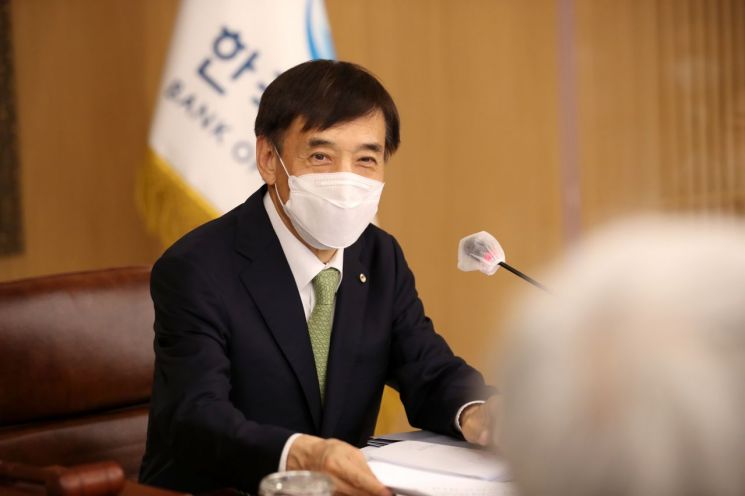 On the morning of the 27th, Lee Ju-yeol, Governor of the Bank of Korea, is presiding over the Monetary Policy Committee meeting held at the Bank of Korea in Jung-gu, Seoul.
[Asia Economy Reporter Kim Eun-byeol] On the 27th, Lee Ju-yeol, Governor of the Bank of Korea, stated regarding the necessity of raising the base interest rate, "We should not rush too much, but at the same time, we must not miss the timing (of the hike)."
Governor Lee made these remarks at a press conference immediately after the Monetary Policy Committee (MPC) meeting, saying, "Whether the base interest rate will be raised within the year depends on how the economic situation unfolds." He also added, "It is true that there was a lot of discussion about this at today's MPC meeting."
On the same day, the Bank of Korea revised its economic growth forecast for this year upward by 1.0 percentage point from 3.0% to 4.0% in just three months. The inflation forecast for this year was also raised from 1.3% to 1.8%. This reflects the expectation that the domestic economic recovery will be strengthened by favorable exports, investment, and improved private consumption.
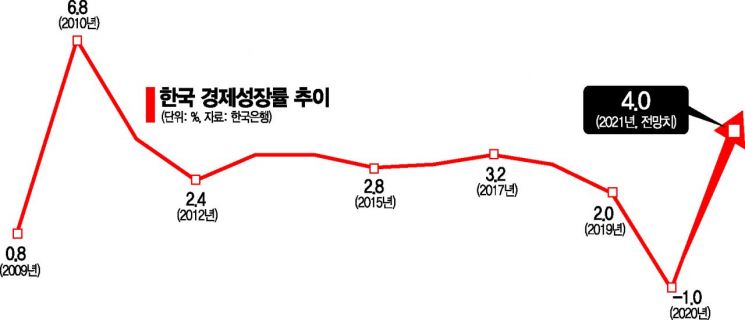
As the growth and inflation forecasts have been raised, the possibility of an interest rate hike within the year has also increased. Professor Ahn Dong-hyun of Seoul National University’s Department of Economics said, "Lockdowns in the US and Europe have almost been lifted, and herd immunity is becoming visible," adding, "The US economy is recovering rapidly centered on consumption, which could lead to increased exports from Korea and make 4% growth possible." He continued, "The US is likely to attempt tapering (reducing bond purchases) before raising interest rates this year, but there is a high possibility that we will raise rates first," and "The timing of the hike could be moved forward to the third quarter." Professor Lee In-ho of Seoul National University’s Department of Economics also predicted a 0.25 percentage point rate hike in the second half of the year and said, "If vaccine incentives are introduced, domestic demand could be further stimulated."
Governor Lee responded, "I expect such opinions to be sufficiently present," and said, "We eased monetary policy to an exceptional degree to prepare for the possibility of an economic downturn due to COVID-19, and if the economic situation improves, it is natural to appropriately adjust this exceptional situation."
He added, "We must prevent the accumulation of financial imbalances," and said, "It is true that we face the difficulty of not rushing at the appropriate time but also not being late." As of the end of the first quarter, household debt in Korea reached a record high of 1,765 trillion won. The rapid increase has led to calls for managing household debt through interest rate hikes, but raising rates too quickly could stall the recovering economy, a concern that Governor Lee also expressed.
The MPC members of the Bank of Korea stated in the monetary policy direction statement, "We will maintain an accommodative monetary policy stance, but during this process, we will carefully monitor the economic conditions of major countries and pay closer attention to the accumulation of financial imbalances such as capital inflows into asset markets and the increase in household debt."
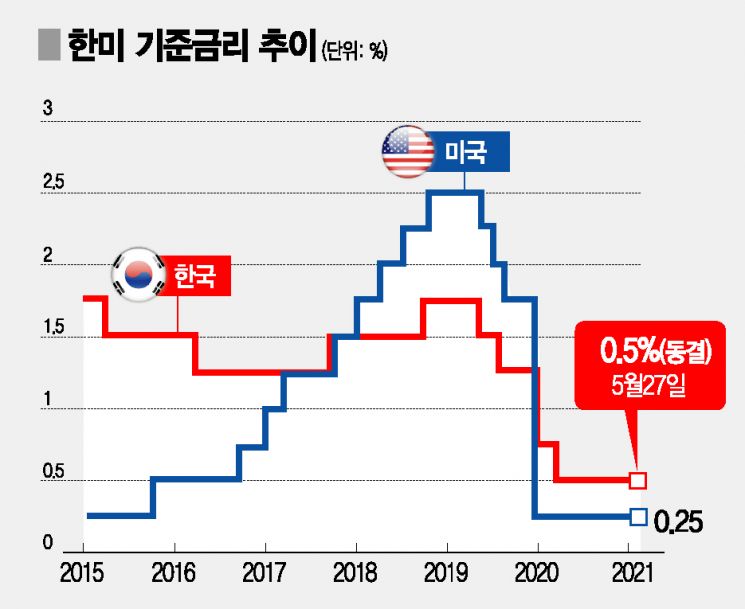
Experts argue that considering household debt, it is better to start raising interest rates early and increase them gradually. Korea has often waited until the US raised rates after a crisis and then followed belatedly. However, this time, with household debt at an all-time high, a different approach is needed. If rates are raised sharply after a delay, the interest burden could become too heavy, causing money to flow out of risky assets, resulting in a 'reverse money move.'
There are forecasts that a sharp rate hike could severely impact the real estate market. Household debt in Korea has a high proportion of mortgage loans, and 70% of these are variable-rate loans. If interest burdens become excessively high due to rate hikes, selling pressure could increase, causing housing prices to plummet. In the late 1980s, Japan raised rates belatedly, which burst a massive real estate bubble and led to a decade-long recession. The three Nordic countries also experienced financial crises after missing the timing of rate hikes.
Professor Kim Jin-il of Korea University’s Department of Economics said, "(The market shock) depends on how quickly rates are raised," and added, "Some experts argue that it is better to signal as soon as possible and then raise rates slowly." Professor Kim So-young also said, "If rates are raised too late, they must be raised sharply, which cannot avoid market shocks."
Meanwhile, Governor Lee explained that the growth forecast assumes that vaccine inoculation progresses faster than expected and that the sentiment of economic agents improves, leading to a rapid normalization of the economy. He said, "We also considered scenarios where additional economic stimulus measures are implemented, and since domestic consumption recovery is expected to accelerate, growth could be much higher than the baseline forecast in such situations."
© The Asia Business Daily(www.asiae.co.kr). All rights reserved.
![Clutching a Stolen Dior Bag, Saying "I Hate Being Poor but Real"... The Grotesque Con of a "Human Knockoff" [Slate]](https://cwcontent.asiae.co.kr/asiaresize/183/2026021902243444107_1771435474.jpg)


















