Chemical Research Institute "7.4% Reduction Possible in Total Petrochemical Industry CO2 Emissions"
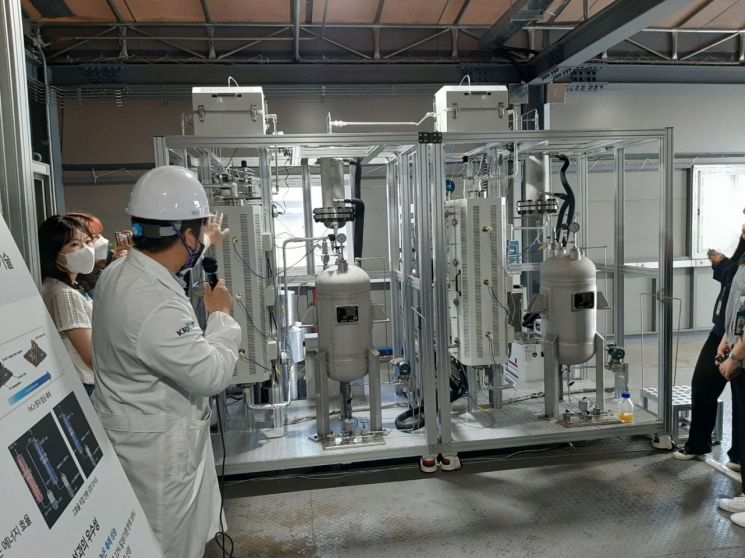 On the 25th, at the Korea Research Institute of Chemical Technology in Daejeon, a researcher explained the technology that converts carbon dioxide into naphtha during a carbon neutrality technology briefing.
[Asia Economy Reporter Kim Bong-su] Carbon dioxide (CO2) is widely recognized as the primary culprit of global warming. Although research worldwide is underway to capture CO2 and convert it into various chemical raw materials, the technology still faces challenges such as low efficiency and high costs, making economic viability a distant goal. However, a domestic research team has developed a high-efficiency, low-cost technology that can convert carbon dioxide into naphtha, a raw material for petrochemicals.
On the morning of the 25th, at the Korea Research Institute of Chemical Technology in the Daedeok Research and Development Complex in Daejeon, a carbon neutrality technology briefing was held. When a researcher unlocked a valve on a test facility pipe, a yellow substance flowed out. This was naphtha produced by capturing by-product gas from a steel mill and utilizing the carbon dioxide contained within it. Kim Seok-ki, a senior researcher at the institute present at the site, explained, "This is a win-win technology that can significantly reduce carbon dioxide emissions while producing high-quality naphtha that normally requires petroleum refining."
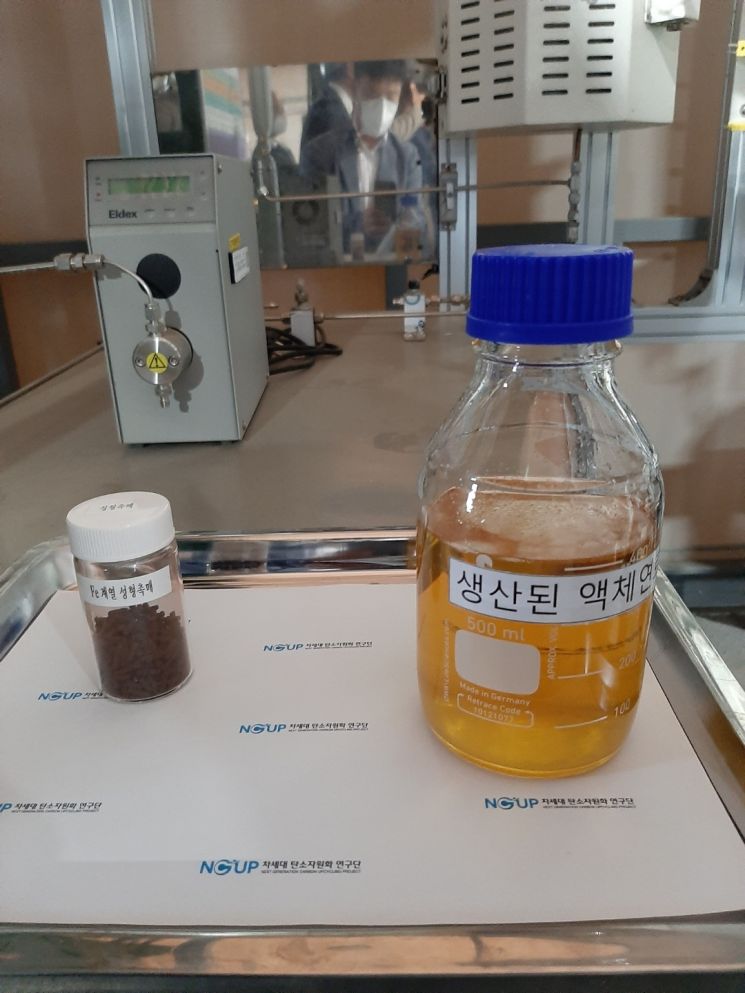 Naphtha produced using carbon dioxide conversion technology developed by the Korea Research Institute of Chemical Technology.
Naphtha is a petrochemical raw material used in South Korea for producing clothing, textiles, plastics, gasoline, and more, with an annual consumption exceeding approximately 54 million tons. The refining process for this material generates about 61 million tons of greenhouse gases. In other words, if this technology is fully commercialized, it could drastically reduce greenhouse gas emissions from petroleum refining while enabling naphtha production without petroleum. Notably, naphtha remains an essential basic chemical raw material even in achieving carbon neutrality.
The research team improved upon the conventional indirect conversion method, which requires high temperatures above 800°C, by developing a process that directly converts carbon dioxide into naphtha at a lower temperature of 300°C. They addressed previous challenges such as low CO2 conversion efficiency and the excessive generation of by-products like carbon monoxide and methane, which hindered commercialization. The key breakthrough was developing a catalyst by alloying cobalt with iron at the atomic level, significantly enhancing performance. This high-performance catalyst facilitates reactions at low temperatures while minimizing by-product formation. As a result, the naphtha yield exceeded 22%, an improvement of more than 37% compared to the existing direct conversion technology (around 16%).
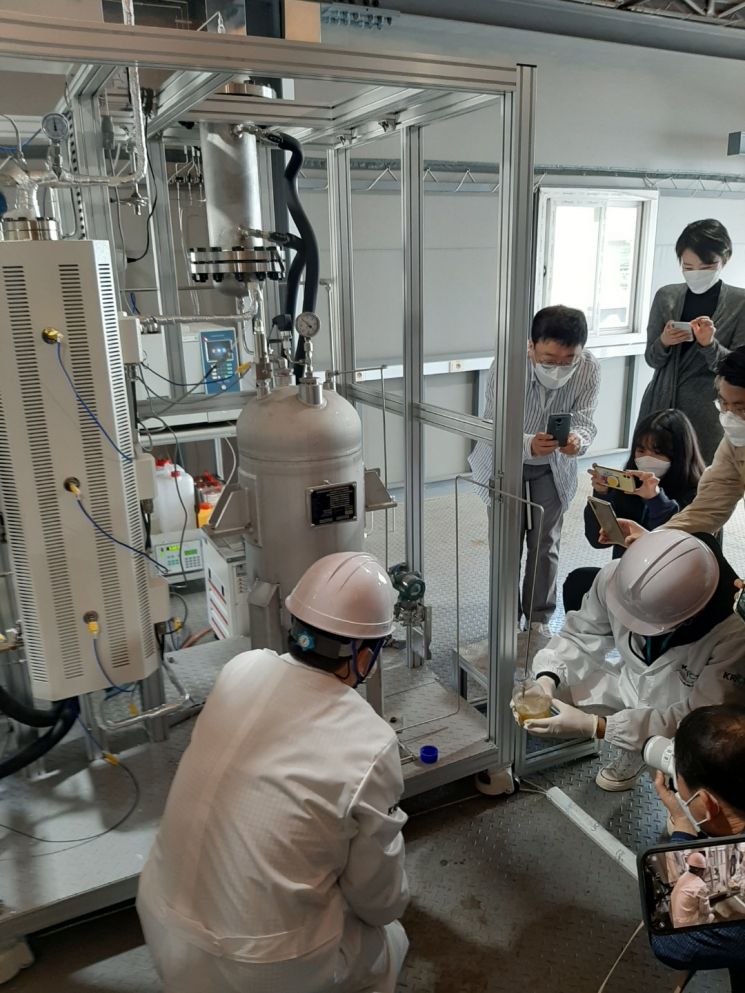 On the 25th, officials from the Korea Research Institute of Chemical Technology are showing naphtha produced by converting carbon dioxide, displayed in bottles.
Assuming that 10% of the surplus power from the 63.8 gigawatts (GW) of renewable energy generation capacity targeted for 2030 is utilized, this technology could reduce carbon dioxide emissions by 4.53 million tons annually and produce 2.54 million tons of naphtha. This corresponds to about a 7.4% reduction in total greenhouse gas emissions from the petrochemical industry.
Senior Researcher Jeon Gi-won stated, "Based on this newly developed core technology, further research will be conducted to improve conversion efficiency and economic feasibility. We will also collaborate with demand-side companies to scale up the process to pilot plant size." The research findings were published in the February issue of 'ACS Catalysis' (IF: 12.350), an international journal specializing in catalysis.
© The Asia Business Daily(www.asiae.co.kr). All rights reserved.



















