Stalled Anti-Discrimination Law: Citizens Take Initiative
"We Can't Just Stand By" "Stop Neglecting Duties, National Assembly"
Dong-A Pharmaceutical Hiring Discrimination Victim Speaks Out as Petitioner
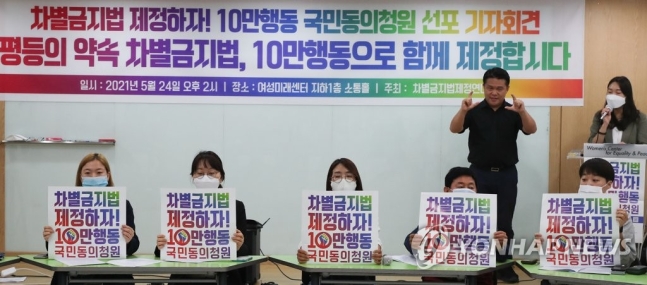 The 'Coalition for the Enactment of the Anti-Discrimination Act,' consisting of 151 civic groups nationwide demanding the enactment of the Anti-Discrimination Act, held a press conference on the 24th to announce the '100,000 Action National Consent Petition.' Photo by Yonhap News
They are launching the '100,000 Action for the Enactment of the Anti-Discrimination Act.'
[Asia Economy Reporter Kang Joo-hee] It has been nearly a year since the 'Anti-Discrimination Act,' which guarantees the basic rights of social minorities, was proposed, but as discussions in the National Assembly remain sluggish, voices of criticism from citizens are growing louder.
The 'Coalition for the Enactment of the Anti-Discrimination Act,' composed of 151 civic groups nationwide, held a press conference on the 24th to announce the launch of the '100,000 National Consent Petition Campaign' for the enactment of the Anti-Discrimination Act. In particular, attention is focused on whether the enactment of the Anti-Discrimination Act will accelerate as victim A, who revealed that she was asked gender-discriminatory questions during a recruitment interview at Dong-A Pharmaceutical last year, personally became a petitioner for the national consent petition.
Civil society emphasized that the National Assembly should no longer delay the enactment of the Anti-Discrimination Act under the pretext of 'social consensus.'
A registered the national consent petition for the enactment of the Anti-Discrimination Act on the day and became the first signatory. A revealed that she was asked gender-discriminatory questions during the Dong-A Pharmaceutical second half new employee recruitment held on November 16 last year and demanded an official apology from Dong-A Pharmaceutical.
The National Assembly's national consent petition system was introduced in January last year. Petitions that receive the consent of 100,000 people within 30 days are referred to the relevant standing committee of the National Assembly for review without the need for a member of the National Assembly to propose them.
In the petition, A said, "I have lived most of my 25 years as part of the privileged class. I was born to affluent Korean parents, lived in Seoul and abroad, and graduated from a four-year university in Seoul. I am a heterosexual, non-disabled, full-time employee." She added, "But six months ago, all this power crumbled helplessly simply because of my gender. Since all power is relative, I realized that I too can become a weak, excluded, and hated target at any time."
She continued, "Whenever discussions about the Anti-Discrimination Act begin, the National Assembly always repeats that 'social consensus is necessary.' This is wrong," and criticized, "It is not that the public cannot keep up with the National Assembly's awareness, but that the National Assembly does not follow the public's awareness. This is a clear dereliction of duty." She emphasized, "The National Assembly, which took away 'normalcy' from me and us, must stop neglecting its duties and respond now. It can no longer be delayed. The Anti-Discrimination Act is needed right now."
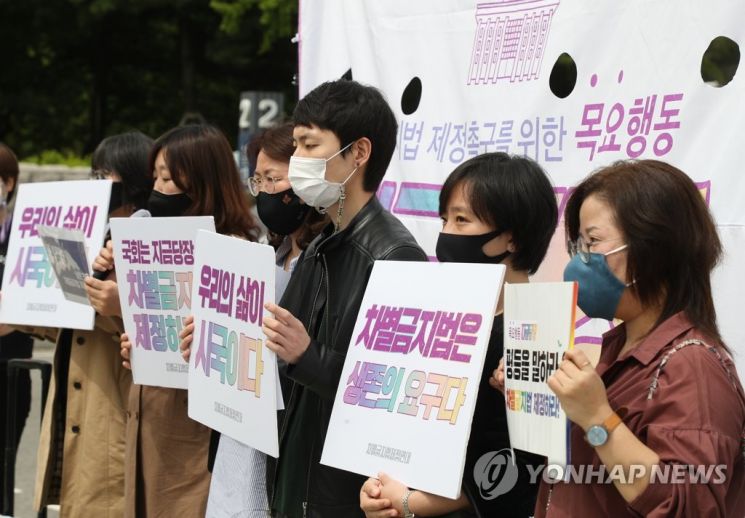 Citizens are attending the Thursday Action urging the enactment of the Anti-Discrimination Act held in front of the National Assembly in Yeouido, Seoul, on the 6th, calling for the bill's enactment. Photo by Yonhap News
The Anti-Discrimination Act was primarily proposed by Justice Party lawmaker Jang Hye-young in June last year. It stipulates that discrimination without reasonable grounds based on 23 categories including gender, disability, age, language, country of origin, ethnicity, sexual orientation, and gender identity should not occur in all areas of political, economic, social, and cultural life.
Regarding anti-discrimination, current laws such as the Act on the Prohibition of Discrimination against Persons with Disabilities and the Framework Act on Gender Equality exist as individual laws in specific fields, which limits their ability to accurately remedy various forms of discrimination occurring in daily life. Therefore, the Anti-Discrimination Act aims to clearly specify the categories of discrimination and realize substantive equality for the people.
However, even as it approaches one year since the Anti-Discrimination Act was proposed, the ruling Democratic Party and the main opposition People Power Party have shown a passive attitude toward discussions on the related law. The Anti-Discrimination Act is currently pending in the Legislation and Judiciary Committee, the relevant standing committee. This appears to be due to opposition from some Christian groups regarding the inclusion of sexual minorities in the discrimination categories.
On the other hand, there are public opinion survey results showing that the majority of the public supports the enactment of the Anti-Discrimination Act. In a national awareness survey conducted by the National Human Rights Commission last April with 1,000 adults nationwide, 9 out of 10 respondents (88.5%) answered that they support the legislation of the Anti-Discrimination Act.
Additionally, some segments of Protestantism and Catholicism are also showing movements in favor of the enactment of the Anti-Discrimination Act. Four Christian organizations, including the Catholic Human Rights Committee, held a press conference on the 20th in front of the National Assembly during the 6th Thursday Action 'Right Now' to urge the enactment of the law. This is why criticism arises that the National Assembly is ignoring citizens' demands and shirking responsibility.
Christian believers emphasized, "Even after the year has changed, efforts at the National Assembly level to enact the law remain sluggish, and the suffering of those who endure discrimination and hatred continues," and "We once again appeal for the enactment of the Anti-Discrimination Act for all Christians who empathize with and stand in solidarity with those who suffer."
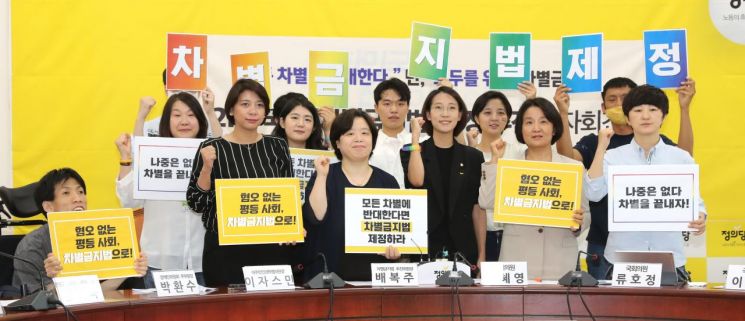 In June last year, at the Justice Party's '21st National Assembly Anti-Discrimination Act Enactment Urging Press Conference' held at the National Assembly in Yeouido, Seoul, Assembly member Jang Hye-young (fifth from the right) and other attendees are holding placards. Photo by Yonhap News
The Coalition for the Enactment of the Anti-Discrimination Act repeatedly urged the National Assembly to take responsible attitudes toward the enactment of the law.
Lee Jong-gul, co-representative of the Coalition for the Enactment of the Anti-Discrimination Act, said at a press conference on the 24th, "In the fourth year of the Moon Jae-in administration, which claimed to inherit the spirit of the Candlelight Protests, and the 21st National Assembly, which is approaching its first anniversary, there is no responsible discussion on the Anti-Discrimination Act at all," and pointed out, "Is it because they do not understand the seriousness of hatred and discrimination? Or because they do not know why discrimination must be prohibited?"
He continued, "The reason citizens act directly is that they can no longer just watch the government and National Assembly evade responsibility," and raised his voice, "At a time when inequality is worsening day by day due to COVID-19, are they trying to give up on equality altogether? The Democratic Party, as the ruling party, cannot escape responsibility in a situation where hatred and discrimination harm democracy."
© The Asia Business Daily(www.asiae.co.kr). All rights reserved.



















