Service in Seoul's Northwest 3 Districts (Seodaemun, Mapo, Eunpyeong) from Midnight May 27... May 26, 2 PM Yonsei Medical Center Declaration Ceremony... Securing Golden Time with Optimal Treatment Preparation Before Arrival of Severe Emergency Patients
[Asia Economy Reporter Jong-il Park] Seodaemun-gu (Mayor Moon Seok-jin) announced that starting from midnight on the 27th, the Ministry of Science and ICT and the National IT Industry Promotion Agency will launch emergency medical services based on 5th generation communication (5G) and artificial intelligence (AI) in the northwest three districts of Seoul (Seodaemun, Mapo, Eunpyeong).
At 2 p.m. on the 26th, the day before the launch, a proclamation ceremony will be held at Yonsei Medical Center, which led the system development, with officials from related organizations participating to pledge smooth service provision.
This service will be implemented on a limited basis in the northwest three districts of Seoul?Seodaemun-gu, Mapo-gu, Eunpyeong-gu?and Goyang City, which were selected as pilot areas. Through demonstration until December this year, the system will be advanced and its effectiveness verified for nationwide expansion.
The consortium for the “AI-based Intelligent Emergency Medical System Development Project” includes the northwest three districts of Seoul (Seodaemun, Mapo, Eunpyeong), the development project team Yonsei Medical Center, five emergency medical institutions (Yonsei University Severance Hospital, Dongshin Medical Foundation Dongshin Hospital, Eunpyeong Cheonggu Seongsim Hospital, Eunpyeong St. Mary’s Hospital, Seran Hospital), and three fire stations involved in the demonstration (Seodaemun Fire Station, Mapo Fire Station, Eunpyeong Fire Station).
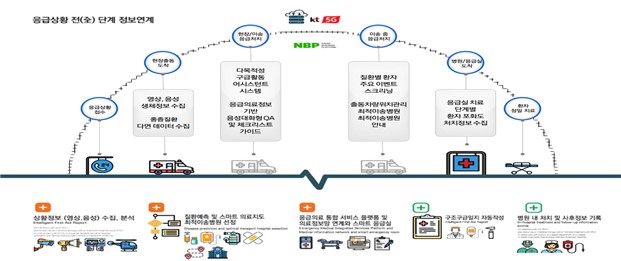
The intelligent emergency medical service is a system developed to transmit various information of emergency patients (voice, video, vital signs) from inside the ambulance via the 5G network, analyze this data on an integrated platform, and guide the patient to the hospital most suitable for their severity and symptom-specific treatment.
This system provides ambulance paramedics with standard emergency treatment methods and optimal hospital transfer routes, supporting automatic creation of ambulance activity logs.
It also supports emergency room medical staff by transmitting real-time situations inside the ambulance, enabling optimal treatment preparation before the emergency patient arrives.
Based on 2018 data, among patients transferred to regional and local emergency medical centers, 20.2% of severe trauma patients, 36.1% of acute myocardial infarction patients, and 27.5% of stroke patients were moved from the first-arrival hospital to another hospital.
The intelligent emergency medical service to be implemented this time is expected to significantly improve the problem of severe emergency patients not being directly transported to the appropriate treatment hospital during the ambulance stage, thus preventing the loss of the golden time.
This project is a government initiative investing 18 billion KRW over three years (2019?2021) to design and develop core technologies and begin demonstrations. The Ministry of Science and ICT, Ministry of Health and Welfare, and National Fire Agency have cooperated to establish a rapid and consistent management system from emergency patient occurrence to treatment.
Mayor Moon Seok-jin said, “I expect Seodaemun-gu to establish itself as a leading region in South Korea’s emergency medical policy by introducing an AI-based emergency medical system that provides the most appropriate emergency medical services to all residents without discrimination.”
© The Asia Business Daily(www.asiae.co.kr). All rights reserved.
![Clutching a Stolen Dior Bag, Saying "I Hate Being Poor but Real"... The Grotesque Con of a "Human Knockoff" [Slate]](https://cwcontent.asiae.co.kr/asiaresize/183/2026021902243444107_1771435474.jpg)















