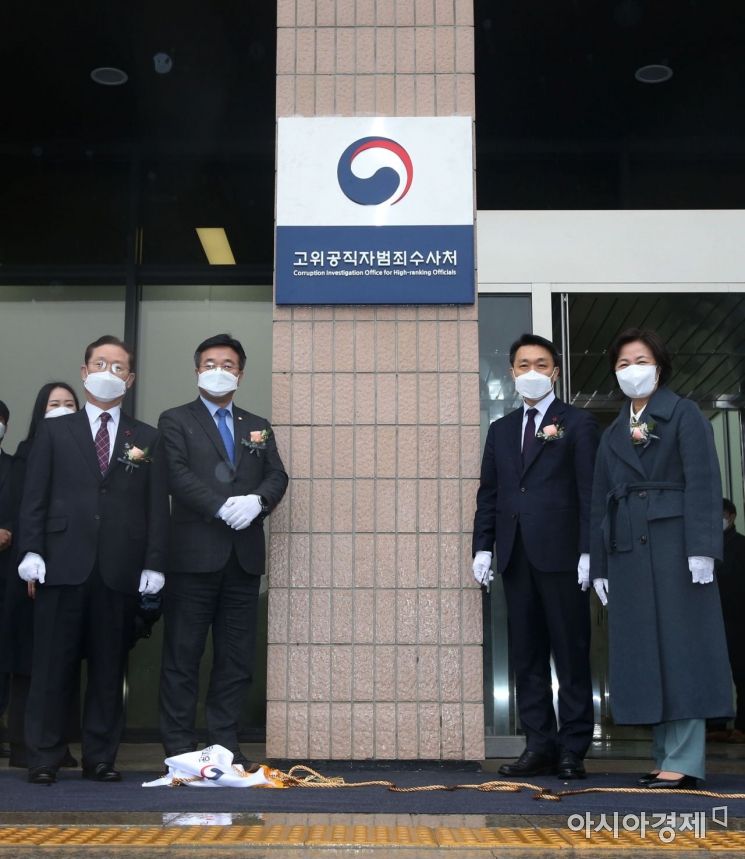
 On January 21st afternoon, at the Government Gwacheon Complex, Nam Gi-myeong, head of the Preparatory Group for the establishment of the Corruption Investigation Office for High-ranking Officials (CIO), Choo Mi-ae, Minister of Justice, Yoon Ho-jung, Chairman of the National Assembly Legislation and Judiciary Committee, and Kim Jin-wook, Chief of the CIO, unveiled the signboard at the signboard ceremony. Photo by Moon Ho-nam munonam@
[Asia Economy Reporter Choi Seok-jin] The conflict over the division of authority between the High-ranking Officials' Crime Investigation Office (Gong-su-cheo) and the prosecution, which began over the scope of case transfers, is intensifying due to the recently enacted and promulgated "Gong-su-cheo Case Handling Rules" (hereinafter referred to as the Case Handling Rules).
While this can be seen as an inevitable phenomenon arising during the institutional establishment of the newly created Gong-su-cheo, there are also criticisms that the Gong-su-cheo hastily included gaps created by the rapid passage of the law without sufficient consultation during the legislative process into the rules, thereby inviting controversy.
Both Gong-su-cheo and the prosecution publicly emphasize inter-agency cooperation, but in practice, there seems to be little chance of narrowing differences during working-level consultations. Therefore, until authoritative interpretations of the "Act on the Establishment and Operation of the High-ranking Officials' Crime Investigation Office" (Gong-su-cheo Act) or the Case Handling Rules, which are currently controversial in courts or the Constitutional Court, are issued or the law is amended, confusion is inevitable.
The most controversial provisions in the Case Handling Rules enacted and promulgated by Gong-su-cheo include: Article 14, Paragraph 3, Subparagraph 1, Item (b), and Article 25, Paragraph 2, which explicitly stipulate the "transfer with prosecution rights reserved," causing the greatest conflict with the prosecution; Article 25, Paragraph 3, which assumes that the police can apply for arrest warrants to Gong-su-cheo instead of the prosecution; and Articles 28, Paragraph 2, and 31, Paragraph 1, which state that Gong-su-cheo can transfer cases to the prosecution and make non-prosecution decisions for crimes where it only has investigative authority but not prosecution authority.
Prior to this, there is a significant difference in perspective between Gong-su-cheo and the prosecution regarding the legal nature of the "Gong-su-cheo Rules," specifically whether rules concerning citizens' rights and obligations or relations with other state agencies can be regulated by Gong-su-cheo rules.
Can Gong-su-cheo make 'non-prosecution decisions' on cases it cannot prosecute?
Article 28, Paragraph 2 of the Gong-su-cheo Case Handling Rules states, "In cases other than those specified in Article 3, Paragraph 1, Item 2 of the Act, if a non-prosecution decision is made after investigation of high-ranking officials' crimes, the related documents and evidence shall be attached to the case transfer form No. 21 and sent to a prosecutor belonging to the Seoul Central District Prosecutors' Office."
Also, Article 31, Paragraph 1 states, "When an investigative officer makes a prosecution request or a non-prosecution decision under Article 28, Paragraph 2, the prescribed matters shall be recorded in the case transfer register form No. 22, and confirmation must be obtained from the responsible staff of the Seoul Central District Prosecutors' Office for each case. However, if the case transfer register is printed in bulk by computer processing and confirmed, the entry in the register may be omitted." This clause is based on the non-prosecution decision in Article 28, Paragraph 2.
Looking at Article 28, the Gong-su-cheo Act Article 3, Paragraph 1, Item 2 stipulates that for high-ranking officials' crimes and related crimes committed by the Chief Justice of the Supreme Court, Supreme Court Justices, Prosecutor General, judges, prosecutors, and police officers of rank Superintendent or higher during their tenure or by their family members, Gong-su-cheo has both investigative and prosecution authority.
Therefore, Article 28, Paragraph 2 can be interpreted as allowing Gong-su-cheo to make non-prosecution decisions even for crimes where it does not have prosecution authority, excluding those crimes for which it does have prosecution authority.
Gong-su-cheo clarified this point in a summary explanation of the rules, stating, "When Gong-su-cheo concludes an investigation on cases where it does not have prosecution authority, it shall make a prosecution request or a non-prosecution decision (Article 28, Paragraph 1 of the rules) and transfer the case records to the prosecution, thereby clarifying the procedures for handling cases other than those specified in Article 3, Paragraph 1, Item 2 of the Act."
However, the problem is that the higher law, the Gong-su-cheo Act, does not contain provisions regulating such content, and it is difficult to see that Gong-su-cheo has such authority based on the interpretation of related provisions.
Article 26, Paragraph 1 of the Gong-su-cheo Act (Transfer of related documents and evidence by Gong-su-cheo prosecutors) states, "When a Gong-su-cheo prosecutor investigates cases other than those specified in Article 3, Paragraph 1, Item 2, he/she shall promptly transfer the related documents and evidence to a prosecutor belonging to the Seoul Central District Prosecutors' Office."
In other words, this is an obligation for Gong-su-cheo to hand over investigation records and related documents and evidence to the prosecution after completing investigations on cases where it only has investigative authority but no prosecution authority. It is naturally assumed that the prosecution receiving the records will decide whether to prosecute.
Gong-su-cheo cites Article 27 of the Gong-su-cheo Act (Transfer of related recognized cases), which states, "When the head of Gong-su-cheo makes a non-prosecution decision on high-ranking officials' crimes, he/she shall transfer related crime cases discovered during the investigation process to the Supreme Prosecutors' Office."
Although this suggests that the Gong-su-cheo head has the authority to make non-prosecution decisions under the higher law, it is difficult to interpret the provision as including all high-ranking officials' crimes beyond those for which Gong-su-cheo has prosecution authority under Article 3, Paragraph 1, Item 2 of the Gong-su-cheo Act. Rather, Article 27 is naturally interpreted as requiring Gong-su-cheo to transfer related crime cases discovered during the investigation to the Supreme Prosecutors' Office when making a non-prosecution decision on cases for which it has prosecution authority.
Moreover, based on legal common sense, it is reasonable to believe that Gong-su-cheo has the authority to make non-prosecution decisions on crimes it can prosecute. The claim that it cannot prosecute certain crimes but can make non-prosecution decisions is difficult to accept.
It is understandable that the prosecution opposes this.
The Supreme Prosecutors' Office stated, "There is no legal basis for Gong-su-cheo to make non-prosecution decisions on cases that must be transferred to the prosecution after investigation, and this may cause confusion among complainants and other parties involved."
Before the revised Criminal Procedure Act, which adjusted investigative authority between the police and prosecution, the police conducted investigations under the prosecution's supervision and then transferred cases to the prosecution with opinions on 'prosecution' or 'non-prosecution.' However, this was merely a report of investigation results by the police and did not have binding force to significantly influence the prosecutor's decision on prosecution.
However, the current content included in Gong-su-cheo's rules allows Gong-su-cheo to make 'non-prosecution decisions' when transferring cases it cannot prosecute to the prosecution under the Gong-su-cheo Act, seemingly binding the prosecution to such decisions, which has sparked controversy.
Regarding this situation, lawyer A said, "Fundamentally, the cause seems to be that the Gong-su-cheo Act was hastily enacted without including necessary content properly," but also pointed out, "Due to the difficult situation faced by Gong-su-cheo Chief Kim Jin-wook, such as the 'Emperor Escort' controversy involving Prosecutor General Lee Sung-yoon, he seems to be somewhat forcibly trying to fill the legal gaps with rules."
The nature of Gong-su-cheo rules... statutory ordinance? administrative rule?
The difference in positions between Gong-su-cheo and the prosecution regarding the Case Handling Rules stems from their opposing views on the legal nature of Gong-su-cheo rules.
Some rules are explicitly authorized by the Constitution, such as those of the Supreme Court, the Constitutional Court, and the National Election Commission. Typically, such rules are statutory ordinances that can regulate matters related to citizens' rights and obligations and have external legal effect.
Article 108 of the Constitution states, "The Supreme Court may establish rules concerning procedures in litigation, internal discipline, and administrative affairs within the scope not conflicting with laws." Article 113, Paragraph 2 states, "The Constitutional Court may establish rules concerning procedures in adjudication, internal discipline, and administrative affairs within the scope not conflicting with laws." Article 114, Paragraph 6 states, "The National Election Commission may establish rules concerning election management, national referendum management, or political party affairs within the scope of laws and may establish rules concerning internal discipline within the scope not conflicting with laws."
Among these, rules concerning internal discipline and administrative affairs are administrative rules, but rules concerning litigation procedures by the Supreme Court, adjudication procedures by the Constitutional Court, and election or referendum management by the National Election Commission are generally regarded as statutory ordinances with external binding force.
On the other hand, rules of institutions without constitutional rule-making authority generally regulate only internal administrative procedures and are recognized as administrative rules without external binding force.
In the case of the Board of Audit and Inspection, although it is a constitutional institution, there has been controversy because the Constitution does not directly grant rule-making authority, and it is stipulated in the Board of Audit and Inspection Act.
The Constitutional Court and the Supreme Court hold the view that even if the rules are in the form of administrative rules, if they concretely specify matters delegated by higher laws or necessary details for implementing laws, they have the effect of statutory ordinances with external binding force as 'supplementary administrative rules' combined with higher laws.
Gong-su-cheo claims that its rules have the effect equivalent to presidential decrees.
Originally, the Baek Hye-ryun bill, which formed the basis of the Gong-su-cheo Act, stipulated that matters necessary for the organization and operation of Gong-su-cheo be determined by "presidential decree," but during the National Assembly discussions, to guarantee the institutional independence of Gong-su-cheo, it was revised and approved to be determined by "Gong-su-cheo rules." This historical reason is cited as the basis.
The logic is that since it was originally to be regulated by presidential decree but was changed to Gong-su-cheo rules to guarantee independence, the effect should be recognized as equivalent to presidential decrees.
On the other hand, the prosecution holds that Gong-su-cheo rules are naturally administrative rules regulating only internal administrative matters and cannot regulate investigation procedures related to citizens' rights and obligations or matters affecting other investigative agencies such as the prosecution or police.
They argue that Gong-su-cheo has no constitutional authority to enact statutory ordinances, and the rules were enacted and promulgated without going through procedures such as legislative notice, consultation with related agencies, and review by the Ministry of Government Legislation, which are mandatory for statutory ordinances, so the rules are merely internal administrative rules.
The police have also expressed the same position as the prosecution regarding the "transfer with prosecution rights reserved."
Conflict between Gong-su-cheo and prosecution escalating into inter-agency hierarchy dispute... attention on court and Constitutional Court rulings before law amendment
Meanwhile, the conflict between Gong-su-cheo and the prosecution, which began over the scope of case transfers, has recently escalated into a dispute over inter-agency hierarchy.
The fundamental cause is that the Gong-su-cheo Act does not even contain basic provisions regarding the division of authority among the three investigative agencies: Gong-su-cheo, prosecution, and police, making confusion inevitable until the law is amended.
In March, when Gong-su-cheo re-transferred the cases of Prosecutor General Lee Sung-yoon and Prosecutor Lee Kyu-won to the prosecution, stating that since these were Gong-su-cheo prosecution target cases, the cases should be transferred to Gong-su-cheo after investigation completion, the prosecution strongly opposed.
Ultimately, the prosecution did not comply with Gong-su-cheo's transfer request and indicted Prosecutor Lee, and later Gong-su-cheo enacted and promulgated the Case Handling Rules clarifying that transfer with prosecution rights reserved is possible, but the prosecution directly indicted Prosecutor General Lee.
Lee Jung-seop, head of the Criminal Division 3 of Suwon District Prosecutors' Office, expressed strong displeasure, saying, "The transfer target is a 'case,' not 'authority,' so Gong-su-cheo's insistence on transferring cases to Gong-su-cheo after investigation completion is nothing but exercising 'investigative supervision authority' without legal basis."
At the end of last month, the Supreme Prosecutors' Office reportedly sent an official letter stating that "when Gong-su-cheo transfers cases without prosecution authority to the prosecution, the prosecution must comply with requests for supplementary investigation, and Gong-su-cheo has no authority to make non-prosecution decisions on cases without prosecution authority."
Under the Gong-su-cheo Act, Gong-su-cheo has prosecution authority only over high-ranking officials' crimes and related crimes committed by the Chief Justice of the Supreme Court, Supreme Court Justices, Prosecutor General, judges, prosecutors, and police officers of rank Superintendent or higher during their tenure or by their family members. For example, in the case of Cho Hee-yeon, Superintendent of Seoul Metropolitan Office of Education, which Gong-su-cheo started investigating as a "No. 1 case," Gong-su-cheo has only investigative authority and no prosecution authority.
For cases other than those where Gong-su-cheo exceptionally has prosecution authority, Gong-su-cheo is in the same position as the police, which has no prosecution authority, in relation to the prosecution. Therefore, the prosecution argues that under the revised Criminal Procedure Act, prosecutors can naturally request supplementary investigations from Gong-su-cheo, just as they can from judicial police officers.
Both Gong-su-cheo's claim that it can make "transfer with prosecution rights reserved" to the prosecution after completing investigations and the prosecution's claim that it can request supplementary investigations from Gong-su-cheo can be seen as assuming the other agency is subordinate.
From Gong-su-cheo's perspective, the head of Gong-su-cheo has the authority to request other investigative agencies such as the prosecution or police to transfer cases related to high-ranking officials' crimes to Gong-su-cheo, can re-transfer cases if necessary, and other investigative agencies have an obligation to notify Gong-su-cheo upon recognizing high-ranking officials' crimes, suggesting Gong-su-cheo holds a superior position in investigating such crimes.
On the other hand, from the prosecution's perspective, since Gong-su-cheo's prosecution authority over high-ranking officials' crimes is very limited, the prosecution, which has prosecution authority over other public official crimes investigated by Gong-su-cheo, can request supplementary investigations if Gong-su-cheo's investigation is insufficient, similar to the police.
Lee Wan-gyu, former head of Bucheon Branch of Incheon District Prosecutors' Office, who was regarded as the most knowledgeable about criminal procedure law theory within the prosecution and also represented former Prosecutor General Yoon Seok-youl in litigation, argued on his Facebook on the 20th that the search and seizure of the Seoul Metropolitan Office of Education in the Cho Hee-yeon case was illegal because Gong-su-cheo has no authority to request warrants.
He explained that the most fundamental concept of a prosecutor is prosecution authority, so Gong-su-cheo prosecutors can only request warrants within the scope of their prosecution authority. For cases without prosecution authority, they should be regarded as having the same status as judicial police officers, not prosecutors. Although the Constitutional Court recognized Gong-su-cheo prosecutors' warrant application rights, this was only for cases where Gong-su-cheo also has prosecution authority, granting them the same powers as prosecutors under the Prosecutors' Office Act.
Formally, although the head of Gong-su-cheo holds a vice-ministerial rank, the Prosecutor General commands several vice-ministerial senior prosecutors and is treated as a ministerial-level official, making it difficult to regard the prosecution as subordinate to Gong-su-cheo.
When the Constitutional Court was first established, there was a similar dispute with the Supreme Court. A fierce power struggle occurred over the position of the highest judicial institution between the Supreme Court, which has the authority to interpret and apply laws, and the Constitutional Court, which can declare laws unconstitutional.
Specifically, confusion arose when the two institutions issued different decisions and rulings regarding whether the Supreme Court or the Constitutional Court has final constitutional review authority over orders and rules rather than laws, and whether to recognize the effect of modified decisions such as limited unconstitutionality.
The conflict between Gong-su-cheo and the prosecution over "case transfers" and "warrants" ultimately needs to be resolved through amendments to the Gong-su-cheo Act. However, since it is expected to take considerable time before the law is amended, there is a high possibility that initial judicial decisions will be made through court rulings or Constitutional Court decisions beforehand.
Regarding the effect of the "transfer with prosecution rights reserved" claimed by Gong-su-cheo, it will be determined depending on whether the court handling the cases of Prosecutor Lee Kyu-won and Prosecutor General Lee Sung-yoon finds any problems with the prosecution's indictment or proceeds with the trial under the judgment that the prosecution's indictment is lawful.
© The Asia Business Daily(www.asiae.co.kr). All rights reserved.

















