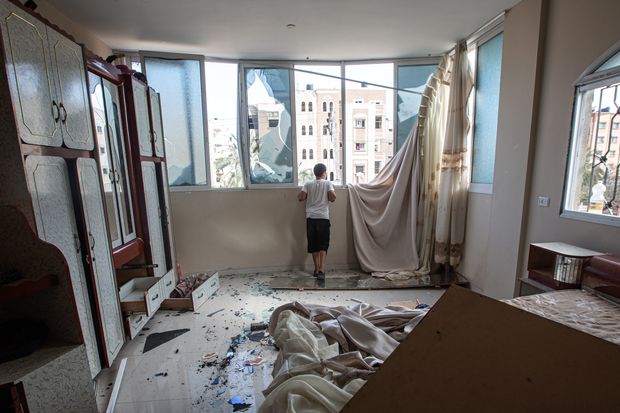
[Asia Economy Reporter Yujin Cho] Israel and the Palestinian armed faction Hamas, which have been engaged in armed conflict for ten days, have agreed to a ceasefire through international mediation.
According to major foreign media on the 20th (local time), the Israeli government held a security-related ministers' meeting that evening and unanimously approved a mutual unconditional ceasefire plan. The ceasefire will begin at 2 a.m. on the 21st.
Hamas also confirmed that it accepted the ceasefire plan mediated by Egypt and the United Nations.
Since the outbreak of the armed conflict on the 10th, 232 people, including 61 children, have died and about 1,900 have been injured in the Gaza Strip, while Israel has reported 12 deaths and over 300 injuries.
The Wall Street Journal (WSJ) reported that the international community, including the United States, Egypt, and Qatar, has been persuading both Israeli Prime Minister Benjamin Netanyahu and Hamas leaders to end military operations, and it appears that Israel, which had taken a hardline stance, has changed its position.
U.S. President Joe Biden increased pressure for a ceasefire by holding four phone calls with Prime Minister Netanyahu after the clashes. It is also reported that President Biden had a phone conversation with Egyptian President Abdel Fattah el-Sisi the day before to discuss achieving a ceasefire.
Foreign ministers from Germany, the Czech Republic, and Slovakia also visited Israel the previous day and met with Israeli Foreign Minister and others. German Foreign Minister Heiko Maas said, "We want to see an end to the war," and persuaded, "The international community hopes to reach a quick resolution."
U.S. CBS, citing a senior Hamas official, reported that the conditions for a ceasefire with Israel included that Israeli military and police forces do not enter the Al-Aqsa Mosque and that Palestinian residents living in the Sheikh Jarrah area of East Jerusalem are not expelled by Jewish settlements.
This conflict was the bloodiest since the 2014 '50-day war' between Israel and Hamas, which resulted in over 2,000 deaths. After Hamas's preemptive attack on the 10th, Israel responded with fierce bombings, and the two sides engaged in ten days of fighting.
The clashes between Israel and Hamas originated from restrictions on the religious activities of Palestinian Muslims during the Islamic fasting month of Ramadan and conflicts surrounding Israeli settlements.
During this year's Ramadan, Israeli authorities closed the Damascus Gate square north of the Old City, where Muslims gather after breaking their fast in the evening, provoking protests from Palestinian residents.
Although both sides have agreed to a ceasefire, the possibility of armed conflict remains at any time unless a fundamental solution to the long-standing conflict is found.
© The Asia Business Daily(www.asiae.co.kr). All rights reserved.

















