[Asia Economy Reporter Ji Yeon-jin] As inflation in the United States accelerates sharply, so-called 'Seohak Gaemi' investing in global stocks is focusing on corporate earnings in the second quarter. While U.S. companies announced first-quarter results that exceeded expectations, raising hopes for second-quarter earnings, there are concerns about significant uncertainties.
According to KB Securities on the 19th, the first point to check in the second-quarter earnings is whether rising raw material prices are shrinking corporate margins. During the first-quarter earnings announcement season, the increased mentions of 'inflation' indicate that companies are considering ways to pass on prices.
The ISM Manufacturing Index released on the 4th of this month shows that the customer inventory index hit an all-time low. Based on the demand from customers trying to replenish inventory, it is interpreted that companies are successfully passing on prices. On the other hand, it is difficult to confirm the price pass-through power in the service sector, but as news continues about Walmart, Chipotle, and McDonald's raising labor costs, it is analyzed that cost pressures are increasing.
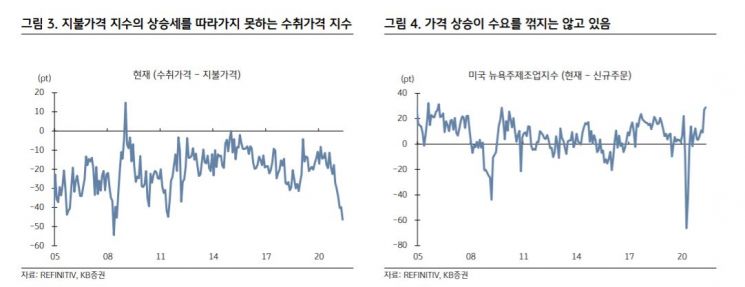
There is also a possibility that companies could not sufficiently increase sales volume or even experienced a decline due to supply disruptions. Despite high demand from economic recovery, ongoing supply issues are expected to prevent some manufacturing companies from increasing production and service companies from increasing sales. A representative example is U.S. automaker Ford, which decided to cut its second-quarter production by 50% compared to plans due to semiconductor shortages. In Apple's case, although it holds absolute bargaining power in the supply chain, it has stated that it may not be able to meet demand for iPads and Macs. KB Securities researcher Kim Il-hyeok predicted, "If sales volume cannot be increased, revenue may be maintained by raising prices, but companies with low pricing power are expected to suffer from supply disruptions."
It is also important to watch whether price increases are dampening demand. Rapid price increases could suppress demand. The new orders index for both the ISM manufacturing and service sectors fell compared to the previous month but remained at a high level, exceeding 60%. In the May New York Fed Manufacturing PMI released on the 17th, the new orders index recorded 28.9, the highest since 2006. Researcher Kim explained, "So far, we have not clearly confirmed that prices are weakening demand."
© The Asia Business Daily(www.asiae.co.kr). All rights reserved.

















