From Commercial Area Analysis and Marketing Support to Tax and Legal Consultation at Banks
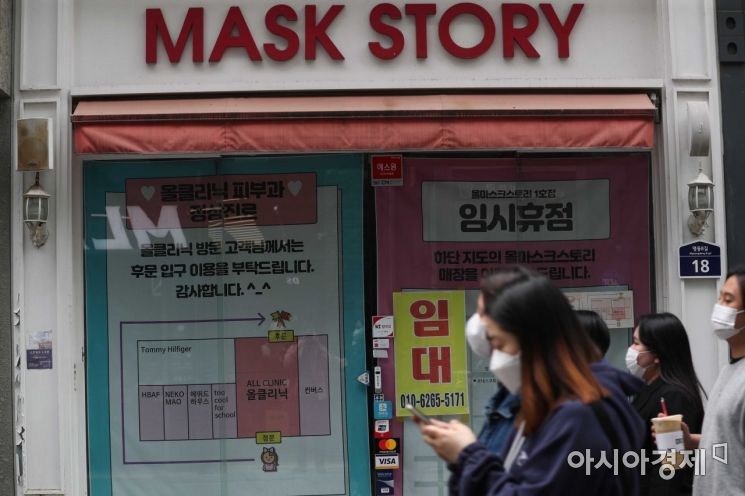 Vacant stores have been steadily increasing in major commercial districts due to the prolonged COVID-19 pandemic. Myeongdong, Seoul's representative commercial area, is seriously affected, with 4 out of 10 stores empty. According to the "2021 Q1 Commercial Real Estate Lease Trend Survey" released by the Korea Real Estate Board, the vacancy rate of medium to large stores in Myeongdong was recorded at 38.4%. Rental inquiries, temporary closure notices, and business termination signs are posted on Myeongdong shops. Photo by Moon Honam munonam@
[Asia Economy Reporter Park Sun-mi] Kim Ju-young (pseudonym), who runs a hanok lodging business in Jongno-gu, Seoul, sought SOHO consulting operated by KB Kookmin Bank after experiencing a sales decline due to COVID-19. He was advised to change his customer base from foreigners to domestic customers and received support for building a system to expose business addresses and information on portal sites and linking reservation systems. Since then, he has recorded the highest sales ever.
The banking sector is actively supporting small and medium-sized enterprises (SMEs) and small business owners suffering from COVID-19 damage through various consulting and education programs. While aiming to practice ESG (Environmental, Social, and Governance) management by supporting COVID-19 affected groups, they are also opening opportunities to expand their customer base amid a tight household loan market.
According to the financial sector on the 18th, KB Kookmin Bank’s ‘KB SOHO Consulting Center’ has conducted 2,112 consulting cases for self-employed individuals affected by COVID-19 so far this year. They provide management consulting in various fields such as location and commercial area analysis, marketing and promotion, financing, taxation, and legal matters.
Moon Jin-gi, a specialist at KB SOHO Consulting Center, said, "Previously, the focus was on startup support consulting, but after the spread of COVID-19, we have shifted to a crisis management support system for small business owners." He added, "We help develop non-face-to-face sales channels through customized consulting reflecting individual business difficulties and social network service (SNS) consulting, as well as financial counseling."
Earlier, in November last year, KB Kookmin Bank fully revamped KB Bridge, which recommends customized policy funds based on artificial intelligence (AI) for small business owners, and launched an open banking service for sole proprietors this month. In February, they also expanded and renewed the lineup of financial products exclusively for SMEs (including sole proprietors).
Shinhan Bank recently provided commercial area analysis consulting for self-employed individuals in Seoul who are struggling due to COVID-19. Based on Shinhan Card’s big data of over 300 million transactions per month, the consulting covered topics useful for business operations such as changes in commercial areas before and after COVID-19 and changes in sales and number of stores in major Seoul commercial areas over the past 10 years.
Banking Sector’s SME and Small Business Support Achieves Dual Benefits
Woori Bank previously provided customized comprehensive consulting for SMEs and small business owners with loan principal maturity extensions and interest payment deferrals, including cost reduction, sales recovery, and financing support.
The banking sector approaches support for SMEs and small business owners not as a profit-based business but as a customer service. However, with tightened regulations limiting household loan expansion, various support services targeting these groups are linked to customer base and profit growth, earning praise for achieving dual benefits.
In fact, SME loans (including SOHO) from the five major commercial banks?KB Kookmin, Shinhan, Hana, Woori, and NH Nonghyup?reached 516.9 trillion won at the end of last month. This is an increase of more than 6.5 trillion won compared to 510.3 trillion won in March, marking the largest monthly increase since May last year.
A banking official said, "It is true that SMEs and small business owners have emerged as major customers of commercial banks in the COVID-19 era," adding, "Support for them leads to multiple effects such as practicing ESG management, blocking financial risks due to management failures, and expanding the customer base through linked financial products."
Meanwhile, financial authorities have urged the financial sector, including banks, to minimize loan disadvantages for SMEs and small business owners facing credit rating downgrades due to deteriorating business performance caused by COVID-19. The Financial Services Commission instructed financial institutions conducting their own credit evaluations, such as banks, insurance companies, and policy finance institutions, to sufficiently reflect recovery potential in non-financial evaluations or the final rating calculation process when evaluating SMEs and small business owners this year.
The reflection criteria include ▲cases where sales have decreased due to COVID-19 ▲cases operating normally without delinquency or capital erosion ▲cases with high potential for financial condition improvement such as sales recovery. Institutions are expected to prepare operational standards based on these criteria, and if credit ratings do not decline, loan limits and conditions such as interest rates are expected to be maintained. Even if credit ratings decline, disadvantages such as loan limit reductions and interest rate increases will be minimized for normal borrowers without defaults.
© The Asia Business Daily(www.asiae.co.kr). All rights reserved.
![Clutching a Stolen Dior Bag, Saying "I Hate Being Poor but Real"... The Grotesque Con of a "Human Knockoff" [Slate]](https://cwcontent.asiae.co.kr/asiaresize/183/2026021902243444107_1771435474.jpg)















