Minister Noh Hyung-wook's First External Schedule After Inauguration
Attended Meetings with Local Governments, Public Enterprises, and Private Associations
Policy to Secure Maximum Quantity Without Resting
Considering Incentives to Increase Private Sector Participation
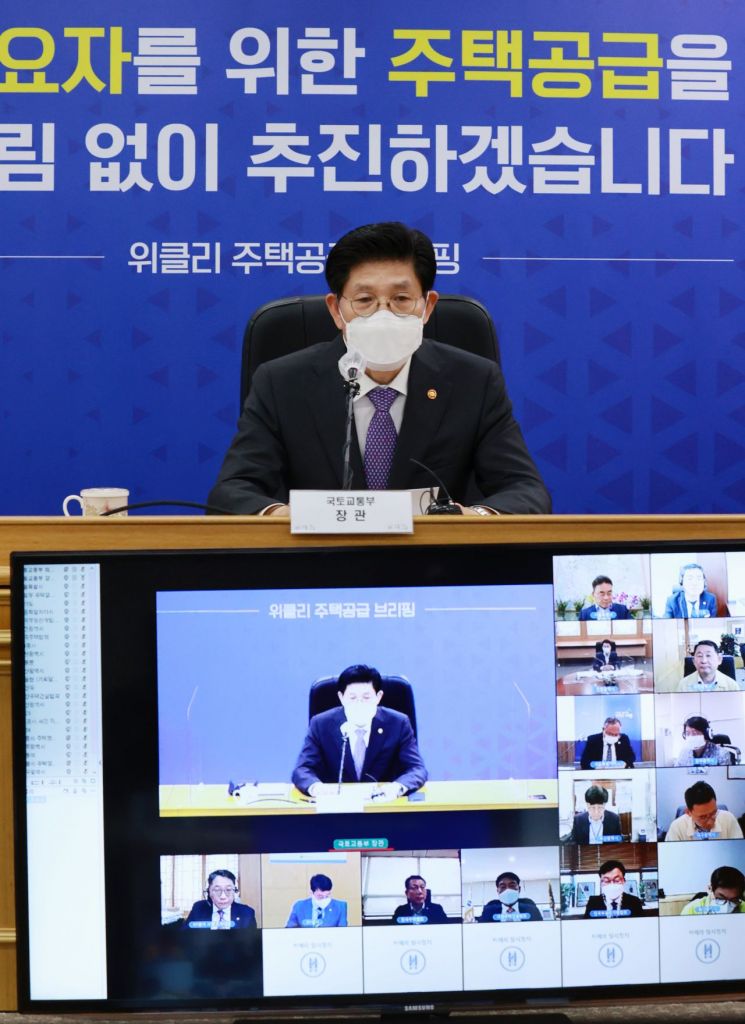 Minister of Land, Infrastructure and Transport Noh Hyung-wook is speaking at a meeting of housing supply agencies held on the morning of the 18th at the Government Complex Sejong in Sejong City.
 [Photo by Yonhap News]
[Asia Economy Reporter Moon Jiwon] The Ministry of Land, Infrastructure and Transport (MOLIT), along with nine local governments, four public enterprises, and three private housing-related associations, gathered to discuss measures to stabilize housing prices through expanded housing supply.
The participating organizations positively evaluated the smooth progress of housing supply under the February 4th measures and agreed to consider providing additional incentives to public development areas where project promotion, including resident consent, is progressing quickly. They also decided to prepare plans to activate private sector participation for additional housing supply within urban areas.
On the 18th, MOLIT announced that Minister Noh Hyung-wook held a meeting with local governments, public enterprises, and others as his first external schedule since taking office. The meeting was held via video conference at the Government Complex Sejong that morning.
Attendees included deputy heads from Seoul, Gyeonggi, Busan, Daegu, Incheon, Gwangju, Daejeon, Ulsan, and Sejong, presidents of Korea Land & Housing Corporation (LH), Housing & Urban Guarantee Corporation (HUG), Seoul Housing & Communities Corporation (SH), Gyeonggi Housing & Communities Corporation (GH), and chairpersons of the Korea Housing Association, Korea Housing Builders Association, and Korea Real Estate Development Association.
The attending leaders agreed on the importance of supplying sufficient housing in urban areas through cooperation between local governments and the private sector.
Since the announcement of the February 4th measures, MOLIT, which is pushing forward follow-up actions, has conducted about 1,362 consultations through the Integrated Support Center and identified a total of 491 candidate sites (415 local government sites and 76 private sites) within urban areas, amounting to approximately 100,000 housing units.
Among these, two candidate sites, Jeungsan 4 District and Susaek 14 District, secured two-thirds consent for project promotion within about a month after resident consent collection began in early last month. MOLIT explained, "Most residents of the candidate sites have long awaited the supply projects, so their expectations and willingness to participate in the supply policy are very high."
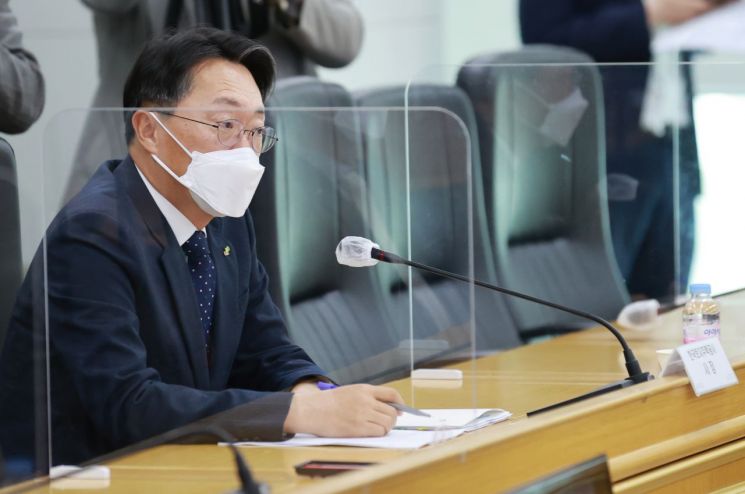 On the morning of the 18th, at the Housing Supply Agencies Meeting held at the Government Complex Sejong in Sejong City, Kim Hyun-joon, President of Korea Land and Housing Corporation (LH), is attentively listening to remarks by Noh Hyung-wook, Minister of Land, Infrastructure and Transport.
 [Image source=Yonhap News]
Private organizations such as the Korea Housing Association and the Korea Housing Builders Association emphasized that uncertainties related to projects must be resolved to promote private participation, and that procedures, support criteria, and participation methods should be promptly finalized through legislation or other means. Additionally, they suggested that urban and architectural regulations, such as floor area ratio expansions, need to be improved to encourage private housing construction.
In response, MOLIT stated that, given the high resident demand, it will identify as many candidate sites as possible, actively consult with local governments and residents from the project planning stage, and cooperate organically with the private sector.
Local governments requested MOLIT’s active cooperation in supporting permit procedures and urban regulation incentives to discover additional candidate sites and secure consent.
In particular, the meeting discussed the need to review supply promotion measures that fully utilize private sector capabilities. Voices were raised to provide sufficient incentives for private-led development and to establish ways for private participation even in public projects to increase private sector involvement.
Minister Noh responded, "It is efficient for the public sector to lead in areas with poor profitability and complex interests, while the private sector should take the lead in areas with sufficient profitability and strong willingness from landowners to develop housing." He emphasized, "In the future, not only public-led supply projects but also private supply activation will be actively considered if each institution proposes institutional improvements."
There was also an opinion that measures are needed to thoroughly block speculative demand inflows to prevent housing prices from being stimulated during the development process.
The participating organizations also discussed providing additional incentives for candidate sites where resident consent and project planning are progressing quickly to achieve prompt results from the February 4th measures.
In this regard, MOLIT plans to consider special management measures, including tailored support plans, for candidate sites such as Jeungsan 4 District and Susaek 14 District, which have already secured resident consent rates for district designation, as well as eight urban public housing complex districts with resident consent rates exceeding 10%, and public redevelopment and reconstruction candidate sites.
© The Asia Business Daily(www.asiae.co.kr). All rights reserved.
![Clutching a Stolen Dior Bag, Saying "I Hate Being Poor but Real"... The Grotesque Con of a "Human Knockoff" [Slate]](https://cwcontent.asiae.co.kr/asiaresize/183/2026021902243444107_1771435474.jpg)
















