"Achieving Carbon Neutrality by 2050 Could Make Small Modular Reactors an Alternative"
Global Shift with $3.2 Billion Investment in US Next-Gen Nuclear Reactors
Government Must Increase Investment and Improve Licensing Regulations to Ensure Economic Feasibility
[Sejong=Asia Economy Reporter Kwon Haeyoung] The Ministry of Trade, Industry and Energy's consideration of participating in the development of the Korean-style Small Modular Reactor (SMR) 'i-SMR' is interpreted as a measure to prevent the collapse of the nuclear power ecosystem, which possesses world-class personnel and technological capabilities. This aligns with the recent trend of major global nuclear power countries turning their attention to the SMR market. However, concerns have been raised that this attempt to find a breakthrough primarily through 'exports' rather than domestic application may be overly influenced by the government's 'nuclear phase-out' policy. Some argue that SMRs should be actively utilized as an alternative to achieve the 2050 carbon neutrality goal.
◆2050 Carbon Neutrality Goal... Sharp Decline in Nuclear Power Generation Share= According to related ministries on the 18th, although the government has established a carbon neutrality strategy for 2050, it plans to reduce the share of nuclear power generation, which emits zero carbon dioxide.
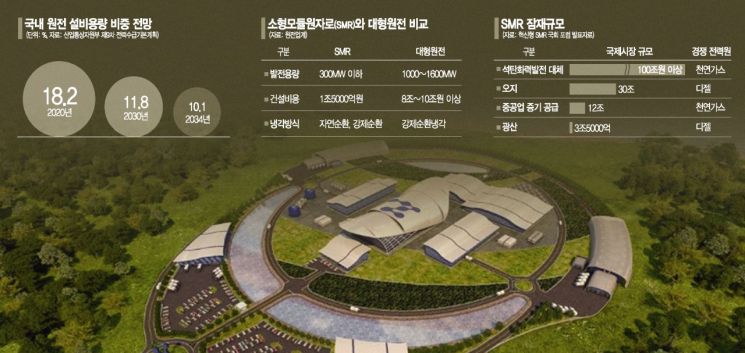
According to the 9th Basic Plan for Electricity Supply and Demand announced by the Ministry of Trade, Industry and Energy in December last year, the share of domestic nuclear power plant capacity in the total energy sources is expected to decrease from 18.2% in 2020 to 11.8% in 2030 and 10.1% in 2034. The share of coal power, another major energy source alongside nuclear power, will decrease from 28.1% in 2020 to 15% in 2034. The gap left by nuclear and coal power will mostly be filled by renewable energy sources such as solar and wind power. The share of renewable energy capacity is expected to expand 2.7 times from 15.8% in 2020 to 40.3% in 2034.
Carbon neutrality to respond to climate change is a path that must be taken. However, the sharp reduction in the share of nuclear power, a clean energy source, raises concerns about increasing burdens on our economy. This is why criticism arises that it is impossible to simultaneously realize nuclear phase-out and carbon neutrality. According to a survey conducted by the Korea Chamber of Commerce and Industry among companies, more than 40% of respondents said the '2050 Carbon Neutrality Promotion Strategy' is "practically difficult."
This is why countries around the world, including the United States and the European Union (EU), are shifting toward actively utilizing nuclear power to achieve carbon neutrality. The EU recently classified nuclear power as an eco-friendly industry.
The economic burden of nuclear phase-out is clearly reflected in Japan's case. After the Fukushima nuclear accident in 2011, Japan's nuclear power operation rate dropped to nearly 0% in 2014 but later reversed with the restart of nuclear plants. The reduction in nuclear power operation led to increased electricity production costs, higher electricity rates, and the relocation of chemical and IT companies with high electricity consumption out of Japan, causing a sharp rise in economic burdens. Previously, the Japan External Trade Organization predicted that if the Japanese government did not restart nuclear power plants, Japan's real GDP would shrink by an average of 7.8 trillion yen (about 81 trillion KRW) annually by 2030. Comparing Japan's trade balance before the Fukushima accident in 2010 and in 2014 when nuclear power was halted shows a decrease of 14.4 trillion yen.
◆Expanding SMR Market... Rising Role in Carbon Neutrality= Major countries such as the United States and the United Kingdom are turning their attention to SMRs, which are relatively safer than large nuclear power plants, as an alternative for carbon neutrality. In October last year, the U.S. announced a $3.2 billion investment plan over seven years to support SMRs and next-generation reactors. The UK also presented a concrete roadmap to build up to 16 SMRs with an investment of 200 million pounds over five years. This reflects the judgment that constructing nuclear power plants with zero carbon dioxide emissions is inevitable for carbon neutrality.
The biggest advantage of SMRs is their higher public acceptance due to greater safety compared to large nuclear power plants. The smaller reactor size results in less radioactive material released and less decay heat generated in case of an accident. Initial investment costs are lower, and simple designs allow for cost reductions. However, their economic feasibility is currently lower than that of large nuclear power plants, which benefit from economies of scale, and this is a challenge to be addressed in the future.
As major countries promote SMRs as a means to achieve carbon neutrality, the SMR market is expected to grow rapidly. The UK's National Nuclear Laboratory (NNL) forecasts that SMR capacity will expand to 65-85 GWe by 2035. One GWe corresponds to the capacity of one nuclear power plant. This suggests that SMR capacity could reach the equivalent of 85 nuclear power plants by 2035.
Professor Jeong Dongwook of the Department of Energy Systems Engineering at Chung-Ang University said, "Korea has been leading in the small nuclear reactor field, but the overall industry assessment is that competitiveness is lacking compared to major countries like the U.S. We need to advance small nuclear reactor technology, which has advantages such as safety, flexible operation, and distributed power generation, based on the technological development experience we have accumulated."
An industry insider said, "SMR licensing is impossible under the existing regulatory framework designed for large nuclear power plants, so a new regulatory system is needed. The U.S. company NuScale, which leads SMR development, has received more than 15 regulatory benefits, leading to cost reductions and improved economic feasibility. Our government also needs to consider revising the regulatory framework to foster SMR development."
© The Asia Business Daily(www.asiae.co.kr). All rights reserved.
![Clutching a Stolen Dior Bag, Saying "I Hate Being Poor but Real"... The Grotesque Con of a "Human Knockoff" [Slate]](https://cwcontent.asiae.co.kr/asiaresize/183/2026021902243444107_1771435474.jpg)















