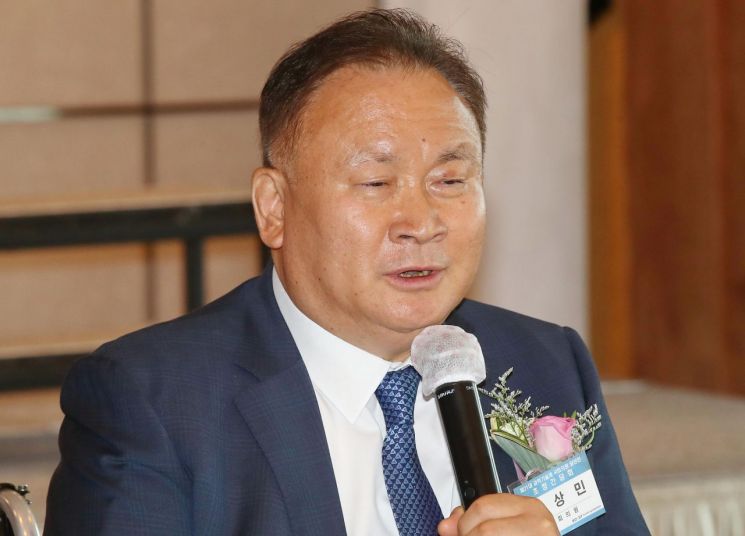
[Asia Economy Reporter Park Cheol-eung] Lee Sang-min, a member of the Democratic Party of Korea, has proposed a temporary special tax bill to overcome COVID-19.
On the 17th, Lee proposed a Social Solidarity Special Tax bill that requires payment of 7.5% (75 per 1,000) each on income tax and corporate tax. However, it will not be imposed on taxable income up to 100 million KRW under the Income Tax Act, and taxable income up to 300 billion KRW under the Corporate Tax Act. It is a temporary earmarked tax.
According to the response Lee received after requesting investigation and analysis from the National Assembly Budget Office, if the Social Solidarity Special Tax is newly established, tax revenue is estimated to increase by 1 trillion KRW starting next year, totaling 18.3 trillion KRW (an average of 4.6 trillion KRW annually) from 2022 to 2025.
The final taxpayers subject to the Social Solidarity Special Tax, with taxable income of 100 million KRW or more from earned income and comprehensive income, are expected to be about 570,000 people. The additional annual tax burden per person is estimated at about 2 million KRW for taxable income up to 200 million KRW, 5 million KRW up to 300 million KRW, 9 million KRW up to 500 million KRW, 17 million KRW for 500 million to 1 billion KRW, and 56 million KRW for over 1 billion KRW.
For corporations, it is estimated to be 103 based on 2019 filings. Although this accounts for only 0.03% of all corporate tax filing corporations, it represents about 50.7% of the total tax amount based on total tax burden. Companies with 300 billion to 500 billion KRW in taxable income are expected to pay an average of about 6 billion KRW per corporation, and those with over 500 billion KRW are expected to pay an average of about 37 billion KRW per corporation.
The main expenditures of the Social Solidarity Special Tax, which is an earmarked tax, include support for individual business owners and small business owners who suffered economic losses due to COVID-19, wage support for employees of small and medium-sized enterprises facing business difficulties due to COVID-19, support for vulnerable groups struggling with livelihood due to COVID-19, costs for COVID-19 response and prevention, and policies to alleviate economic inequality caused by social and economic structural changes.
Lee said, "All presidential and by-election candidates advocate expanding welfare, so the places to spend money increase, but it is wrong to ignore the uncomfortable truth about how to secure funding and only give rosy prospects." He added, "We need to prepare a mid- to long-term roadmap for funding to expand welfare, respond to COVID-19, and prepare for the Fourth Industrial Revolution era."
© The Asia Business Daily(www.asiae.co.kr). All rights reserved.
![Clutching a Stolen Dior Bag, Saying "I Hate Being Poor but Real"... The Grotesque Con of a "Human Knockoff" [Slate]](https://cwcontent.asiae.co.kr/asiaresize/183/2026021902243444107_1771435474.jpg)















