Delivery Rider Reckless Driving and Illegal Riding Serious
Traffic Violations Increased by 50% Compared to Pre-COVID-19 Era
Delivery Riders Say "Structural Issues Forcing Faster Riding Must Be Addressed"
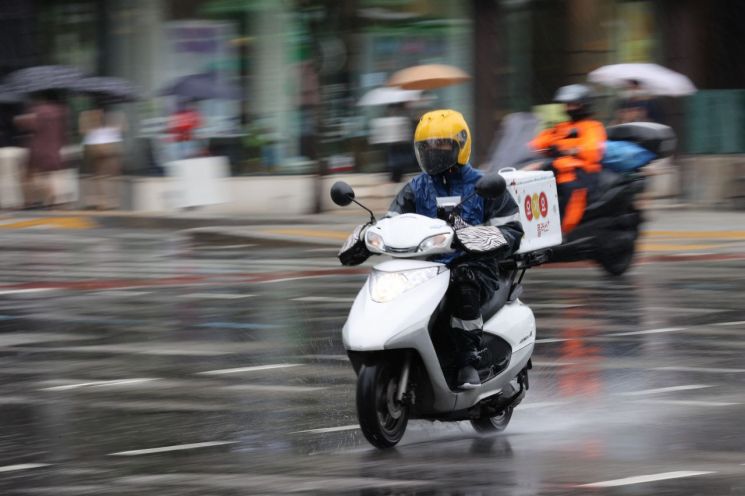 Due to the surge in deliveries caused by COVID-19, reckless driving by riders has become a problem. The photo is unrelated to specific expressions in the article. [Image source=Yonhap News]
[Asia Economy Reporter Jumi Lee] As delivery demand surged due to COVID-19, violations of traffic laws by some riders have become serious, and there are concerns that simply strengthening crackdowns or penalties without structural changes in the industry cannot solve the problem. Voices are growing that the vulnerable profit structure, where riders must deliver as much as possible to increase their earnings, needs to be improved.
On the 10th, a man in his 50s who was working as a delivery rider died after colliding with a motorcycle driven by former announcer Park Shin-young. It was investigated that Park collided with the motorcycle, which entered a red light, while going straight through a yellow light at the intersection in front of Sangam Elementary School in Mapo-gu, Seoul. The police have booked Park on charges of causing injury under the Special Act on Traffic Accident Handling and are investigating.
Although fatal accidents like this have occurred, reckless driving and illegal operation of delivery motorcycles have hardly improved. According to the police, last year there were about 230,000 traffic law violation crackdowns on two-wheeled vehicles such as motorcycles, an increase of about 50% compared to 2019 before the COVID-19 pandemic. In particular, 36.9% of deaths in two-wheeled vehicle traffic accidents were delivery workers. This means that one out of three people who drove two-wheeled vehicles died while making deliveries.
Not only the riders themselves but also pedestrians around vehicle drivers are being threatened. A man in his 20s, Jeong, said, "There was a time when I felt in danger because of a delivery motorcycle cutting sharply between cars (illegal driving maneuver) while I was driving."
Despite the police cracking down on the increasingly serious disorderly operation of delivery motorcycles, the situation remains difficult to resolve as delivery riders respond with 'tricks' to evade enforcement.
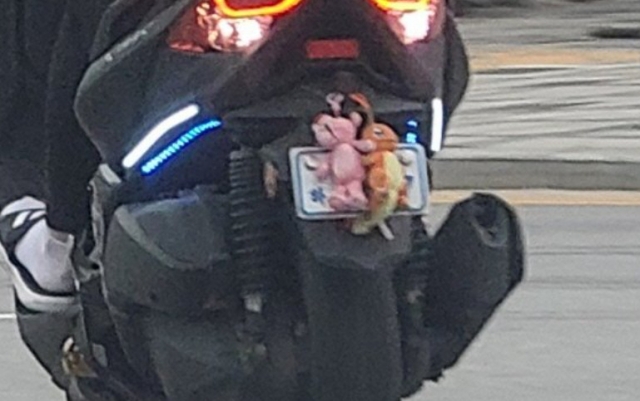 A delivery rider is cleverly covering the license plate with a doll to avoid being caught by authorities while driving. Photo by Online Community Capture
The most representative trick is 'hiding license plates.' This method makes the license plate difficult to identify to avoid being caught. Riders smear mud or adhesive on the plate or hang chain locks, colloquially called 'soondae,' to cover the numbers. Some riders openly cover their plates using dolls or hairbands.
The police plan to respond to illegal driving by enhancing enforcement techniques and increasing fines. The problem is that there is a considerable possibility that riders who evade even these strengthened crackdowns will emerge. Since tricks to hide license plates have appeared, other ingenious methods may also arise. This is why voices call for solving the structural issue that forces riders to drive 'fast, fast' rather than focusing solely on enforcement and punishment.
The delivery riders themselves also argue that the profit structure must be improved. On the 28th of last month, at the 'Rider Policy Delivery Day' event held in front of the National Assembly in Yeouido, the delivery workers' union 'Rider Union' pointed out that competition among delivery agencies has gradually lowered delivery fees, threatening not only riders' livelihoods but also their safety.
Jo Bong-gyu, vice chairman of the Rider Union, explained, "Delivery agencies competitively lower delivery fees under the pretext of attracting franchise stores. When delivery fees are cut, riders have no choice but to deliver more in the same amount of time to earn a certain income. The phenomenon of riders driving dangerously stems from this structural problem."
Jo emphasized, "It is right to crack down on riders who drive recklessly, but if there are riders forced to take risks for their livelihood, the problem cannot be solved by enforcement alone."
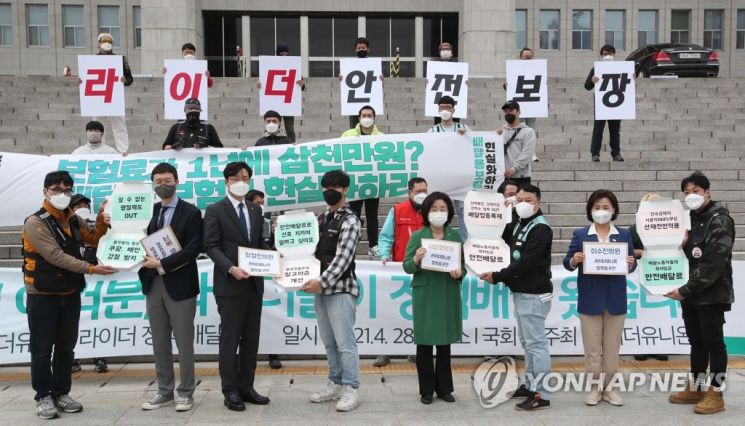 At the 'Rider Union Rider Policy Delivery Day' event, members of the Rider Union, a delivery workers' labor union, are performing a gesture of handing over pizza boxes containing the voices of riders to members of the National Assembly's Environment and Labor Committee.
 [Image source=Yonhap News]
Some voices also point to the commission system as the root cause of reckless driving. Kim Ha-young, author of the book
Kim said, "The delivery fee is about 3,000 won per order, so you have to complete at least 30 orders a day, sometimes up to 50, to earn a decent amount, roughly equivalent to a regular company salary. Also, deliveries are not spread evenly over eight hours like a factory shift but must be done as much as possible during peak lunch and dinner times."
She added, "There is an absolute time required to prepare and deliver food. Because of this, riders become rushed, sometimes visiting 6 or 7 places at once, and feeling that every minute and second is precious, which leads to risky driving."
As calls for changes in riders' profit systems grow louder, politicians have promised to work on improving working conditions. On the 28th of last month, Sim Sang-jung, a member of the Justice Party, attended the 'Rider Policy Delivery Day' event and pointed out, "Even though they do the same work, the pay varies day by day, and working conditions change frequently. If they refuse orders, dispatching stops, and workers bear harsh conditions alone."
She promised, "We will adjust delivery fees, which are below the minimum living cost, to match the status of essential workers and prevent labor exploitation under the name of innovation."
© The Asia Business Daily(www.asiae.co.kr). All rights reserved.



















