Korea Research Foundation Team Develops Electroluminescent Device That Can Be Freely Deformed and Emits Light When Electric Field Is Applied
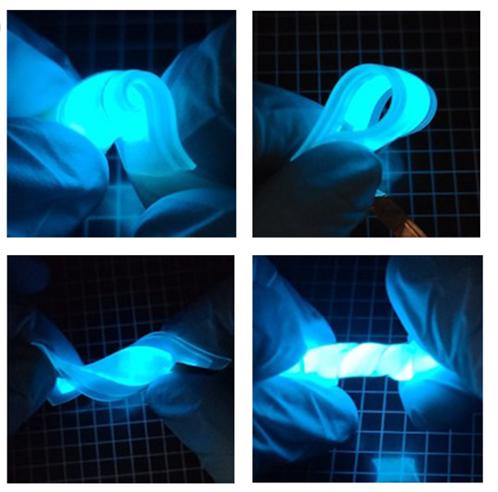
[Asia Economy Reporter Kim Bong-su] The Korea Research Foundation announced on the 17th that a research team led by Professors Yoon Jin-hwan and Jin Sung-ho of Pusan National University has developed an electroluminescent device that works even when bent, twisted, or stretched up to 12 times its original length.
Electroluminescent devices emit bright light when an electric field is applied and are widely used in displays and lighting. Recently, many devices using plastic electrodes instead of metal electrodes have been introduced to allow bending and folding. As demand for wearable devices increases, research on flexible devices that can be freely deformed or stretched using flexible soft materials like hydrogels as electrodes is also active. Ion gels, which are solid-state electrolytes that do not flow and whose properties are relatively easy to control, have attracted attention.
The problem was that they were easily torn and had low electrical conductivity. The research team created a robust gel material and then absorbed ionic liquid, which conducts current well, into the material to produce an ion gel that improved both flexibility and electrical conductivity. The key was to create flexible polymer chains and tough polymer chains each as a network structure and then crosslink these two. To enhance both flexibility and mechanical strength (tensile strength, elasticity, and stretchability), polymers with different characteristics were combined. Previously, technologies mainly used a single polymer chain, but this research is the first to combine polymers with different properties.
The resulting gel material was flexible like slime or rubber bands and resistant to tearing. Furthermore, by absorbing ionic liquid into the gel material, a transparent and highly conductive ion gel electrode was created. It emitted light and could freely change shape or operate even when stretched up to 12 times its original length. Using ionic liquid that is more thermally stable than conventional ion electrolytes, the device operated well over a wide temperature range from 0 to 200 degrees Celsius. This tear-resistant ion gel material is expected to provide a breakthrough for devices such as displays, digital sensors, and batteries that can freely change shape.
The research results were published online on the 13th in the international materials science journal Advanced Materials.
© The Asia Business Daily(www.asiae.co.kr). All rights reserved.
![Clutching a Stolen Dior Bag, Saying "I Hate Being Poor but Real"... The Grotesque Con of a "Human Knockoff" [Slate]](https://cwcontent.asiae.co.kr/asiaresize/183/2026021902243444107_1771435474.jpg)















