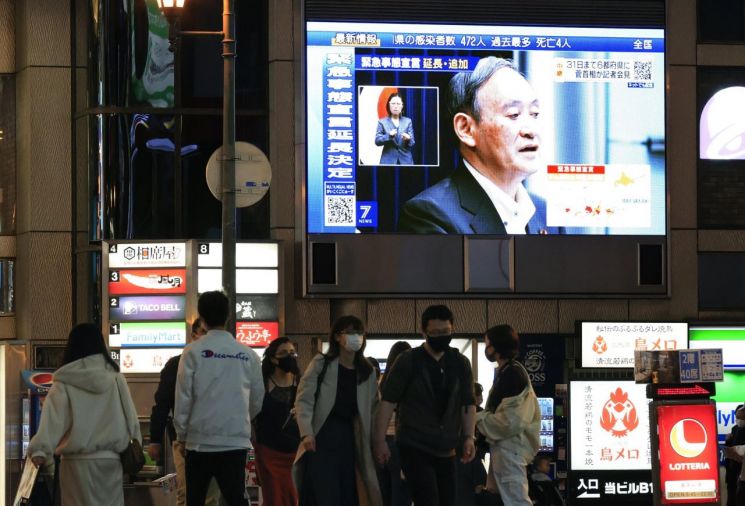
 On the afternoon of the 7th, Japanese Prime Minister Yoshihide Suga's press conference regarding the COVID-19 state of emergency was broadcast live on a large screen installed in downtown Osaka, Japan. [Image source=Yonhap News]
[Asia Economy Reporter Kwon Seoyoung] In Japan, where new COVID-19 cases continue to be in the 6,000 range daily even after the state of emergency was declared in some areas, voices opposing the hosting of the Tokyo Olympics are continuously rising.
On the 13th (local time), Hiroshi Mikitani, CEO of Japan's major e-commerce company Rakuten, criticized the forced hosting of the Tokyo Olympics as a "suicide mission" in an interview with CNN Business. Regarding the Japanese government's stance, he said, "Since vaccination is progressing very slowly, hosting an international Olympics where people from all over the world gather is a risk with too many factors."
He added, "Many countries such as India and Brazil are still suffering from COVID-19. It is not yet time to celebrate," and stated, "I tried to persuade the Japanese government, but so far it has not been successful," and "I have discussed several times with various government officials about the possibility of canceling the Tokyo Olympics, but many are trending against holding the Olympics this year."
In addition, SoftBank's CEO Masayoshi Son and Toyoka's COO Jun Nagata also expressed concerns regarding the Olympic hosting. Public opinion in Japan is not much different. According to a local survey released on the 10th, about 59% of respondents said the Olympics should be canceled. It is also known that dozens agreed to an online petition demanding the cancellation of the Olympics.
This public opinion has not only spread within Japan. The American daily newspaper The New York Times (NYT) also expressed a skeptical stance on the hosting of the Tokyo Olympics. On the 12th (local time), the New York Times published a column titled "The Olympics Are Too Risky, They Should Be Canceled," written by Jules Boykoff, a professor of political science at the University of the Pacific in the U.S.
The column pointed out that Japan's Liberal Democratic Party and the International Olympic Committee (IOC) are pushing to hold the Olympics under the current circumstances solely "because of money." This is because most of the IOC's revenue comes from broadcasting rights fees paid by broadcasters and companies selected as Olympic partners, so the IOC side will not give up financial benefits.
Furthermore, the column criticized the IOC's stated principle of "athlete-first" as contradictory to the attitude of shifting responsibility for participants' COVID-19 infections onto the athletes themselves. It emphasized, "The Tokyo Olympics must be canceled. The IOC should make the right decision, albeit late."
Meanwhile, the Japanese government has raised the level of measures to curb the spread of COVID-19 ahead of the Tokyo Olympics and Paralympics scheduled for July to September this year, including extending the state of emergency in Tokyo and other areas until the end of this month on the 7th. However, due to the continued spread of variant viruses and repeated declarations of emergency leading to a relaxed atmosphere regarding refraining from going out, new infections have not decreased.
According to NHK broadcasting, on the 15th, the total number of newly confirmed COVID-19 infections across Japan was 6,422 (as of 8 p.m.), including 772 in Tokyo. Except for Mondays, when the number of tests decreases and confirmed cases are relatively low, the number of daily confirmed cases in Japan has exceeded 6,000 for the eighth consecutive day since the 7th.
© The Asia Business Daily(www.asiae.co.kr). All rights reserved.
![Clutching a Stolen Dior Bag, Saying "I Hate Being Poor but Real"... The Grotesque Con of a "Human Knockoff" [Slate]](https://cwcontent.asiae.co.kr/asiaresize/183/2026021902243444107_1771435474.jpg)















