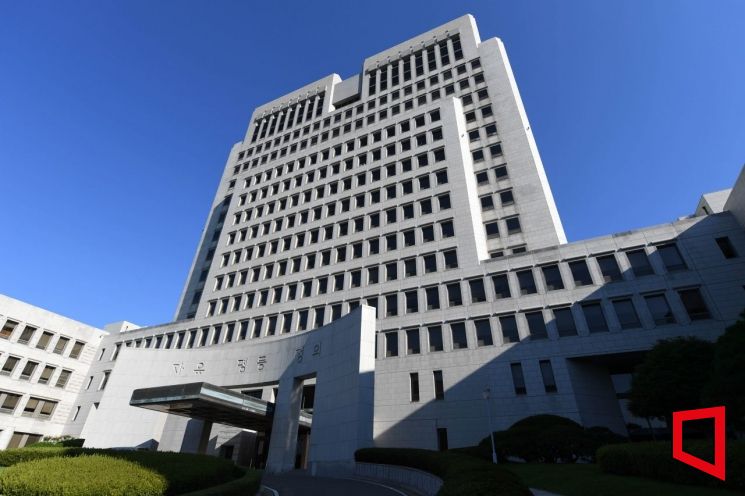
 Supreme Court in Seocho-dong, Seoul. Photo by Honam Moon munonam@
[Asia Economy Reporter Kim Daehyun] The Supreme Court has ruled that if a taxpayer claims that the tax payment notice was not properly delivered and demands a refund of the paid tax, the burden of proof lies with the taxpayer.
On the 16th, the Supreme Court's First Division (Presiding Justice Lee Gitaek) overturned the lower court's ruling that had favored taxpayer A in an unjust enrichment refund lawsuit against Seoul City and remanded the case to the Seoul Central District Court.
In 2003, Seoul City imposed a resident tax of about 102 million won on A, who was abroad at the time. A returned in 2015, and when Seoul City imposed an exit ban on him due to 'tax delinquency,' he paid about 56 million won of the outstanding amount.
Subsequently, A filed a lawsuit against Seoul City demanding a refund of the paid tax. He argued that Seoul City had not issued or delivered the resident tax notice nor conducted public notice delivery, making the taxation illegal and void due to lack of due process.
The first trial dismissed A's claim, reasoning that since there was a record of public notice delivery of the comprehensive income tax notice by the tax office, it was highly likely that the resident tax notice was also publicly delivered.
However, the second trial ruled that Seoul City's action was invalid. The court stated, "Electronic documents related to the public notice delivery of A's comprehensive income tax notice remain and can be verified, but documents related to the resident tax public notice delivery are not available due to expiration of the retention period," and pointed out, "The evidence submitted by Seoul City is insufficient to prove that the notice was delivered to A."
Nevertheless, the Supreme Court held that "in an unjust enrichment refund lawsuit, the burden of proof lies with the party claiming the refund," and ordered a retrial and reconsideration of the case. The court stated, "The lower court's judgment was based on the premise that Seoul City bore the burden of proving that the tax notice was properly delivered," and "the lower court erred in its understanding of the burden of proof regarding unjust enrichment and the invalidity of administrative disposition, which affected the judgment."
© The Asia Business Daily(www.asiae.co.kr). All rights reserved.
![Clutching a Stolen Dior Bag, Saying "I Hate Being Poor but Real"... The Grotesque Con of a "Human Knockoff" [Slate]](https://cwcontent.asiae.co.kr/asiaresize/183/2026021902243444107_1771435474.jpg)














