Top Tier Among Domestic Public Institutions
Record-Breaking Performance Growth Last Year but Wage Increase Rate Below 3%
KOSCOM's Wage Even Fell by 2.4%
All CEO Salaries Exceed 400 Million KRW
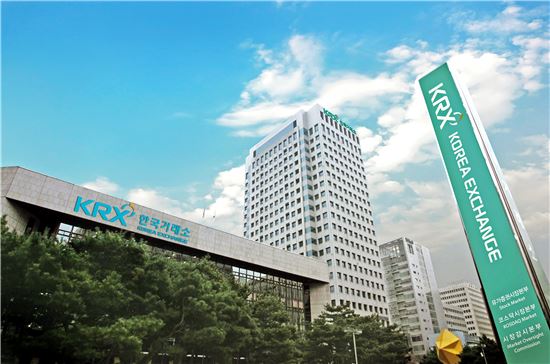
[Asia Economy Reporter Minwoo Lee] The average annual salary of employees at four securities-related institutions?Korea Exchange, Korea Securities Depository, Korea Securities Finance, and Koscom?exceeded 100 million KRW last year.
According to the 2020 business reports and disclosures of the four securities-related institutions on the 16th, the Korea Exchange recorded an average employee compensation of 115 million KRW last year. This was followed by Securities Finance at 112 million KRW, Securities Depository at 111 million KRW, and Koscom at 109 million KRW. This level surpasses by about 60% the average annual salary of 69.32 million KRW per regular employee across all 350 public institutions (including affiliated organizations) disclosed on the public institution management information system 'Alio'.
The average employee compensation ranks comparable to Ulsan National Institute of Science and Technology (UNIST) at 117.25 million KRW, Korea Investment Corporation (KIC) at 114.24 million KRW, Korea Advanced Institute of Science and Technology (KAIST) at 112.64 million KRW, and Korea Development Bank at 112 million KRW.
Regarding this, the Korea Exchange explained in its management disclosure, "Due to the nature of the work, most employees are professionals with advanced experience in listings, disclosures, derivatives, unfair trade investigations, and overseas-linked transactions, and there are virtually no frontline sales positions with lower salaries, resulting in higher average wages compared to other institutions."
These institutions all achieved strong performances last year, buoyed by an unprecedented stock market boom. The Korea Exchange recorded a net profit of 177.7 billion KRW on a separate basis, a 43.1% increase from the previous year. Securities Finance's net profit surged 67.8% to 262 billion KRW during the same period. Securities Depository's net profit nearly doubled, rising 99.9% to 97.8 billion KRW. Koscom also posted a net profit of 38.3 billion KRW, up 43.2% over the same period.
However, the average salary growth rates were limited to 2.7% for the Korea Exchange, 1.8% for Securities Finance, 0.3% for Securities Depository, and -2.4% for Koscom. Earlier, the government had instructed public institutions to keep employee salary increases within 2.8% last year. Although only Securities Depository is a legally designated public institution, the other organizations appear to have considered the overall public institution wage increase rate. The Korea Exchange was removed from the public institution category in 2015 but still remains a public-related organization. Securities Finance and Koscom are private companies with the Korea Exchange as the largest shareholder but are regarded as close to public enterprises due to the nature of their operations.
Meanwhile, among the heads of each institution, Securities Finance's CEO received the highest compensation at 564 million KRW, followed by the Korea Exchange at 493 million KRW, Koscom at 423 million KRW, and Securities Depository at 416 million KRW.
© The Asia Business Daily(www.asiae.co.kr). All rights reserved.
![Clutching a Stolen Dior Bag, Saying "I Hate Being Poor but Real"... The Grotesque Con of a "Human Knockoff" [Slate]](https://cwcontent.asiae.co.kr/asiaresize/183/2026021902243444107_1771435474.jpg)














