[Asia Economy Reporter Kim Heung-soon] Six out of ten logistics managers at domestic import-export companies agree on the need for digital transformation in the logistics sector. However, the response to digital transformation is insufficient, highlighting the urgent need for related support.
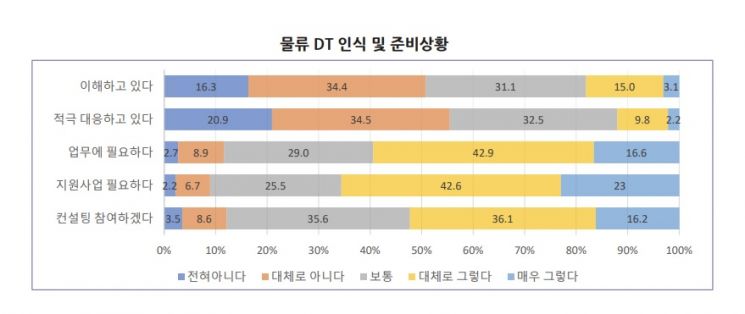
According to the report "Current Status and Implications of Digital Transformation in Import-Export Logistics," released on the 16th by the Korea International Trade Association's International Trade and Commerce Research Institute based on a survey of 453 logistics managers at domestic import-export companies, 59.5% of respondents answered that "digital transformation is also necessary in the logistics sector."
In particular, 95.8% of respondents expected that "digital transformation could reduce logistics costs," showing high expectations for digital transformation. By scale, 14.8% of respondents anticipated a "cost reduction of more than 30%," 23.6% expected a "20-30% reduction," 36.6% predicted a "10-20% reduction," and 20.8% expected a "0-10% reduction." Only 4.2% responded that there would be "no cost reduction effect."
On the other hand, preparation and utilization for this were found to be lacking. Among respondents, only 18.1% answered that they "understand digital transformation," 12% said they are "actively responding to digital transformation," and only 8.7% reported "using platform services." The most urgent support needed to activate the use of digital platforms was identified as "support for platform usage fees" (31.2%) and "platform-related education" (30.4%).
The report pointed out, "While global logistics companies such as Maersk, the world's largest container ship operator, and Flexport, known as the 'Uber of the sea,' have successfully integrated information and communication technology (IT) early on to achieve digital transformation, domestic logistics remains closed to digital transformation due to a network-centered approach and resistance to online transactions."
Lee Jun-bong, head of the Logistics Service Office at the Korea International Trade Association, said, "Logistics digital transformation can be divided into the application of digital technology and business models utilizing it. From the perspective of small and medium-sized shippers, using logistics digital platforms, which are the core of business models, is the most rational approach." He added, "The Trade Association plans to actively support the digital transformation of the logistics industry by promoting logistics digital platforms operated by startups and fostering related ecosystems, as well as linking the association's own logistics platform with external logistics platforms."
© The Asia Business Daily(www.asiae.co.kr). All rights reserved.
![Clutching a Stolen Dior Bag, Saying "I Hate Being Poor but Real"... The Grotesque Con of a "Human Knockoff" [Slate]](https://cwcontent.asiae.co.kr/asiaresize/183/2026021902243444107_1771435474.jpg)















