Proof That Tantalum Disulfide Is an Insulator Below Absolute Zero Temperature
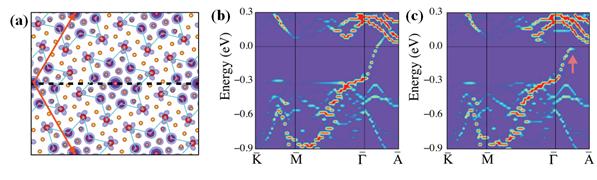 Figure 1. (a) Cross-section of TaS2 forming a hexagram-shaped charge density wave at low temperature. (b) Conventional calculation method describing TaS2 as a conductor in the low-temperature phase. (c) Newly calculated result after correcting the error identified in this study, showing that TaS2 is an insulator. The dashed line at the position of the arrow indicates Mott insulating behavior.
[Asia Economy Reporter Kim Bong-su] A Korean research team has resolved a 40-year-old controversy in the field of physics.
Ulsan National Institute of Science and Technology (UNIST) announced on the 16th that Professor Noh Jeong Park's team from the Department of Physics, in collaboration with the Max Planck Institute in Germany, has solved the long-standing question in physics of whether Tantalum Disulfide (TaS2) is a conductor or an insulator, proving that it is an insulator (a material through which electricity does not flow well).
TaS2 has attracted the attention of the physics community for over 40 years. It exhibits sensitive changes in conductivity and superconductivity even with small temperature variations, making it promising for various applications such as sensors and memory devices. The problem was that below an absolute temperature of 200K, there was no clear conclusion on whether it was a conductor or an insulator, and many research results showed conflicting outcomes. Experimental measurements indicated it was an insulator, but according to the standard theory of quantum physics, it was classified as a conductor. Researchers who measured conductivity and lattice structure generally claimed that TaS2 is an insulator at low temperatures and theoretically argued that it would be a Mott insulator.
The research team discovered that in the process of reducing calculation errors in density functional theory used by quantum physicists in conductivity theories, the ‘charge density wave’ state had not been properly considered. Density functional theory is a quantum mechanical calculation method that allows the determination of the position and density of electrons. Electrical conductivity, which is the flow of electrons, can also be predicted through this theory. However, this theory simplifies numerous electrons as a single particle system, so to reduce calculation errors, it is necessary to incorporate another calculation method. The cause of the error was that the charge density wave (CDW) state, in which about 40 atoms move as one, was not properly accounted for in this process.
By correcting this, calculations show that TaS2 is in a special insulating state called a Mott insulator at an absolute temperature of 200K. A Mott insulator is a material where electrons have pathways to flow but are completely filled within these electron paths, like stepping stones, preventing movement.
Professor Noh Jeong Park explained, “This research represents an advancement in quantum mechanical calculation methods that reveal material changes due to strong correlations among numerous electrons constituting solids,” adding, “It will also help in understanding the characteristics of various phase transition materials and in developing sensors and electronic devices based on phase transition properties that respond sensitively to environmental factors such as temperature.” The research results were published online on the 13th in the prestigious physics journal 'Physical Review Letters.'
© The Asia Business Daily(www.asiae.co.kr). All rights reserved.
![Clutching a Stolen Dior Bag, Saying "I Hate Being Poor but Real"... The Grotesque Con of a "Human Knockoff" [Slate]](https://cwcontent.asiae.co.kr/asiaresize/183/2026021902243444107_1771435474.jpg)















