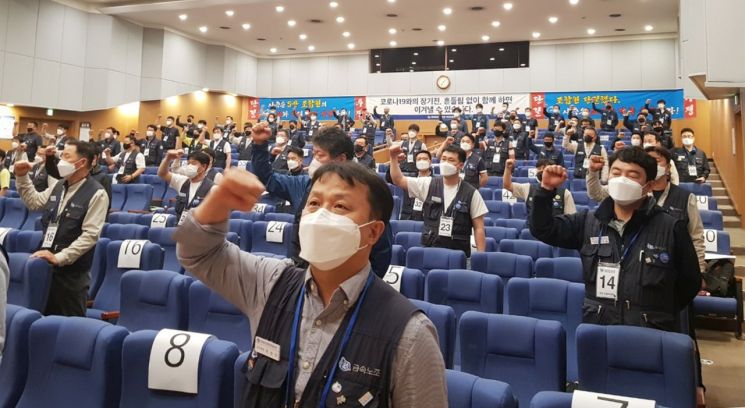
[Asia Economy Reporter Ki-min Lee] Domestic automakers, having faced production disruptions last year due to COVID-19, are now experiencing production setbacks this year because of the global semiconductor shortage, entering the 'Hatu (夏鬪)' season. Given the emergency situation in the completed car industry, there are calls to foster a cooperative atmosphere rather than making unconditional demands.
According to the completed car industry on the 15th, the Hyundai Motor Branch of the Korean Metal Workers' Union (Hyundai Motor Union) and the Kia Branch (Kia Union) recently finalized their collective bargaining agreement (CBA) demands through delegate meetings. Hyundai Motor confirmed a CBA demand that includes a 99,000 KRW wage increase (excluding regular step increments), a 30% performance bonus based on net profit, an increase in the wage table gap, extension of the retirement age to 64, and job retention during the transition to future industries, among other items. The Kia Union also sent a CBA demand to management on the 13th, including prioritizing the domestic factories for the development and production of next-generation models.
Unlike Hyundai Motor and Kia, which recently finalized their demands, mid-sized companies such as Renault Samsung and Korea GM are already making strong demands for wage increases. The Korea GM union recently finalized demands including a 99,000 KRW base wage increase and performance and encouragement bonuses amounting to 150% of the ordinary wage plus 4 million KRW. Since the base wage was frozen last year due to COVID-19, it is known that they intend not to back down this time.
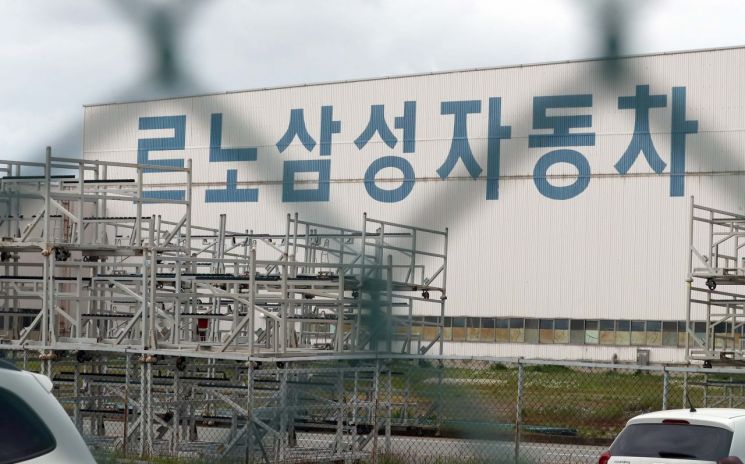
The labor-management conflict has reached its peak at Renault Samsung Motors. Renault Samsung, which posted a deficit for the first time in eight years, is undergoing restructuring by cutting 40% of executives and offering voluntary retirement to employees excluding regular workers, but it has yet to conclude last year's collective bargaining agreement. The Renault Samsung union conducted surprise strikes on the 30th of last month and the 6th of this month and held mourning protests at the Seoul Dobong Service Center.
There are criticisms that the unions of completed car manufacturers are making excessive demands under the current circumstances. Hyundai Motor and Kia have decided to suspend operations of some lines at Ulsan plants 3 and 5 and Soha plant 2 on the 17th and 18th of this month due to semiconductor shortages affecting components such as Airbag Control Units (ACU).
Professor Kim Pil-su of the Department of Automotive Studies at Daelim University also stated, "Currently, labor rights in our country are rigid, and the completed car industry has a high-cost, low-efficiency structure," adding, "The unions are making too many unreasonable demands in the collective bargaining negotiations."
In particular, foreign-affiliated companies other than Hyundai Motor and Kia are continuously experiencing declining sales and are even facing the risk of business withdrawal, so there is advice that the unions should not escalate the situation to an extreme level and increase risks.
At the Automobile Day event held on the 12th, Chung Man-ki, chairman of the Korea Automobile Manufacturers Association, mentioned the crisis of the three foreign-affiliated completed car companies including Korea GM and Renault Samsung Motors, stating, "Their rankings are deteriorating in all evaluations such as quality, cost, time, and productivity," and advised, "Instead of performance bonuses, maintaining the seniority wage system, annualized negotiation cycles, and addressing frequent strikes and labor rigidity, proactive cooperative practices must be established."
© The Asia Business Daily(www.asiae.co.kr). All rights reserved.
![Clutching a Stolen Dior Bag, Saying "I Hate Being Poor but Real"... The Grotesque Con of a "Human Knockoff" [Slate]](https://cwcontent.asiae.co.kr/asiaresize/183/2026021902243444107_1771435474.jpg)
















