Last Year’s Space Budget $8.852 Billion, Focused Investment with 10% Annual Increase Over the Past Decade

[Asia Economy Reporter Kim Bong-su] China's Mars probe Tianwen-1 successfully landed on Mars on the 15th, marking China's "space rise" finally catching up with the United States in the field of Mars exploration.
Mars, known as the second Earth, has emerged as the main battleground for intense space development competition among countries worldwide. The first country to start Mars exploration was the former Soviet Union, which launched the world's first Mars probe Marsnik in 1961. However, while most attempts ended in failure, the United States took the lead. The U.S. launched Mariner 4 in 1965, capturing images of the Martian surface, and in 1976, Viking 1 and 2 consecutively succeeded in landing on Mars, setting a new milestone in humanity's history of Mars development. Including Perseverance, which landed on Mars in February and is conducting exploration such as the successful flight experiment of the unmanned helicopter Ingenuity, the U.S. has launched five Mars exploration rovers and stands at the forefront. Through Perseverance, the U.S. is experimenting on the existence of life on Mars and oxygen production using carbon dioxide in the atmosphere, effectively preparing for Mars city development. The U.S. private space company SpaceX has declared plans for commercial Mars travel in the 2020s and large-scale city construction in the 2030s.
China is virtually the only country challenging the U.S.'s dominance. China launched the Mars probe Tianwen-1 in November 2020, demonstrating technology almost on par with the U.S., including an orbiter, lander, and rover. Tianwen-1 plans to explore the Martian surface for three months through the rover "Zhurong" (God of Fire), searching for water and ice and analyzing soil and rock components.
Other countries have yet to reach this level. Russia and Europe lag behind. The European Space Agency (ESA) succeeded in landing Europe's first Mars probe Beagle 2 in 2003 but plans to conduct the ExoMars project next year with Russia to search for signs of life on Mars and collect rock samples. Other countries are still at a beginner level. In Asia, India was the first to succeed in Mars orbit exploration with the launch of Mangalyaan in 2014 but has made little progress since. The United Arab Emirates (UAE) also launched the Mars probe Amal last year and succeeded in orbit insertion in February this year but remains at a "beginner" level.
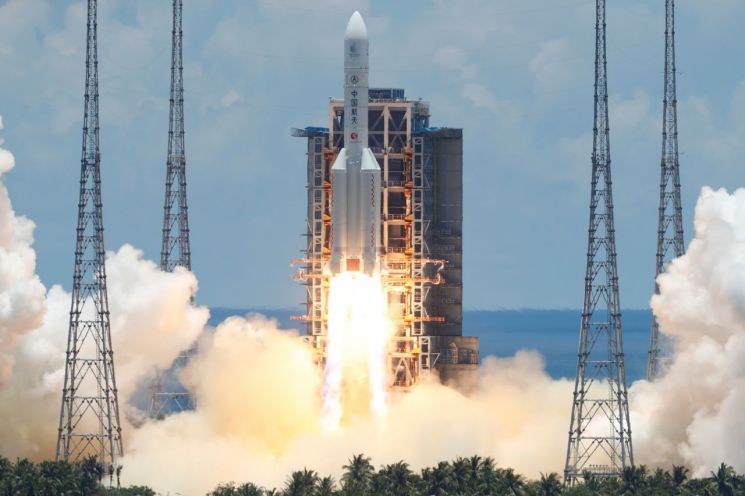
China's "space rise" is thanks to concentrated investment to keep pace with the global hegemony competition with the U.S. According to the Ministry of Science and ICT, as of 2020, China's space development budget investment was $8.852 billion, the highest single-country level excluding the U.S. (the European Union's $13.282 billion). It is more than twice that of Russia ($3.58 billion) and Japan ($3.323 billion). South Korea's budget is $722 million. China has been focusing national power by increasing the budget by 8.5% annually over the past five years. In 2020, 25% of the total budget was allocated to manned spaceflight, followed by space science, exploration, and Earth observation. However, China plans to have private companies replace the government's role in the future, so government-level investment is expected to grow by about 2% annually, significantly lower than the average 10% growth over the past decade.
Recently, China's space policy has shifted from merely securing a technological foundation until the 2010s to focusing on commercialization and internationalization, greatly increasing investment and declaring its "space rise." According to the Korea Aerospace Research Institute (KARI), China's space development is led by the State Administration for Science, Technology and Industry for National Defense (SASTIND), which sets policies, regulations, annual development plans, and allocates budgets for space programs. The National Space Administration handles private space policies, programs, and international cooperation, supporting these efforts. The Chinese Academy of Sciences (CAS) manages scientific satellite programs through the Space Science Application Research Center and operates 120 institutions and 24 state-owned enterprises. The China Aerospace Science and Technology Corporation (CASC) is responsible for space technology development and spacecraft and satellite manufacturing. CASC is a massive conglomerate with eight research and development (R&D) institutions, 11 public enterprises, 12 listed companies, employing 180,000 staff, and estimated revenue of 123.3 billion RMB in 2014.
© The Asia Business Daily(www.asiae.co.kr). All rights reserved.
![Clutching a Stolen Dior Bag, Saying "I Hate Being Poor but Real"... The Grotesque Con of a "Human Knockoff" [Slate]](https://cwcontent.asiae.co.kr/asiaresize/183/2026021902243444107_1771435474.jpg)
















