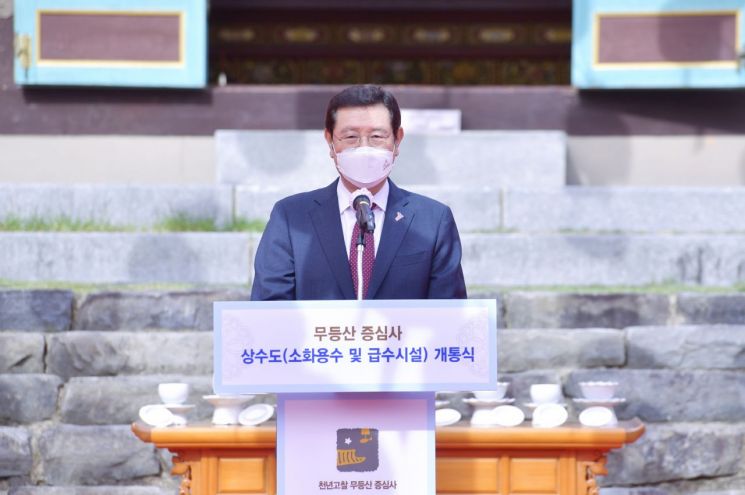
 Lee Yong-seop, Mayor of Gwangju Metropolitan City, is delivering a congratulatory speech at the opening ceremony of the firefighting water and water supply facilities held at Jeungsimsa Temple in Dong-gu on the afternoon of the 14th. Photo by Gwangju Metropolitan City
[Asia Economy Honam Reporting Headquarters Reporter Park Seon-gang] The fire extinguishing water and water supply facilities of Jeungsimsa Temple, designated as Cultural Heritage Material No. 1 by Gwangju Metropolitan City, have been improved.
Gwangju City announced on the 14th that it held an opening ceremony for the fire extinguishing water and water supply facilities in the courtyard of Jeungsimsa Daeungjeon Hall.
This facility improvement was promoted as part of the city-designated cultural heritage repair and maintenance project, investing 700 million KRW since 2019 to improve the fire extinguishing water and water supply facilities along a 1.8 km section from Munbinjeongsa to Jeungsimsa.
In particular, to protect Jeungsimsa's valuable cultural assets from fires or surrounding mountain fires, a 1.8 km water pipe for stable fire extinguishing water supply was installed for the already installed outdoor fire hydrants, along with one water tank and two pumping stations.
The construction was designed by Dong-gu District and the city’s Waterworks Headquarters in September 2019 and carried out until this month.
Mayor Lee Yong-seop said, “With this improvement project for fire extinguishing water and water supply facilities, not only will there be efficient initial response in case of mountain temple fires, but citizens visiting Jeungsimsa can use and drink the clean and safe Bityeoul water under the energy of Mudeungsan Mountain and feel the charm of green Gwangju. Going forward, Gwangju City will do its best not only to cherish and preserve cultural heritage but also to discover and foster unique and distinctive cultural resources exclusive to Gwangju.”
Meanwhile, Gwangju City plans to invest a total of 12.4 billion KRW this year to establish a cultural heritage management system.
First, it will allocate 2.4 billion KRW for repair and maintenance to preserve the original form of cultural heritage, 1.2 billion KRW for cultural heritage utilization and education projects, 800 million KRW for daily inspection and emergency repair care projects, and 600 million KRW for maintenance of traditional temple disaster prevention systems to preserve and manage the region’s precious cultural assets.
Jeungsimsa is a thousand-year-old temple founded during the Unified Silla period and holds the Nationally Designated Cultural Heritage Treasure No. 131, the Iron Seated Vairocana Buddha statue.
In addition, Gwangju City-designated cultural heritage includes Cultural Heritage Material No. 1 Jeungsimsa, Tangible Cultural Heritage No. 1 Jeungsimsa Three-story Stone Pagoda, No. 13 Obaekjeon Hall, and No. 14 Stone Bodhisattva Standing Statue.
© The Asia Business Daily(www.asiae.co.kr). All rights reserved.
![Clutching a Stolen Dior Bag, Saying "I Hate Being Poor but Real"... The Grotesque Con of a "Human Knockoff" [Slate]](https://cwcontent.asiae.co.kr/asiaresize/183/2026021902243444107_1771435474.jpg)















