Why Keep It If It's Not Enforced... 'Death Penalty' Debate Continues
Government Claims "Death Penalty Still Functions" and Advocates Retention
Experts Say "Death Sentence Causes Great Anxiety for Defendants"
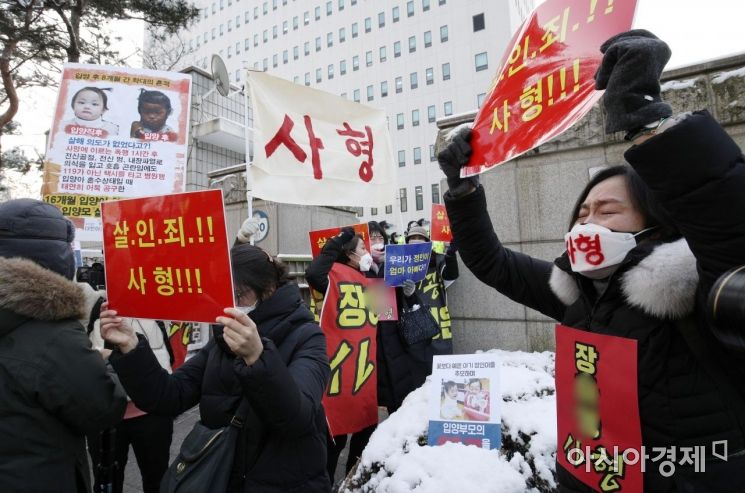 On January 13, when the first trial was held for the adoptive parents accused of abusing and causing the death of their 16-month-old adopted daughter Jeongin, citizens protested in front of the Seoul Yangcheon-gu Southern District Court, demanding the application of murder charges. Photo by Hyunmin Kim kimhyun81@
[Asia Economy Reporter Kang Ju-hee] The first trial sentence for Jang Mo, the adoptive mother accused of brutally abusing and ultimately causing the death of Jeong-in, will be decided on the 14th. Previously, the prosecution demanded the death penalty for Jang. However, even if a death sentence is handed down, the likelihood of it being carried out is very low, leading some to criticize the death penalty system as being ineffective in practice.
Experts explained that, regardless of the execution of the death penalty, there is a significant difference from the defendant's perspective between receiving a death sentence or a life sentence.
According to reports, the Criminal Division 13 of the Seoul Southern District Court (Chief Judge Lee Sang-joo) will hold a sentencing hearing on the same day for Jang Mo Yang, who was indicted on charges including murder, and An Mo Yang, the adoptive father, who was indicted on charges including violation of the Child Welfare Act.
At the previous sentencing hearing, the prosecution demanded the death penalty for Jang, stating, "It is judged that there was an implied intent to kill," which is the maximum sentence under the law. For the adoptive father An, the prosecution demanded 7 years and 6 months imprisonment.
Jang was arrested and indicted on charges of habitual assault and abuse of her adopted daughter Jeong-in from June to October last year, and for delivering a strong blow to the abdomen that caused her death (murder, etc.).
Jeong-in passed away on October 13 last year while receiving treatment at a hospital in Mok-dong, Yangcheon-gu, Seoul. At that time, Jeong-in had bruises all over her body and severe injuries to her head and abdomen.
Based on recent opinions from forensic experts and autopsy doctors, the prosecution concluded that Jang delivered a fatal injury by forcefully stepping on Jeong-in’s already damaged abdomen on the day of her death.
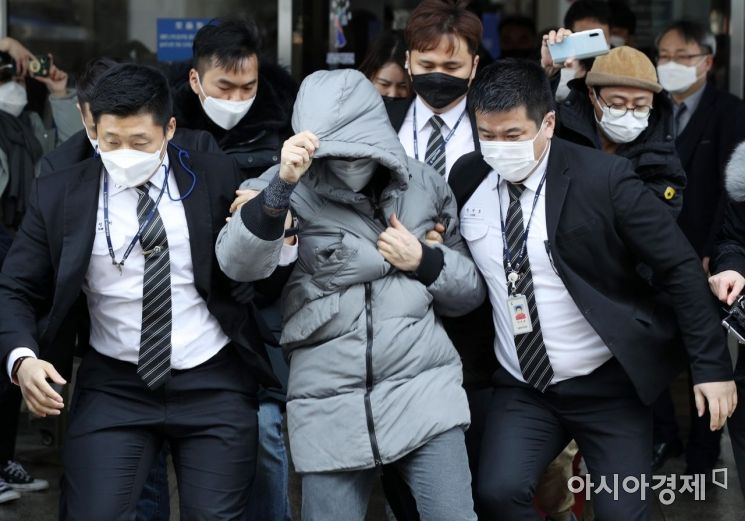 Stepfather Ahn, accused of abusing Jeong-in for several months after adopting her, leading to her death. Photo by Hyunmin Kim kimhyun81@
Given the national outrage over the case, public attention is focused on whether Jang will receive the death sentence. At the same time, there are criticisms questioning the meaning of receiving a death sentence in South Korea, which is effectively a country that has abolished the death penalty.
One netizen commented, "The death penalty, which is never carried out, seems like a meaningless system," adding, "Instead of just demanding it, they should actually carry it out. Isn't this a criminal who cruelly caused the death of an innocent child?"
Another netizen argued, "What use is a death sentence that will never be executed? The death penalty should be enforced to raise awareness about serious crimes."
South Korea is one of the few OECD member countries, along with the United States and Japan, that still maintains the death penalty. However, the last execution was carried out on December 30, 1997, against 23 heinous criminals. For over 20 years since then, death sentences have been handed down but not executed. Based on this, the international human rights organization Amnesty International classifies South Korea as a country that has abolished the death penalty.
Domestically, debates over the retention or abolition of the death penalty continue, and the Constitutional Court has been reviewing the constitutionality of the death penalty system for over two years. Those advocating for abolition argue that the death penalty is an inhumane punishment that violates human dignity and that the state has no right to deprive citizens of their right to life.
 A lighting performance urging the abolition of the death penalty is being held at the Seodaemun Prison History Hall in Seoul to mark the "World Day Against the Death Penalty." Photo by Yonhap News.
In this regard, the government submitted a statement to the Constitutional Court in February last year advocating for the retention of the death penalty. The Ministry of Justice stated in the document, "The death penalty system cannot be overlooked as it functions as a 'necessary evil' devised from the fundamental human fear of death and the desire for retribution against crime."
It added, "The death penalty does not violate the constitutional right to life under the principle of prohibition of excess, and as long as legislation, sentencing, and execution are strictly carried out, it cannot be seen as infringing on human dignity and value. It is reasonable to view the Korean Constitution as recognizing the death penalty as a type of punishment, so defining it as a statutory penalty is consistent with the Constitution."
Experts explained that, regardless of the execution of the death penalty, there is a significant difference from the defendant's perspective between receiving a death sentence or a life sentence.
Professor Lee Soo-jung of the Department of Criminal Psychology at Kyonggi University appeared on a broadcast last January and said, "(The death penalty) has not been executed since 1997, and the general view is that it is unlikely to be executed. From the defendant's perspective, there is a big difference," adding, "With life imprisonment, there is still a possibility of release, but if sentenced to death, release is currently impossible."
She continued, "The death penalty itself carries the meaning that my right to life could be taken away by the state, and if policies change, the death penalty could suddenly be carried out one day," adding, "Because of this uncertainty, from the defendant's perspective, it makes a world of difference."
© The Asia Business Daily(www.asiae.co.kr). All rights reserved.
![Clutching a Stolen Dior Bag, Saying "I Hate Being Poor but Real"... The Grotesque Con of a "Human Knockoff" [Slate]](https://cwcontent.asiae.co.kr/asiaresize/183/2026021902243444107_1771435474.jpg)

















